

281
naturally in sediments under conditions of high
pressure, low temperature and high methane
concentrations; see also Chapter 14). In such
sediments from the Hydrate Ridge at 700 m water
depth off the Oregon coast, conspicuous microbial aggregates, apparently responsible for the
anaerobic oxidation of methane, were first
observed (Boetius et al. 2000). The 3-5 µm large
aggregates were stained with fluorescent molecular probes and studied under the fluorescence
microscope. They were all found to consist of a
central colony of archaea overgrown by sulfate
reducing bacteria. In the AOM zone of the
sediment, the biomass of these aggregates exceeded the biomass of all other microorganisms by an
order of magnitude, thus indicating that they were
indeed responsible for the methane oxidation with
sulfate. Since then, similar aggregates have been
found world-wide in diverse methane enriched
surface sediments (Orphan et al. 2001, 2002;
Michaelis et al. 2002; Knittel et al. 2005).
Further evidence for the identity of the
anaerobic methane oxidizers had come from
isotope analyses of specific lipid biomarkers in
sediments with high rates of AOM. Relative to
marine organic carbon or bicarbonate, methane is
highly enriched in the lighter carbon isotope,
12
C,
over the heavier carbon isotope,
13
C, with δ
13
C
values ranging from -50 to -90‰ (Whiticar 1999;
see also Chapter 10). The archaeal biomarkers in
these sediments were strongly enriched in
12
C,
which indicated that methane served as the main
carbon source for the microorganisms (Hinrichs et
al. 1999; Elvert et al. 2000; Thiel et al. 2001). Also
biomarkers derived from bacteria showed extreme
12
C enrichment and indicated that the associated
sulfate reducers were also involved in the AOM
process (Hinrichs et al. 2000; Elvert et al. 2000;
Pancost et al. 2000). Final evidence that the
aggregates carried out anaerobic oxidation of
methane was provided by a recently developed
SIMS technique (secondary ion mass spectrometry) by which carbon isotopic analysis could be
done on individual microscopic AOM aggregates
and thereby confirm that their cell material
contained the
12
C depleted isotope signal of
methane (Orphan et al. 2001).
Equation 8.8 above proposed a net equation for
anaerobic oxidation of methane by sulfate that is
based on modeled pore water profiles and
laboratory experiments with sediment enrichments.
No single microorganism is yet known, however,
that is able to carry out such a complete oxidation
of methane to bicarbonate and it remains an open
question whether such organisms exist. Instead,
the process may proceed in two steps involving an
intermediate electron carrier that is transferred from
the archaea to the sulfate reducers within the AOM
aggregates. Hoehler et al. (1994) first suggested
that AOM is carried out by a consortium of archaea
and sulfate reducing bacteria and that hydrogen
might serve as such an intermediate that is
transferred from the methane oxidizers to the
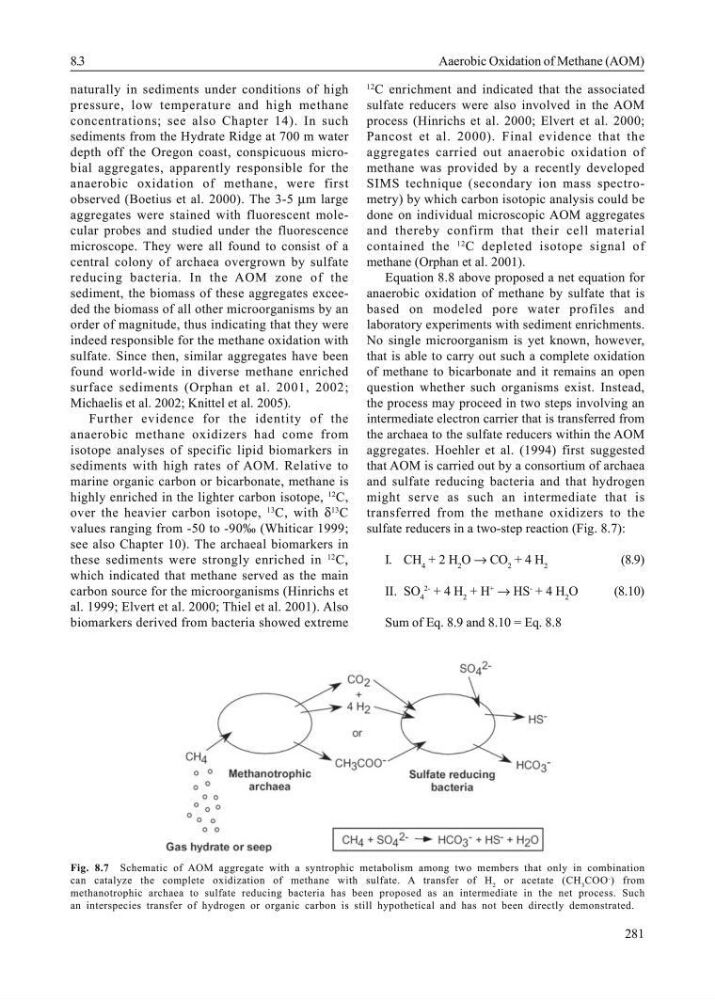
sulfate reducers in a two-step reaction (Fig. 8.7):
I. CH 4 + 2 H 2 O → CO 2 + 4 H 2
(8.9)
II. SO 4
2+ 4 H 2 + H
+
→ HS
-
+ 4 H 2 O
(8.10)
Sum of Eq. 8.9 and 8.10 = Eq. 8.8
Fig. 8.7 Schematic of AOM aggregate with a syntrophic metabolism among two members that only in combination
can catalyze the complete oxidization of methane with sulfate. A transfer of H 2 or acetate (CH 3 COO
- ) from
methanotrophic archaea to sulfate reducing bacteria has been proposed as an intermediate in the net process. Such
an interspecies transfer of hydrogen or organic carbon is still hypothetical and has not been directly demonstrated.
8.3
Aaerobic Oxidation of Methane (AOM)
naturally in sediments under conditions of high
pressure, low temperature and high methane
concentrations; see also Chapter 14). In such
sediments from the Hydrate Ridge at 700 m water
depth off the Oregon coast, conspicuous microbial aggregates, apparently responsible for the
anaerobic oxidation of methane, were first
observed (Boetius et al. 2000). The 3-5 µm large
aggregates were stained with fluorescent molecular probes and studied under the fluorescence
microscope. They were all found to consist of a
central colony of archaea overgrown by sulfate
reducing bacteria. In the AOM zone of the
sediment, the biomass of these aggregates exceeded the biomass of all other microorganisms by an
order of magnitude, thus indicating that they were
indeed responsible for the methane oxidation with
sulfate. Since then, similar aggregates have been
found world-wide in diverse methane enriched
surface sediments (Orphan et al. 2001, 2002;
Michaelis et al. 2002; Knittel et al. 2005).
Further evidence for the identity of the
anaerobic methane oxidizers had come from
isotope analyses of specific lipid biomarkers in
sediments with high rates of AOM. Relative to
marine organic carbon or bicarbonate, methane is
highly enriched in the lighter carbon isotope,
12
C,
over the heavier carbon isotope,
13
C, with δ
13
C
values ranging from -50 to -90‰ (Whiticar 1999;
see also Chapter 10). The archaeal biomarkers in
these sediments were strongly enriched in
12
C,
which indicated that methane served as the main
carbon source for the microorganisms (Hinrichs et
al. 1999; Elvert et al. 2000; Thiel et al. 2001). Also
biomarkers derived from bacteria showed extreme
12
C enrichment and indicated that the associated
sulfate reducers were also involved in the AOM
process (Hinrichs et al. 2000; Elvert et al. 2000;
Pancost et al. 2000). Final evidence that the
aggregates carried out anaerobic oxidation of
methane was provided by a recently developed
SIMS technique (secondary ion mass spectrometry) by which carbon isotopic analysis could be
done on individual microscopic AOM aggregates
and thereby confirm that their cell material
contained the
12
C depleted isotope signal of
methane (Orphan et al. 2001).
Equation 8.8 above proposed a net equation for
anaerobic oxidation of methane by sulfate that is
based on modeled pore water profiles and
laboratory experiments with sediment enrichments.
No single microorganism is yet known, however,
that is able to carry out such a complete oxidation
of methane to bicarbonate and it remains an open
question whether such organisms exist. Instead,
the process may proceed in two steps involving an
intermediate electron carrier that is transferred from
the archaea to the sulfate reducers within the AOM
aggregates. Hoehler et al. (1994) first suggested
that AOM is carried out by a consortium of archaea
and sulfate reducing bacteria and that hydrogen
might serve as such an intermediate that is
transferred from the methane oxidizers to the
sulfate reducers in a two-step reaction (Fig. 8.7):
I. CH 4 + 2 H 2 O → CO 2 + 4 H 2
(8.9)
II. SO 4
2+ 4 H 2 + H
+
→ HS
-
+ 4 H 2 O
(8.10)
Sum of Eq. 8.9 and 8.10 = Eq. 8.8
Fig. 8.7 Schematic of AOM aggregate with a syntrophic metabolism among two members that only in combination
can catalyze the complete oxidization of methane with sulfate. A transfer of H 2 or acetate (CH 3 COO
- ) from
methanotrophic archaea to sulfate reducing bacteria has been proposed as an intermediate in the net process. Such
an interspecies transfer of hydrogen or organic carbon is still hypothetical and has not been directly demonstrated.
8.3
Aaerobic Oxidation of Methane (AOM)