

261
these with other early diagenetic reaction pathways. For example, rates of organic carbon mineralization by each electron acceptor (O 2 , NO 3
-
,
Mn(IV), Fe(III), SO 4
2) are - strictly speaking -
necessary to make a statement on the relative
contribution of dissimilatory iron and manganese
reduction. For the case of iron and manganese,
the determination of such rates are problematic as
both electron acceptors may be reduced by
reduced species as well as by microbial respiration. Additionally, pore water fluxes usually
strongly underestimate the true reduction rate as
adsorption and precipitation of Fe
2+
/Mn
2+
-bearing
minerals buffer the build-up within pore-water.
Therefore, ‘rates of dissimilatory Fe-oxide and
Mn-oxide reduction are the least well quantified of
the carbon oxidation pathways’ (Canfield 1993).
An overview of methods to determine the various organic carbon oxidation pathways is provided by Canfield (1993). As these methods are
technically highly demanding and time-consuming, only very few sediments have been investigated with respect to the contribution of the different organic carbon oxidation pathways. Among
such studies different methods have been applied
which may bear additional uncertainties. Thus, a
present-day discussion on the importance of iron
and manganese must be speculative to some degree.
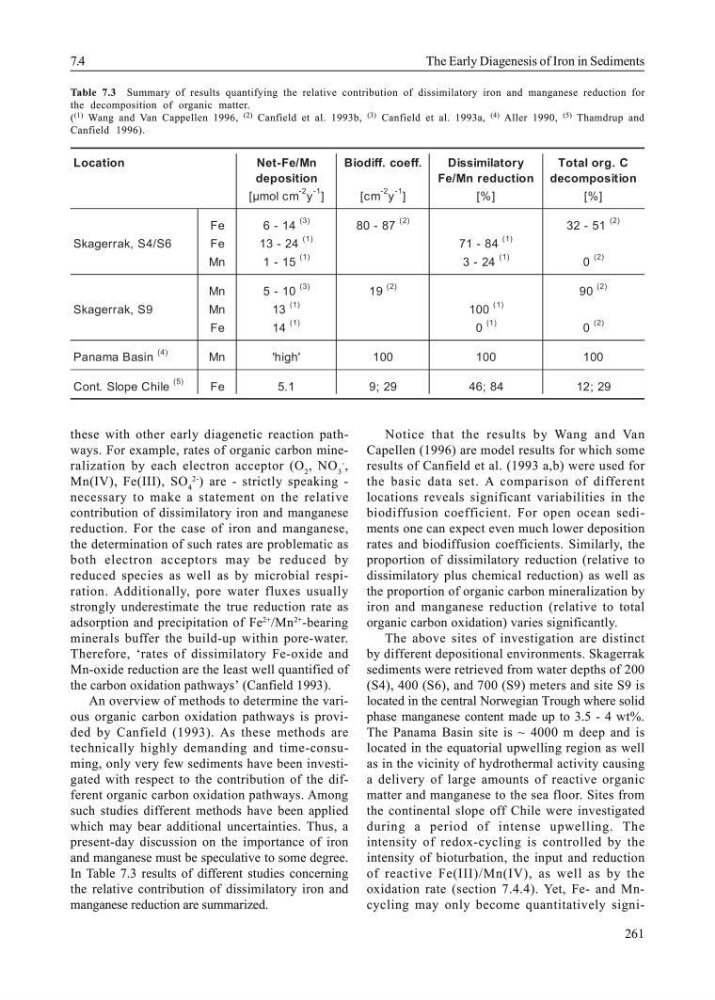
In Table 7.3 results of different studies concerning
the relative contribution of dissimilatory iron and
manganese reduction are summarized.
Notice that the results by Wang and Van
Capellen (1996) are model results for which some
results of Canfield et al. (1993 a,b) were used for
the basic data set. A comparison of different
locations reveals significant variabilities in the
biodiffusion coefficient. For open ocean sediments one can expect even much lower deposition
rates and biodiffusion coefficients. Similarly, the
proportion of dissimilatory reduction (relative to
dissimilatory plus chemical reduction) as well as
the proportion of organic carbon mineralization by
iron and manganese reduction (relative to total
organic carbon oxidation) varies significantly.
The above sites of investigation are distinct
by different depositional environments. Skagerrak
sediments were retrieved from water depths of 200
(S4), 400 (S6), and 700 (S9) meters and site S9 is
located in the central Norwegian Trough where solid
phase manganese content made up to 3.5 - 4 wt%.
The Panama Basin site is ~ 4000 m deep and is
located in the equatorial upwelling region as well
as in the vicinity of hydrothermal activity causing
a delivery of large amounts of reactive organic
matter and manganese to the sea floor. Sites from
the continental slope off Chile were investigated
during a period of intense upwelling. The
intensity of redox-cycling is controlled by the
intensity of bioturbation, the input and reduction
of reactive Fe(III)/Mn(IV), as well as by the
oxidation rate (section 7.4.4). Yet, Fe- and Mncycling may only become quantitatively signi7.4
The Early Diagenesis of Iron in Sediments
Location
Net-Fe/Mn
Biodiff. coeff.
Dissimilatory
Total org. C
deposition
Fe/Mn reduction decomposition
[µmol cm
-2 y
-1 ]
[cm
-2 y
-1 ]
[ % ]
[ % ]
Fe
6 - 14
(3)
80 - 87
(2)
32 - 51
(2)
Skagerrak, S4/S6
Fe
13 - 24
(1)
71 - 84
(1)
Mn
1 - 15
(1)
3 - 24
(1)
0
(2)
Mn
5 - 10
(3)
19
(2)
90
(2)
Skagerrak, S9
Mn
13
(1)
100
(1)
Fe
14
(1)
0
(1)
0
(2)
Panama Basin
(4)
Mn
'high'
100
100
100
Cont. Slope Chile
(5)
Fe
5.1
9; 29
46; 84
12; 29
Table 7.3 Summary of results quantifying the relative contribution of dissimilatory iron and manganese reduction for
the decomposition of organic matter.
( (1) Wang and Van Cappellen 1996, (2) Canfield et al. 1993b, (3) Canfield et al. 1993a, (4) Aller 1990, (5) Thamdrup and
Canfield 1996).
these with other early diagenetic reaction pathways. For example, rates of organic carbon mineralization by each electron acceptor (O 2 , NO 3
-
,
Mn(IV), Fe(III), SO 4
2) are - strictly speaking -
necessary to make a statement on the relative
contribution of dissimilatory iron and manganese
reduction. For the case of iron and manganese,
the determination of such rates are problematic as
both electron acceptors may be reduced by
reduced species as well as by microbial respiration. Additionally, pore water fluxes usually
strongly underestimate the true reduction rate as
adsorption and precipitation of Fe
2+
/Mn
2+
-bearing
minerals buffer the build-up within pore-water.
Therefore, ‘rates of dissimilatory Fe-oxide and
Mn-oxide reduction are the least well quantified of
the carbon oxidation pathways’ (Canfield 1993).
An overview of methods to determine the various organic carbon oxidation pathways is provided by Canfield (1993). As these methods are
technically highly demanding and time-consuming, only very few sediments have been investigated with respect to the contribution of the different organic carbon oxidation pathways. Among
such studies different methods have been applied
which may bear additional uncertainties. Thus, a
present-day discussion on the importance of iron
and manganese must be speculative to some degree.
In Table 7.3 results of different studies concerning
the relative contribution of dissimilatory iron and
manganese reduction are summarized.
Notice that the results by Wang and Van
Capellen (1996) are model results for which some
results of Canfield et al. (1993 a,b) were used for
the basic data set. A comparison of different
locations reveals significant variabilities in the
biodiffusion coefficient. For open ocean sediments one can expect even much lower deposition
rates and biodiffusion coefficients. Similarly, the
proportion of dissimilatory reduction (relative to
dissimilatory plus chemical reduction) as well as
the proportion of organic carbon mineralization by
iron and manganese reduction (relative to total
organic carbon oxidation) varies significantly.
The above sites of investigation are distinct
by different depositional environments. Skagerrak
sediments were retrieved from water depths of 200
(S4), 400 (S6), and 700 (S9) meters and site S9 is
located in the central Norwegian Trough where solid
phase manganese content made up to 3.5 - 4 wt%.
The Panama Basin site is ~ 4000 m deep and is
located in the equatorial upwelling region as well
as in the vicinity of hydrothermal activity causing
a delivery of large amounts of reactive organic
matter and manganese to the sea floor. Sites from
the continental slope off Chile were investigated
during a period of intense upwelling. The
intensity of redox-cycling is controlled by the
intensity of bioturbation, the input and reduction
of reactive Fe(III)/Mn(IV), as well as by the
oxidation rate (section 7.4.4). Yet, Fe- and Mncycling may only become quantitatively signi7.4
The Early Diagenesis of Iron in Sediments
Location
Net-Fe/Mn
Biodiff. coeff.
Dissimilatory
Total org. C
deposition
Fe/Mn reduction decomposition
[µmol cm
-2 y
-1 ]
[cm
-2 y
-1 ]
[ % ]
[ % ]
Fe
6 - 14
(3)
80 - 87
(2)
32 - 51
(2)
Skagerrak, S4/S6
Fe
13 - 24
(1)
71 - 84
(1)
Mn
1 - 15
(1)
3 - 24
(1)
0
(2)
Mn
5 - 10
(3)
19
(2)
90
(2)
Skagerrak, S9
Mn
13
(1)
100
(1)
Fe
14
(1)
0
(1)
0
(2)
Panama Basin
(4)
Mn
'high'
100
100
100
Cont. Slope Chile
(5)
Fe
5.1
9; 29
46; 84
12; 29
Table 7.3 Summary of results quantifying the relative contribution of dissimilatory iron and manganese reduction for
the decomposition of organic matter.
( (1) Wang and Van Cappellen 1996, (2) Canfield et al. 1993b, (3) Canfield et al. 1993a, (4) Aller 1990, (5) Thamdrup and
Canfield 1996).