

7
The Biogeochemistry of Iron
258
The intensity of the redox cycling and thus
the importance for oxidation and reduction reactions in the sediment is terminated by either one
of the following conditions: 1. In case of the
absence of any efficient oxidant (e.g. O 2 ) in the
upper-most layer or bottom water no oxidation
will occur and the redox cycling cannot be maintained. 2. In case of the absence of a reactive
fraction (bioavailable or ‘rapidly’ reducible by HS
-
,
see section 7.4.3.1) in the lower layer no reduction will occur and the redox cycle will cease. 3. A
vertical transport mode must be maintained
between the zone of oxidation and the zone of
reduction. As advection is usually very much
slower than the downward transport by
bioturbation the intensity of bioturbation
terminates the transport between the redox-zones.
For the most simple assumption of an
homogeneously mixed layer the intensity of
bioturbation is expressed by the biodiffusion (or
mixing) coefficient, D b , which can be deduced
appropriately along with the sedimentation rate
with the aid of natural radioactive isotopes.
According to Nittrouer et al. (1983/1984) the
general advection-diffusion equation can be
rearranged to calculate the sedimentation rate, A:
A
x
ln
C
C
D
x
ln
C
C
0
x
b
0
x
=
−
⎛
⎝
⎜
⎜
⎞
⎠
⎟
⎟
λ
(7.17)
with λ: decay constant [y
-1
], x: depth interval
between two levels [cm], C 0 , C x : activity at an
upper sediment level and at a lower level with the
distance x below C 0 [decays per minute, dpm] D b :
biodiffusion coefficient [cm
2
y
-1
]. If mixing is
negligible (D b = 0) then the above equation can
be simplified:
A
x
ln
C
C
0
x
=
λ
(7.18)
In case of a very low sedimentation rate relative
to mixing (A
2
« λ⋅D b ) Eq. 7.17 can be rearranged to
calculate the biodiffusion coefficient, D b :
D
x
ln
C
C
b
0
x
2
=
⎛
⎝
⎜
⎜
⎜
⎜
⎞
⎠
⎟
⎟
⎟
⎟
λ
(7.19)
The above restrictions for the calculations of
the sedimentation rate and the biodiffusion
coefficient imply the use of radioactive isotopes
with different half-lifes (t 1/2 = 0.693 ⋅ λ
-1
) for
different purposes and depositional environments. The higher the sedimentation rate, the
shorter should be the half-life of the radioactive
isotope. The more intense bioturbation in the
surface layer, the shorter should be the half-life of
the applied radioactive isotope be. For coastal
and shelf sediments sedimentation rates of
several decimeters to few meters per 1000 years
are typical and can be determined by
210
Pb (t 1/2 =
22.3 y). Shorter lived isotopes (e.g. t 1/2 of
234
Th =
24.1 d) are applicable for the determination of the
mixing intensity.
230
Th (t 1/2 = 75,200 y) is a
commonly used radioactive isotope in oceanographic sciences to trace processes over longer
periods of times. The above isotopes are rapidly
scavenged by particles once they are formed from
the decay of some parent isotopes and settle to
the sea floor. Due to analytical reasons postdepositional processes can be traced for a time
Depth in core (cm)
210
Pb - activity (dpm g
-1
)
0.5
20
10
5
2
1
Surface mixed layer
decay
Accumulation rate
22 10 -2 g cm -2 yr -1
1.3 mm yr -1
Background levels
of 210 Pb
W7606A
Sta. 28A
( Exp. Sta. 8)
10
20
30
40
50
Region of radioaktive
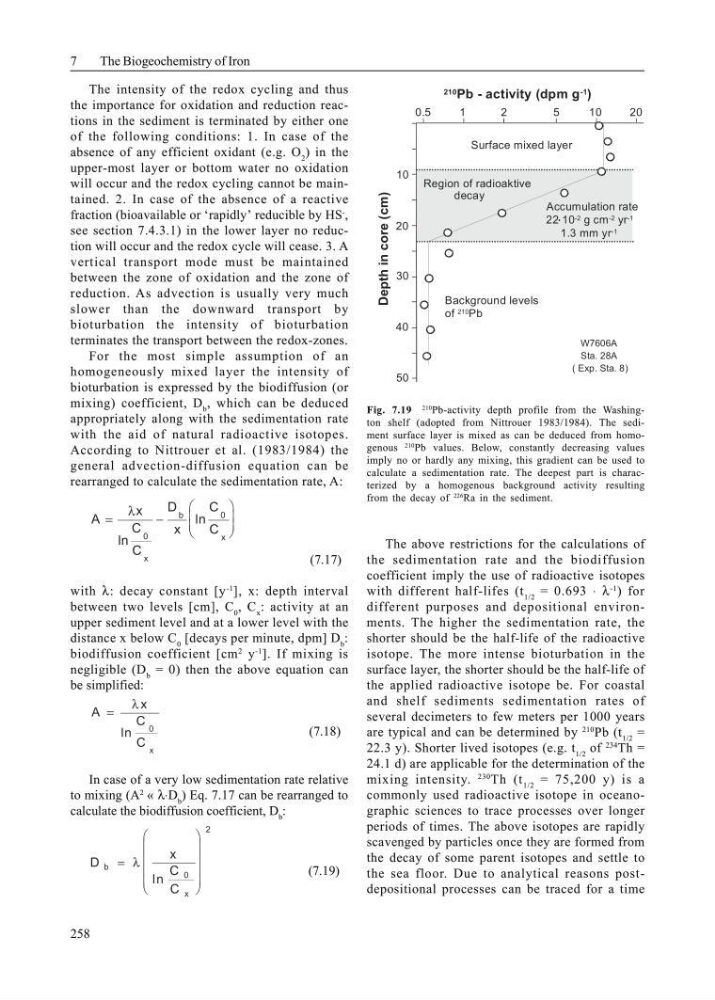
Fig. 7.19
210 Pb-activity depth profile from the Washington shelf (adopted from Nittrouer 1983/1984). The sediment surface layer is mixed as can be deduced from homogenous
210 Pb values. Below, constantly decreasing values
imply no or hardly any mixing, this gradient can be used to
calculate a sedimentation rate. The deepest part is characterized by a homogenous background activity resulting
from the decay of
226 Ra in the sediment.
The Biogeochemistry of Iron
258
The intensity of the redox cycling and thus
the importance for oxidation and reduction reactions in the sediment is terminated by either one
of the following conditions: 1. In case of the
absence of any efficient oxidant (e.g. O 2 ) in the
upper-most layer or bottom water no oxidation
will occur and the redox cycling cannot be maintained. 2. In case of the absence of a reactive
fraction (bioavailable or ‘rapidly’ reducible by HS
-
,
see section 7.4.3.1) in the lower layer no reduction will occur and the redox cycle will cease. 3. A
vertical transport mode must be maintained
between the zone of oxidation and the zone of
reduction. As advection is usually very much
slower than the downward transport by
bioturbation the intensity of bioturbation
terminates the transport between the redox-zones.
For the most simple assumption of an
homogeneously mixed layer the intensity of
bioturbation is expressed by the biodiffusion (or
mixing) coefficient, D b , which can be deduced
appropriately along with the sedimentation rate
with the aid of natural radioactive isotopes.
According to Nittrouer et al. (1983/1984) the
general advection-diffusion equation can be
rearranged to calculate the sedimentation rate, A:
A
x
ln
C
C
D
x
ln
C
C
0
x
b
0
x
=
−
⎛
⎝
⎜
⎜
⎞
⎠
⎟
⎟
λ
(7.17)
with λ: decay constant [y
-1
], x: depth interval
between two levels [cm], C 0 , C x : activity at an
upper sediment level and at a lower level with the
distance x below C 0 [decays per minute, dpm] D b :
biodiffusion coefficient [cm
2
y
-1
]. If mixing is
negligible (D b = 0) then the above equation can
be simplified:
A
x
ln
C
C
0
x
=
λ
(7.18)
In case of a very low sedimentation rate relative
to mixing (A
2
« λ⋅D b ) Eq. 7.17 can be rearranged to
calculate the biodiffusion coefficient, D b :
D
x
ln
C
C
b
0
x
2
=
⎛
⎝
⎜
⎜
⎜
⎜
⎞
⎠
⎟
⎟
⎟
⎟
λ
(7.19)
The above restrictions for the calculations of
the sedimentation rate and the biodiffusion
coefficient imply the use of radioactive isotopes
with different half-lifes (t 1/2 = 0.693 ⋅ λ
-1
) for
different purposes and depositional environments. The higher the sedimentation rate, the
shorter should be the half-life of the radioactive
isotope. The more intense bioturbation in the
surface layer, the shorter should be the half-life of
the applied radioactive isotope be. For coastal
and shelf sediments sedimentation rates of
several decimeters to few meters per 1000 years
are typical and can be determined by
210
Pb (t 1/2 =
22.3 y). Shorter lived isotopes (e.g. t 1/2 of
234
Th =
24.1 d) are applicable for the determination of the
mixing intensity.
230
Th (t 1/2 = 75,200 y) is a
commonly used radioactive isotope in oceanographic sciences to trace processes over longer
periods of times. The above isotopes are rapidly
scavenged by particles once they are formed from
the decay of some parent isotopes and settle to
the sea floor. Due to analytical reasons postdepositional processes can be traced for a time
Depth in core (cm)
210
Pb - activity (dpm g
-1
)
0.5
20
10
5
2
1
Surface mixed layer
decay
Accumulation rate
22 10 -2 g cm -2 yr -1
1.3 mm yr -1
Background levels
of 210 Pb
W7606A
Sta. 28A
( Exp. Sta. 8)
10
20
30
40
50
Region of radioaktive
Fig. 7.19
210 Pb-activity depth profile from the Washington shelf (adopted from Nittrouer 1983/1984). The sediment surface layer is mixed as can be deduced from homogenous
210 Pb values. Below, constantly decreasing values
imply no or hardly any mixing, this gradient can be used to
calculate a sedimentation rate. The deepest part is characterized by a homogenous background activity resulting
from the decay of
226 Ra in the sediment.