

233
ses, however, has been identified even in deepsea sediments (e.g. Smith and Baldwin 1984). The
important question in this regard is: How fast
does oxic respiration react to the input of labile
organic matter? If the reaction constant is high,
organic matter will be quickly recycled at the
sediment surface. If furthermore, the input of
organic matter is episodic or seasonal, a highly
variable oxygen flux at a given time interval might
occur. Since organic particles are subject to burial,
mixing, and other respiratory processes the
surface content will always result in a more or less
time-integrated value that does not necessarily
reflect the oxygen flux at the time of a single
measurement.
More recently, Soetaert et al. (1996) demonstrated the dependence of degradation rates of
different mineralization pathways, as well as
oxygen, nitrate, and other fluxes on seasonal
variations in organic matter deposition and its
reaction rate. Some of the model results compared to the measured carbon flux to the
sediment and the oxygen uptake rates are plotted
in Figure 6.24. The study was based on data
derived from box corer and benthic chamber
deployments in the abyssal Pacific and covered a
time span of more than two years. The carbon
flux function was derived from sediment trap data
and sedimentation rates, whereas oxygen fluxes
were obtained by the adaptation of total mineralization rates of organic material arriving at the
sediment surface (and a number of other input
parameters). A higher rate would account for
variation as reflected by the carbon flux curve,
whereas a low rate would continually reduce the
seasonal variability.
A situation different from that in the Northeast
Pacific which does not comply to a general
relationship can be found in the Argentine Basin.
As shown in Figures 6.18 and 12.14, distribution
maps of nutrient release from deep-sea sediments
in the South Atlantic indicate high mineralization
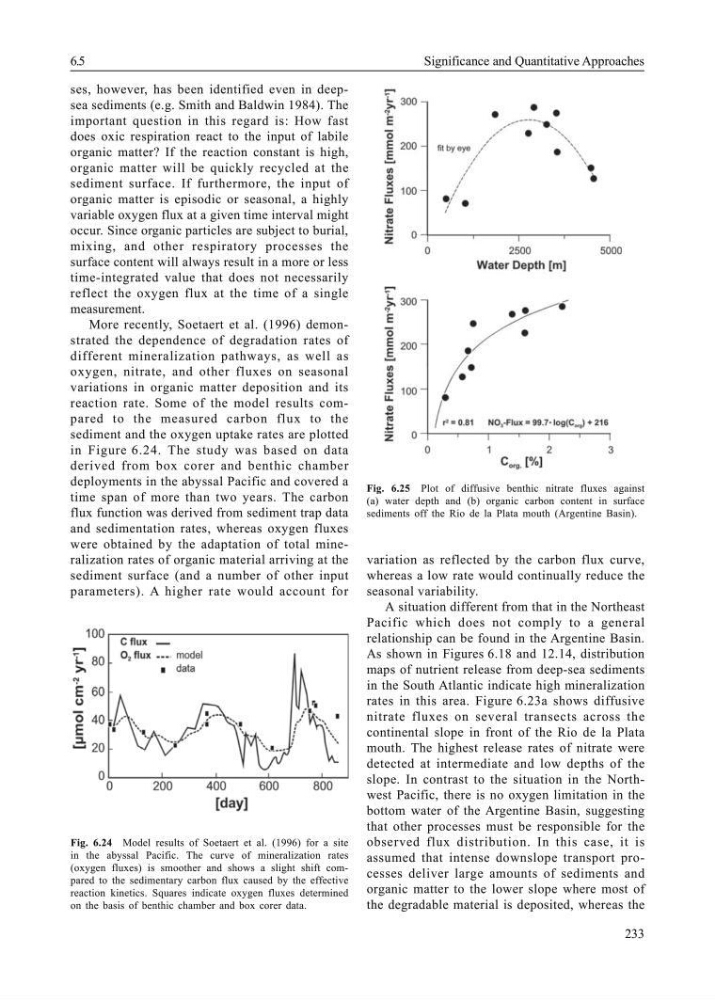
rates in this area. Figure 6.23a shows diffusive
nitrate fluxes on several transects across the
continental slope in front of the Rio de la Plata
mouth. The highest release rates of nitrate were
detected at intermediate and low depths of the
slope. In contrast to the situation in the Northwest Pacific, there is no oxygen limitation in the
bottom water of the Argentine Basin, suggesting
that other processes must be responsible for the
observed flux distribution. In this case, it is
assumed that intense downslope transport processes deliver large amounts of sediments and
organic matter to the lower slope where most of
the degradable material is deposited, whereas the
Fig. 6.24 Model results of Soetaert et al. (1996) for a site
in the abyssal Pacific. The curve of mineralization rates
(oxygen fluxes) is smoother and shows a slight shift compared to the sedimentary carbon flux caused by the effective
reaction kinetics. Squares indicate oxygen fluxes determined
on the basis of benthic chamber and box corer data.
Fig. 6.25 Plot of diffusive benthic nitrate fluxes against
(a) water depth and (b) organic carbon content in surface
sediments off the Rio de la Plata mouth (Argentine Basin).
6.5
Significance and Quantitative Approaches
ses, however, has been identified even in deepsea sediments (e.g. Smith and Baldwin 1984). The
important question in this regard is: How fast
does oxic respiration react to the input of labile
organic matter? If the reaction constant is high,
organic matter will be quickly recycled at the
sediment surface. If furthermore, the input of
organic matter is episodic or seasonal, a highly
variable oxygen flux at a given time interval might
occur. Since organic particles are subject to burial,
mixing, and other respiratory processes the
surface content will always result in a more or less
time-integrated value that does not necessarily
reflect the oxygen flux at the time of a single
measurement.
More recently, Soetaert et al. (1996) demonstrated the dependence of degradation rates of
different mineralization pathways, as well as
oxygen, nitrate, and other fluxes on seasonal
variations in organic matter deposition and its
reaction rate. Some of the model results compared to the measured carbon flux to the
sediment and the oxygen uptake rates are plotted
in Figure 6.24. The study was based on data
derived from box corer and benthic chamber
deployments in the abyssal Pacific and covered a
time span of more than two years. The carbon
flux function was derived from sediment trap data
and sedimentation rates, whereas oxygen fluxes
were obtained by the adaptation of total mineralization rates of organic material arriving at the
sediment surface (and a number of other input
parameters). A higher rate would account for
variation as reflected by the carbon flux curve,
whereas a low rate would continually reduce the
seasonal variability.
A situation different from that in the Northeast
Pacific which does not comply to a general
relationship can be found in the Argentine Basin.
As shown in Figures 6.18 and 12.14, distribution
maps of nutrient release from deep-sea sediments
in the South Atlantic indicate high mineralization
rates in this area. Figure 6.23a shows diffusive
nitrate fluxes on several transects across the
continental slope in front of the Rio de la Plata
mouth. The highest release rates of nitrate were
detected at intermediate and low depths of the
slope. In contrast to the situation in the Northwest Pacific, there is no oxygen limitation in the
bottom water of the Argentine Basin, suggesting
that other processes must be responsible for the
observed flux distribution. In this case, it is
assumed that intense downslope transport processes deliver large amounts of sediments and
organic matter to the lower slope where most of
the degradable material is deposited, whereas the
Fig. 6.24 Model results of Soetaert et al. (1996) for a site
in the abyssal Pacific. The curve of mineralization rates
(oxygen fluxes) is smoother and shows a slight shift compared to the sedimentary carbon flux caused by the effective
reaction kinetics. Squares indicate oxygen fluxes determined
on the basis of benthic chamber and box corer data.
Fig. 6.25 Plot of diffusive benthic nitrate fluxes against
(a) water depth and (b) organic carbon content in surface
sediments off the Rio de la Plata mouth (Argentine Basin).
6.5
Significance and Quantitative Approaches