

6
Benthic Cycling of Oxygen, Nitrogen and Phosphorus
230
matter mineralization (7-11%) is well within the
range of current estimates (see compilation in
Middelburg et al. 1996a). Even higher rates of
3.2⋅10
13
mol N yr
-1
have been estimated more
recently by Codispoti et al. (2001) who explained
this upward correction mainly by the need of
balancing the isotopic nitrate pool at δ
15
N of
about 5‰ (Sigman et al. 1999, 2000).
Total denitrification rates vary between
0.4 mmol m
-2
yr
-1
in the deep-sea (Bender and
Heggie 1984) and 1,200 mmol m
-2
yr
-1
(measured by
the N 2 method) in continental margin sediments
(Devol 1991) which is up to a factor of two higher
than otherwise indicated by the highest fluxes of
nitrate into the sediments. For estuarine and
coastal areas Seitzinger et al. (1988) have summarized
average rates between 440-2,200 mmol m
-2
yr
-1
with
highest rates of up to 9,000 mmol m
-2
yr
-1
. However,
considering the suggestions of Luther et al. (1997)
a high amount of N 2 fluxes may be due to ammonia
oxidation by MnO 2 in the oxic zone of the
sediment bypassing denitrification and thus
organic matter decay. If their estimate is correct
that this process could contribute to up to 90% of
N 2 production in continental margin sediments a
careful evaluation and possibly a re-estimation of
published denitrification rates for this environment is required.
6.5.2
Variation in Different Marine
Environments: Case Studies
We already emphasized the importance of oxic
respiration over other pathways in the deep-sea.
Denitrification (or related processes) only account
for a few percent of the carbon oxidation rate by
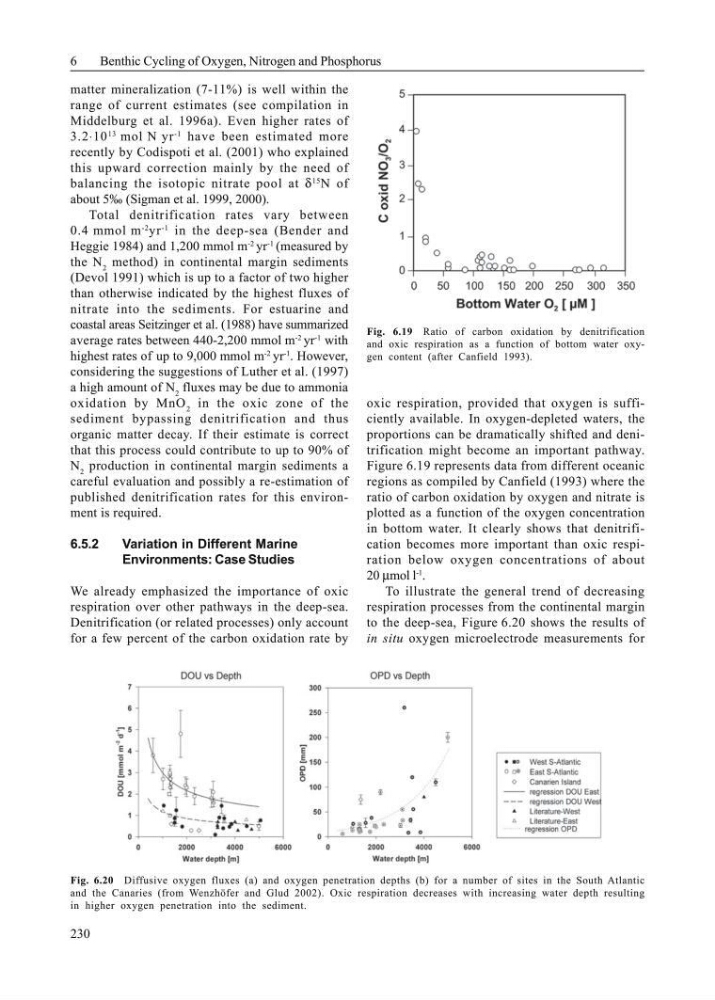
oxic respiration, provided that oxygen is sufficiently available. In oxygen-depleted waters, the
proportions can be dramatically shifted and denitrification might become an important pathway.
Figure 6.19 represents data from different oceanic
regions as compiled by Canfield (1993) where the
ratio of carbon oxidation by oxygen and nitrate is
plotted as a function of the oxygen concentration
in bottom water. It clearly shows that denitrification becomes more important than oxic respiration below oxygen concentrations of about
20 µmol l
-1
.
To illustrate the general trend of decreasing
respiration processes from the continental margin
to the deep-sea, Figure 6.20 shows the results of
in situ oxygen microelectrode measurements for
Fig. 6.19 Ratio of carbon oxidation by denitrification
and oxic respiration as a function of bottom water oxygen content (after Canfield 1993).
Fig. 6.20 Diffusive oxygen fluxes (a) and oxygen penetration depths (b) for a number of sites in the South Atlantic
and the Canaries (from Wenzhöfer and Glud 2002). Oxic respiration decreases with increasing water depth resulting
in higher oxygen penetration into the sediment.
Benthic Cycling of Oxygen, Nitrogen and Phosphorus
230
matter mineralization (7-11%) is well within the
range of current estimates (see compilation in
Middelburg et al. 1996a). Even higher rates of
3.2⋅10
13
mol N yr
-1
have been estimated more
recently by Codispoti et al. (2001) who explained
this upward correction mainly by the need of
balancing the isotopic nitrate pool at δ
15
N of
about 5‰ (Sigman et al. 1999, 2000).
Total denitrification rates vary between
0.4 mmol m
-2
yr
-1
in the deep-sea (Bender and
Heggie 1984) and 1,200 mmol m
-2
yr
-1
(measured by
the N 2 method) in continental margin sediments
(Devol 1991) which is up to a factor of two higher
than otherwise indicated by the highest fluxes of
nitrate into the sediments. For estuarine and
coastal areas Seitzinger et al. (1988) have summarized
average rates between 440-2,200 mmol m
-2
yr
-1
with
highest rates of up to 9,000 mmol m
-2
yr
-1
. However,
considering the suggestions of Luther et al. (1997)
a high amount of N 2 fluxes may be due to ammonia
oxidation by MnO 2 in the oxic zone of the
sediment bypassing denitrification and thus
organic matter decay. If their estimate is correct
that this process could contribute to up to 90% of
N 2 production in continental margin sediments a
careful evaluation and possibly a re-estimation of
published denitrification rates for this environment is required.
6.5.2
Variation in Different Marine
Environments: Case Studies
We already emphasized the importance of oxic
respiration over other pathways in the deep-sea.
Denitrification (or related processes) only account
for a few percent of the carbon oxidation rate by
oxic respiration, provided that oxygen is sufficiently available. In oxygen-depleted waters, the
proportions can be dramatically shifted and denitrification might become an important pathway.
Figure 6.19 represents data from different oceanic
regions as compiled by Canfield (1993) where the
ratio of carbon oxidation by oxygen and nitrate is
plotted as a function of the oxygen concentration
in bottom water. It clearly shows that denitrification becomes more important than oxic respiration below oxygen concentrations of about
20 µmol l
-1
.
To illustrate the general trend of decreasing
respiration processes from the continental margin
to the deep-sea, Figure 6.20 shows the results of
in situ oxygen microelectrode measurements for
Fig. 6.19 Ratio of carbon oxidation by denitrification
and oxic respiration as a function of bottom water oxygen content (after Canfield 1993).
Fig. 6.20 Diffusive oxygen fluxes (a) and oxygen penetration depths (b) for a number of sites in the South Atlantic
and the Canaries (from Wenzhöfer and Glud 2002). Oxic respiration decreases with increasing water depth resulting
in higher oxygen penetration into the sediment.