

225
Under normal deep-sea oxygen conditions, the
nitrate flux is generally directed out of the sediment
due to nitrification and lower denitrification as
shown by results reported by Hammond et al.
(1996) from measurements in the central equatorial
Pacific (Fig. 6.15). It is further indicated that fluxes
of oxygen, silicate, or ∑CO 2 are easier to determine than nitrate or, particularly, phosphate,
because of the magnitude of concentration
change over time. Phosphate in Figure 6.15 shows
large scatter and does not allow a reliable flux
calculation. The differences in the order of
magnitude result from the reaction stoichiometry
of organic matter decomposition (Eq. 6.1).
Additional processes, like the dissolution of
biogenic opal and calcium carbonate in the
sediments, is of further significance for the
parameters silicate and alkalinity. Whereas silicate
fluxes depend on the amount and the surface area
of soluble opal, the degree of silica undersaturation
in pore waters, and the content of terrigenous
components (cf. Section 12.3.3), variations of
alkalinity and ∑CO 2 fluxes are controlled by
respiratory production of CO 2 and dissolution of
calcium carbonate (cf. Section 9.3.2).
The result of the phosphate measurement
shown in Figure 6.15 indicates that flux chamber
measurements are restricted to a certain number of
measurable parameters. Even more, this is true for
profiling lander systems. Apart from oxygen, only
pH-, pCO 2 -, H 2 S and Ca-electrodes have been
successfully employed on in situ lander systems
(Cai et al. 1995; Hales and Emerson 1997;
Wenzhöfer et al. 2001a; de Beer et al. 2005). There
is, however, another microelectrode technique
described by Brendel and Luther (1995) which has,
however, not yet been tested in situ. This voltammetric microelectrode technique allows the
simultaneous determination of the most characteristic redox species: oxygen, manganese, iron and
sulfide. Results from continental slope sediments
of northeast Canada revealed clear and undisturbed vertical redox sequences, which is usually
not the case when different methods are applied
(Luther et al. 1997, 1998).
6.4.2
Ex-Situ Pore Water Data from
Deep-Sea Sediments
Mostly, solutes are still determined ex-situ by
extraction of pore water from multicorer or box
corer samples (see Chapter 3). Additionally,
numerous ex-situ measurements of oxygen and
nitrate exist which were carried out by onboard
core incubations or microelectrode measurements.
Generally, the determination of a dissolved
species in water samples does not pose a problem,
if sampling is handled carefully and, in specific
cases, contact with atmospheric oxygen is
avoided. Manifold problems arise, however, when
a sediment sample is retrieved from some thousand
meters below the sea surface and subsequently
during the extraction of pore water onboard a ship
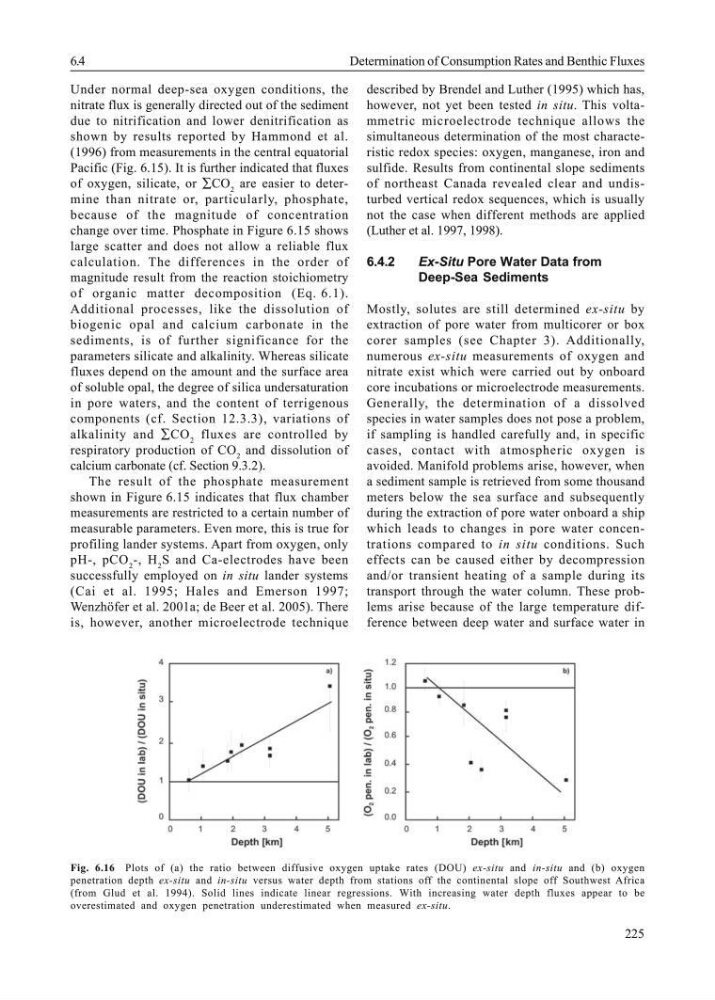
which leads to changes in pore water concentrations compared to in situ conditions. Such
effects can be caused either by decompression
and/or transient heating of a sample during its
transport through the water column. These problems arise because of the large temperature difference between deep water and surface water in
Fig. 6.16 Plots of (a) the ratio between diffusive oxygen uptake rates (DOU) ex-situ and in-situ and (b) oxygen
penetration depth ex-situ and in-situ versus water depth from stations off the continental slope off Southwest Africa
(from Glud et al. 1994). Solid lines indicate linear regressions. With increasing water depth fluxes appear to be
overestimated and oxygen penetration underestimated when measured ex-situ.
6.4
Determination of Consumption Rates and Benthic Fluxes
Under normal deep-sea oxygen conditions, the
nitrate flux is generally directed out of the sediment
due to nitrification and lower denitrification as
shown by results reported by Hammond et al.
(1996) from measurements in the central equatorial
Pacific (Fig. 6.15). It is further indicated that fluxes
of oxygen, silicate, or ∑CO 2 are easier to determine than nitrate or, particularly, phosphate,
because of the magnitude of concentration
change over time. Phosphate in Figure 6.15 shows
large scatter and does not allow a reliable flux
calculation. The differences in the order of
magnitude result from the reaction stoichiometry
of organic matter decomposition (Eq. 6.1).
Additional processes, like the dissolution of
biogenic opal and calcium carbonate in the
sediments, is of further significance for the
parameters silicate and alkalinity. Whereas silicate
fluxes depend on the amount and the surface area
of soluble opal, the degree of silica undersaturation
in pore waters, and the content of terrigenous
components (cf. Section 12.3.3), variations of
alkalinity and ∑CO 2 fluxes are controlled by
respiratory production of CO 2 and dissolution of
calcium carbonate (cf. Section 9.3.2).
The result of the phosphate measurement
shown in Figure 6.15 indicates that flux chamber
measurements are restricted to a certain number of
measurable parameters. Even more, this is true for
profiling lander systems. Apart from oxygen, only
pH-, pCO 2 -, H 2 S and Ca-electrodes have been
successfully employed on in situ lander systems
(Cai et al. 1995; Hales and Emerson 1997;
Wenzhöfer et al. 2001a; de Beer et al. 2005). There
is, however, another microelectrode technique
described by Brendel and Luther (1995) which has,
however, not yet been tested in situ. This voltammetric microelectrode technique allows the
simultaneous determination of the most characteristic redox species: oxygen, manganese, iron and
sulfide. Results from continental slope sediments
of northeast Canada revealed clear and undisturbed vertical redox sequences, which is usually
not the case when different methods are applied
(Luther et al. 1997, 1998).
6.4.2
Ex-Situ Pore Water Data from
Deep-Sea Sediments
Mostly, solutes are still determined ex-situ by
extraction of pore water from multicorer or box
corer samples (see Chapter 3). Additionally,
numerous ex-situ measurements of oxygen and
nitrate exist which were carried out by onboard
core incubations or microelectrode measurements.
Generally, the determination of a dissolved
species in water samples does not pose a problem,
if sampling is handled carefully and, in specific
cases, contact with atmospheric oxygen is
avoided. Manifold problems arise, however, when
a sediment sample is retrieved from some thousand
meters below the sea surface and subsequently
during the extraction of pore water onboard a ship
which leads to changes in pore water concentrations compared to in situ conditions. Such
effects can be caused either by decompression
and/or transient heating of a sample during its
transport through the water column. These problems arise because of the large temperature difference between deep water and surface water in
Fig. 6.16 Plots of (a) the ratio between diffusive oxygen uptake rates (DOU) ex-situ and in-situ and (b) oxygen
penetration depth ex-situ and in-situ versus water depth from stations off the continental slope off Southwest Africa
(from Glud et al. 1994). Solid lines indicate linear regressions. With increasing water depth fluxes appear to be
overestimated and oxygen penetration underestimated when measured ex-situ.
6.4
Determination of Consumption Rates and Benthic Fluxes