

6
Benthic Cycling of Oxygen, Nitrogen and Phosphorus
220
occur in form of aggregated colloidal suspensions
or coating surfaces around suspended clay
particles (e.g. Krom and Berner 1980; Froelich
1988), the organic fraction consists of organic
matter and fish debris. After their accumulation on
the sediment surface, the primary phases undergo
an intensive redistribution due to early diagenetic
modification, which is mainly affected by the close
coupling of the P-cycling with the geochemistry
of redox-sensitive iron phases (e.g. Froelich et al.
1982; Ruttenberg and Berner 1993; Slomp et al.
1996, 2002, 2004; Filippelli 1997, 2001; Schenau
and de Lange 2001). A simplified illustration of
most relevant processes in the generalised benthic P cycle is given in Figure 6.11.
The major species of dissolved phosphorus in
the marine environment is HPO 4
2. Phosphate is
mainly released to the (pore) water either during
microbial degradation of organic matter and/or
concomitant with the reduction of ferric iron.
Since phosphate cannot be used as an electron
acceptor (cf. next section) under most environmental conditions, the only processes consuming phosphate are 1) the biological uptake for
the formation of new biomass, 2) the adsorbtion
onto particle surfaces or co-precipitation with insitu-formed minerals and 3) the formation of
authigenic carbonate fluorapatite (CFA). To
examine the different processes of the P-cycle
and to quantify the transfer and flux rates,
Ruttenberg (1992) developed a selective leaching
procedure which allows the speciation of solidphase P into five reservoirs on the basis of their
chemical reactivity. This established analytical
scheme, known as the SEDEX method, was slightly
modified several times to get more detailed information about specific phosphorus-containing
phases (e.g. Slomp et al. 1996; Eijsink et al. 1997;
Schenau and de Lange 2000). However, the
following solid phases could be identified as the
quantitatively most important P-reservoirs in
marine sediments: 1) exchangeable or loosely
sorbed P, 2) P bound to ferric oxides and
oxyhydroxides, 3) fish debris, 4) CFA + biogenic
hydroxyapatite + CaCO 3 -bound P, 5) detrital
apatite of igneous or metamorphic origin, and 6)
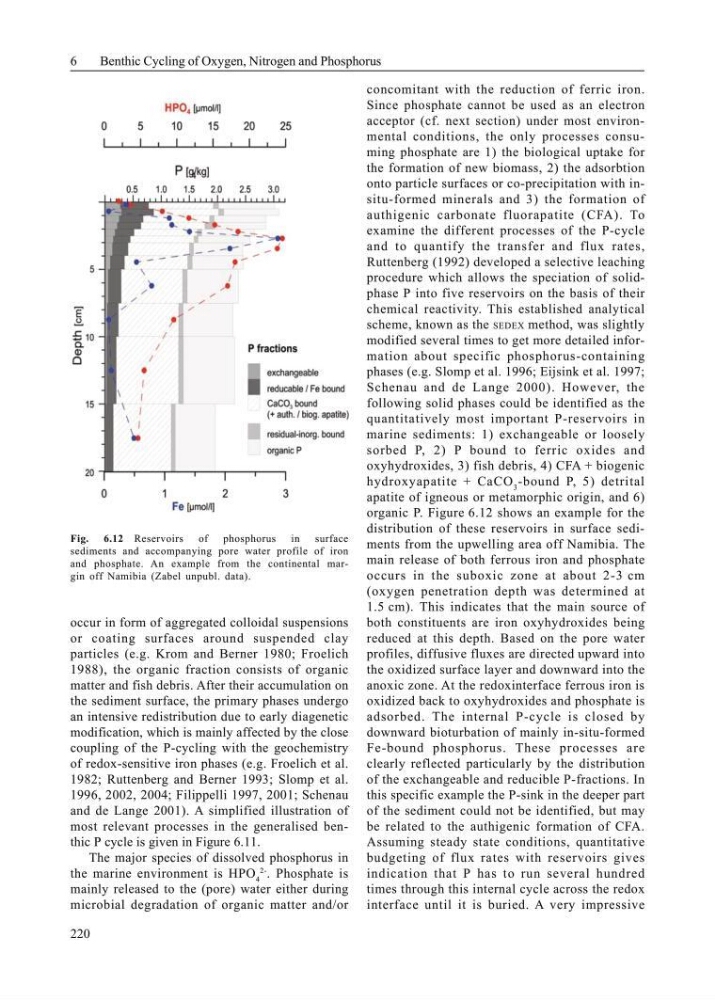
organic P. Figure 6.12 shows an example for the
distribution of these reservoirs in surface sediments from the upwelling area off Namibia. The
main release of both ferrous iron and phosphate
occurs in the suboxic zone at about 2-3 cm
(oxygen penetration depth was determined at
1.5 cm). This indicates that the main source of
both constituents are iron oxyhydroxides being
reduced at this depth. Based on the pore water
profiles, diffusive fluxes are directed upward into
the oxidized surface layer and downward into the
anoxic zone. At the redoxinterface ferrous iron is
oxidized back to oxyhydroxides and phosphate is
adsorbed. The internal P-cycle is closed by
downward bioturbation of mainly in-situ-formed
Fe-bound phosphorus. These processes are
clearly reflected particularly by the distribution
of the exchangeable and reducible P-fractions. In
this specific example the P-sink in the deeper part
of the sediment could not be identified, but may
be related to the authigenic formation of CFA.
Assuming steady state conditions, quantitative
budgeting of flux rates with reservoirs gives
indication that P has to run several hundred
times through this internal cycle across the redox
interface until it is buried. A very impressive
Fig. 6.12 Reservoirs of phosphorus in surface
sediments and accompanying pore water profile of iron
and phosphate. An example from the continental margin off Namibia (Zabel unpubl. data).
Benthic Cycling of Oxygen, Nitrogen and Phosphorus
220
occur in form of aggregated colloidal suspensions
or coating surfaces around suspended clay
particles (e.g. Krom and Berner 1980; Froelich
1988), the organic fraction consists of organic
matter and fish debris. After their accumulation on
the sediment surface, the primary phases undergo
an intensive redistribution due to early diagenetic
modification, which is mainly affected by the close
coupling of the P-cycling with the geochemistry
of redox-sensitive iron phases (e.g. Froelich et al.
1982; Ruttenberg and Berner 1993; Slomp et al.
1996, 2002, 2004; Filippelli 1997, 2001; Schenau
and de Lange 2001). A simplified illustration of
most relevant processes in the generalised benthic P cycle is given in Figure 6.11.
The major species of dissolved phosphorus in
the marine environment is HPO 4
2. Phosphate is
mainly released to the (pore) water either during
microbial degradation of organic matter and/or
concomitant with the reduction of ferric iron.
Since phosphate cannot be used as an electron
acceptor (cf. next section) under most environmental conditions, the only processes consuming phosphate are 1) the biological uptake for
the formation of new biomass, 2) the adsorbtion
onto particle surfaces or co-precipitation with insitu-formed minerals and 3) the formation of
authigenic carbonate fluorapatite (CFA). To
examine the different processes of the P-cycle
and to quantify the transfer and flux rates,
Ruttenberg (1992) developed a selective leaching
procedure which allows the speciation of solidphase P into five reservoirs on the basis of their
chemical reactivity. This established analytical
scheme, known as the SEDEX method, was slightly
modified several times to get more detailed information about specific phosphorus-containing
phases (e.g. Slomp et al. 1996; Eijsink et al. 1997;
Schenau and de Lange 2000). However, the
following solid phases could be identified as the
quantitatively most important P-reservoirs in
marine sediments: 1) exchangeable or loosely
sorbed P, 2) P bound to ferric oxides and
oxyhydroxides, 3) fish debris, 4) CFA + biogenic
hydroxyapatite + CaCO 3 -bound P, 5) detrital
apatite of igneous or metamorphic origin, and 6)
organic P. Figure 6.12 shows an example for the
distribution of these reservoirs in surface sediments from the upwelling area off Namibia. The
main release of both ferrous iron and phosphate
occurs in the suboxic zone at about 2-3 cm
(oxygen penetration depth was determined at
1.5 cm). This indicates that the main source of
both constituents are iron oxyhydroxides being
reduced at this depth. Based on the pore water
profiles, diffusive fluxes are directed upward into
the oxidized surface layer and downward into the
anoxic zone. At the redoxinterface ferrous iron is
oxidized back to oxyhydroxides and phosphate is
adsorbed. The internal P-cycle is closed by
downward bioturbation of mainly in-situ-formed
Fe-bound phosphorus. These processes are
clearly reflected particularly by the distribution
of the exchangeable and reducible P-fractions. In
this specific example the P-sink in the deeper part
of the sediment could not be identified, but may
be related to the authigenic formation of CFA.
Assuming steady state conditions, quantitative
budgeting of flux rates with reservoirs gives
indication that P has to run several hundred
times through this internal cycle across the redox
interface until it is buried. A very impressive
Fig. 6.12 Reservoirs of phosphorus in surface
sediments and accompanying pore water profile of iron
and phosphate. An example from the continental margin off Namibia (Zabel unpubl. data).