

199
group of organisms in order to observe whether
the process is taken over by another group or may
proceed autocatalytically, c) to let the inhibitor
substitute the substrate in the process and
measure the transformation of the inhibitor with
higher sensitivity. Ideally, the inhibitor should be
specific for only the relevant target organisms or
metabolic reaction. In reality, most inhibitors have
side effects and it is necessary through appropriate control experiments to determine these and
to find the minimum inhibitor dose required to
obtain the required effect. Some examples are
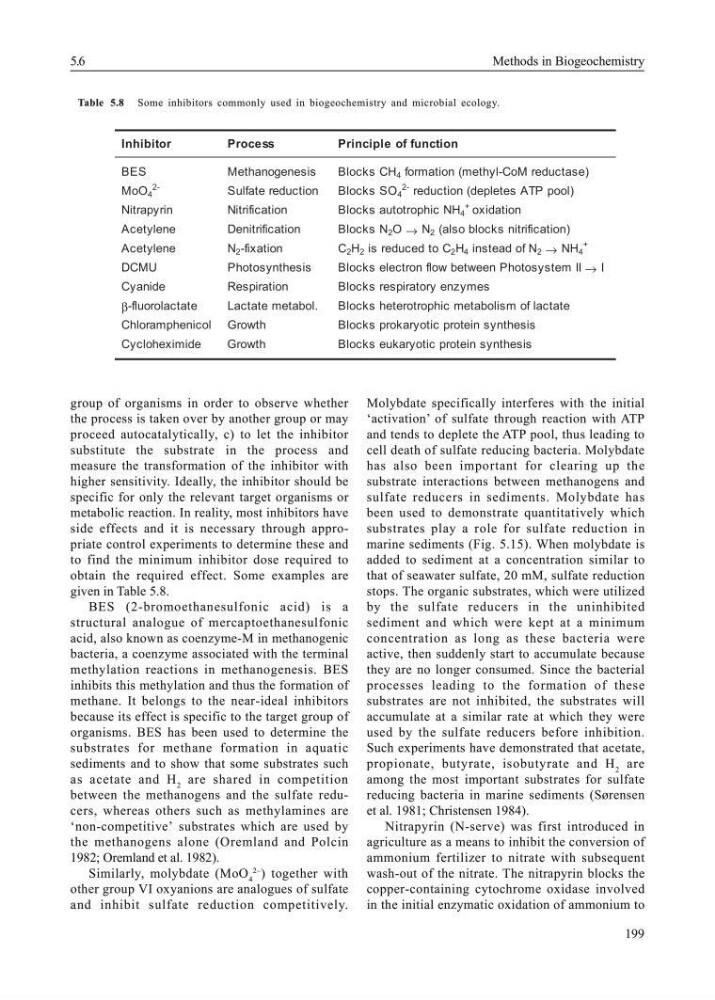
given in Table 5.8.
BES (2-bromoethanesulfonic acid) is a
structural analogue of mercaptoethanesulfonic
acid, also known as coenzyme-M in methanogenic
bacteria, a coenzyme associated with the terminal
methylation reactions in methanogenesis. BES
inhibits this methylation and thus the formation of
methane. It belongs to the near-ideal inhibitors
because its effect is specific to the target group of
organisms. BES has been used to determine the
substrates for methane formation in aquatic
sediments and to show that some substrates such
as acetate and H 2 are shared in competition
between the methanogens and the sulfate reducers, whereas others such as methylamines are
‘non-competitive’ substrates which are used by
the methanogens alone (Oremland and Polcin
1982; Oremland et al. 1982).
Similarly, molybdate (MoO 4
2–
) together with
other group VI oxyanions are analogues of sulfate
and inhibit sulfate reduction competitively.
5.6
Methods in Biogeochemistry
Molybdate specifically interferes with the initial
‘activation’ of sulfate through reaction with ATP
and tends to deplete the ATP pool, thus leading to
cell death of sulfate reducing bacteria. Molybdate
has also been important for clearing up the
substrate interactions between methanogens and
sulfate reducers in sediments. Molybdate has
been used to demonstrate quantitatively which
substrates play a role for sulfate reduction in
marine sediments (Fig. 5.15). When molybdate is
added to sediment at a concentration similar to
that of seawater sulfate, 20 mM, sulfate reduction
stops. The organic substrates, which were utilized
by the sulfate reducers in the uninhibited
sediment and which were kept at a minimum
concentration as long as these bacteria were
active, then suddenly start to accumulate because
they are no longer consumed. Since the bacterial
processes leading to the formation of these
substrates are not inhibited, the substrates will
accumulate at a similar rate at which they were
used by the sulfate reducers before inhibition.
Such experiments have demonstrated that acetate,
propionate, butyrate, isobutyrate and H 2 are
among the most important substrates for sulfate
reducing bacteria in marine sediments (Sørensen
et al. 1981; Christensen 1984).
Nitrapyrin (N-serve) was first introduced in
agriculture as a means to inhibit the conversion of
ammonium fertilizer to nitrate with subsequent
wash-out of the nitrate. The nitrapyrin blocks the
copper-containing cytochrome oxidase involved
in the initial enzymatic oxidation of ammonium to
Table 5.8 Some inhibitors commonly used in biogeochemistry and microbial ecology.
Inhibitor
Process
Principle of function
BES
Methanogenesis
Blocks CH 4 formation (methyl-CoM reductase)
MoO 4
2Sulfate reduction
Blocks SO 4
2- reduction (depletes ATP pool)
Nitrapyrin
Nitrification
Blocks autotrophic NH 4
+ oxidation
Acetylene
Denitrification
Blocks N 2 O → N 2 (also blocks nitrification)
Acetylene
N 2 -fixation
C 2 H 2 is reduced to C 2 H 4 instead of N 2 → NH 4
+
DCMU
Photosynthesis
Blocks electron flow between Photosystem II → I
Cyanide
Respiration
Blocks respiratory enzymes
β-fluorolactate
Lactate metabol.
Blocks heterotrophic metabolism of lactate
Chloramphenicol Growth
Blocks prokaryotic protein synthesis
Cycloheximide
Growth
Blocks eukaryotic protein synthesis
group of organisms in order to observe whether
the process is taken over by another group or may
proceed autocatalytically, c) to let the inhibitor
substitute the substrate in the process and
measure the transformation of the inhibitor with
higher sensitivity. Ideally, the inhibitor should be
specific for only the relevant target organisms or
metabolic reaction. In reality, most inhibitors have
side effects and it is necessary through appropriate control experiments to determine these and
to find the minimum inhibitor dose required to
obtain the required effect. Some examples are
given in Table 5.8.
BES (2-bromoethanesulfonic acid) is a
structural analogue of mercaptoethanesulfonic
acid, also known as coenzyme-M in methanogenic
bacteria, a coenzyme associated with the terminal
methylation reactions in methanogenesis. BES
inhibits this methylation and thus the formation of
methane. It belongs to the near-ideal inhibitors
because its effect is specific to the target group of
organisms. BES has been used to determine the
substrates for methane formation in aquatic
sediments and to show that some substrates such
as acetate and H 2 are shared in competition
between the methanogens and the sulfate reducers, whereas others such as methylamines are
‘non-competitive’ substrates which are used by
the methanogens alone (Oremland and Polcin
1982; Oremland et al. 1982).
Similarly, molybdate (MoO 4
2–
) together with
other group VI oxyanions are analogues of sulfate
and inhibit sulfate reduction competitively.
5.6
Methods in Biogeochemistry
Molybdate specifically interferes with the initial
‘activation’ of sulfate through reaction with ATP
and tends to deplete the ATP pool, thus leading to
cell death of sulfate reducing bacteria. Molybdate
has also been important for clearing up the
substrate interactions between methanogens and
sulfate reducers in sediments. Molybdate has
been used to demonstrate quantitatively which
substrates play a role for sulfate reduction in
marine sediments (Fig. 5.15). When molybdate is
added to sediment at a concentration similar to
that of seawater sulfate, 20 mM, sulfate reduction
stops. The organic substrates, which were utilized
by the sulfate reducers in the uninhibited
sediment and which were kept at a minimum
concentration as long as these bacteria were
active, then suddenly start to accumulate because
they are no longer consumed. Since the bacterial
processes leading to the formation of these
substrates are not inhibited, the substrates will
accumulate at a similar rate at which they were
used by the sulfate reducers before inhibition.
Such experiments have demonstrated that acetate,
propionate, butyrate, isobutyrate and H 2 are
among the most important substrates for sulfate
reducing bacteria in marine sediments (Sørensen
et al. 1981; Christensen 1984).
Nitrapyrin (N-serve) was first introduced in
agriculture as a means to inhibit the conversion of
ammonium fertilizer to nitrate with subsequent
wash-out of the nitrate. The nitrapyrin blocks the
copper-containing cytochrome oxidase involved
in the initial enzymatic oxidation of ammonium to
Table 5.8 Some inhibitors commonly used in biogeochemistry and microbial ecology.
Inhibitor
Process
Principle of function
BES
Methanogenesis
Blocks CH 4 formation (methyl-CoM reductase)
MoO 4
2Sulfate reduction
Blocks SO 4
2- reduction (depletes ATP pool)
Nitrapyrin
Nitrification
Blocks autotrophic NH 4
+ oxidation
Acetylene
Denitrification
Blocks N 2 O → N 2 (also blocks nitrification)
Acetylene
N 2 -fixation
C 2 H 2 is reduced to C 2 H 4 instead of N 2 → NH 4
+
DCMU
Photosynthesis
Blocks electron flow between Photosystem II → I
Cyanide
Respiration
Blocks respiratory enzymes
β-fluorolactate
Lactate metabol.
Blocks heterotrophic metabolism of lactate
Chloramphenicol Growth
Blocks prokaryotic protein synthesis
Cycloheximide
Growth
Blocks eukaryotic protein synthesis