

5
Bacteria and Marine Biogeochemistry
184
5.4.3
Relations to Oxygen
Before discussing the biological reactions
further, a few basic concepts should be
clarified. One is the relation of living organisms
to O 2 . Those organisms, who live in the presence of oxygen, are termed aerobic (meaning
‘living with oxygen’), whereas those who live in
the absence of oxygen are anaerobic. This
discrimination is both physiologically and
biogeochemically important. In all aerobic
organisms, toxic forms of oxygen, such as
peroxide or superoxide, are formed as byproducts of the aerobic metabolism. Aerobic
organisms rapidly degrade these aggressive
species with enzymes such as catalase,
peroxidase or superoxide dismutase. Many
organisms, which are obligately anaerobic, lack
these enzymes and are not able to grow in the
presence of oxygen for this and other reasons.
Some organisms need oxygen for their respiration, yet they are killed by higher O 2
concentrations. They are microaerophilic and
thrive at the lower boundary of the O 2 zone,
between the oxic (containing oxygen) and the
anoxic (without oxygen) environments. Other,
non-obligately (facultatively) anaerobic
bacteria may live both in oxidized and in
reduced zones of the sediment. The oxidized
sediment is characterized by redox potentials,
as measured by a naked platinum electrode, of
E H >0-100 mV and up to about +400 mV. Oxidized
sediments are generally brown to olive because
iron minerals are in oxidized forms. In most
marine sediments the O 2 penetration is small
relative to the depth of oxidized iron minerals.
Most of the oxidized zone is therefore anoxic
and has been termed suboxic (Froelich et al.
1979). The reducing sediment below the
suboxic zone has E H below 0-100 mV and down
to -200 mV and may be black or gray from
different forms of iron sulfide minerals.
5.4.4
Definitions of Energy Metabolism
We are now ready to explore the main types of
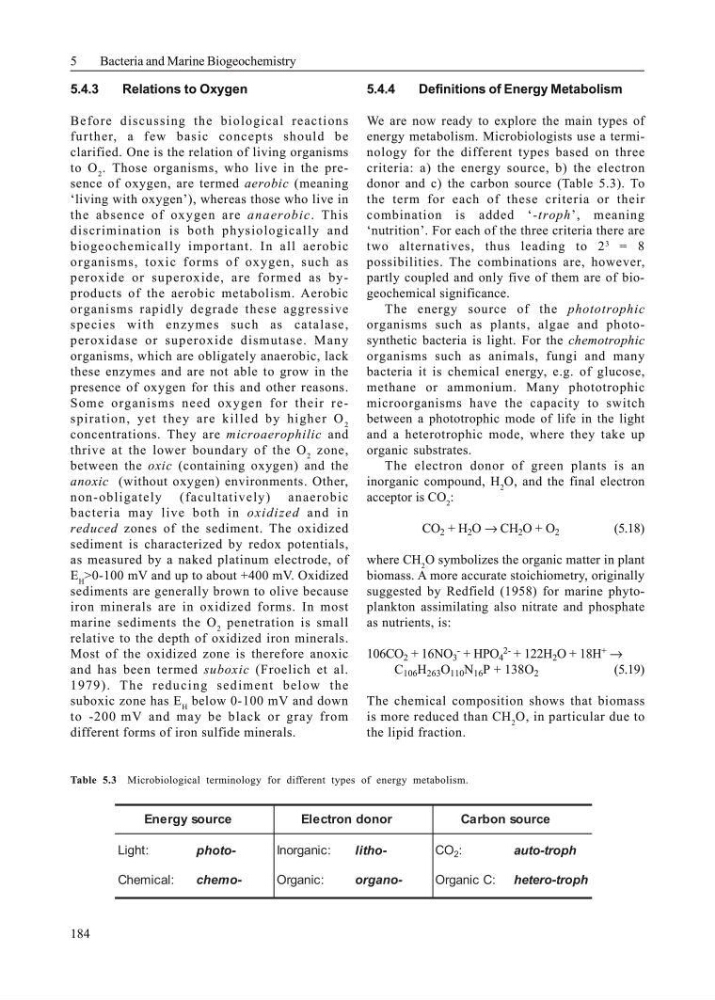
energy metabolism. Microbiologists use a terminology for the different types based on three
criteria: a) the energy source, b) the electron
donor and c) the carbon source (Table 5.3). To
the term for each of these criteria or their
combination is added ‘-troph’, meaning
‘nutrition’. For each of the three criteria there are
two alternatives, thus leading to 2
3
= 8
possibilities. The combinations are, however,
partly coupled and only five of them are of biogeochemical significance.
The energy source of the phototrophic
organisms such as plants, algae and photosynthetic bacteria is light. For the chemotrophic
organisms such as animals, fungi and many
bacteria it is chemical energy, e.g. of glucose,
methane or ammonium. Many phototrophic
microorganisms have the capacity to switch
between a phototrophic mode of life in the light
and a heterotrophic mode, where they take up
organic substrates.
The electron donor of green plants is an
inorganic compound, H 2 O, and the final electron
acceptor is CO 2 :
CO 2 + H 2 O → CH 2 O + O 2
(5.18)
where CH 2 O symbolizes the organic matter in plant
biomass. A more accurate stoichiometry, originally
suggested by Redfield (1958) for marine phytoplankton assimilating also nitrate and phosphate
as nutrients, is:
106CO 2 + 16NO 3
- + HPO 4
2- + 122H 2 O + 18H + →
C 106 H 263 O 110 N 16 P + 138O 2
(5.19)
The chemical composition shows that biomass
is more reduced than CH 2 O, in particular due to
the lipid fraction.
Table 5.3 Microbiological terminology for different types of energy metabolism.
Energy source
Electron donor
Carbon source
Light:
photoInorganic:
lithoCO 2 :
auto-troph
Chemical:
chemoOrganic:
organoOrganic C: hetero-troph
Bacteria and Marine Biogeochemistry
184
5.4.3
Relations to Oxygen
Before discussing the biological reactions
further, a few basic concepts should be
clarified. One is the relation of living organisms
to O 2 . Those organisms, who live in the presence of oxygen, are termed aerobic (meaning
‘living with oxygen’), whereas those who live in
the absence of oxygen are anaerobic. This
discrimination is both physiologically and
biogeochemically important. In all aerobic
organisms, toxic forms of oxygen, such as
peroxide or superoxide, are formed as byproducts of the aerobic metabolism. Aerobic
organisms rapidly degrade these aggressive
species with enzymes such as catalase,
peroxidase or superoxide dismutase. Many
organisms, which are obligately anaerobic, lack
these enzymes and are not able to grow in the
presence of oxygen for this and other reasons.
Some organisms need oxygen for their respiration, yet they are killed by higher O 2
concentrations. They are microaerophilic and
thrive at the lower boundary of the O 2 zone,
between the oxic (containing oxygen) and the
anoxic (without oxygen) environments. Other,
non-obligately (facultatively) anaerobic
bacteria may live both in oxidized and in
reduced zones of the sediment. The oxidized
sediment is characterized by redox potentials,
as measured by a naked platinum electrode, of
E H >0-100 mV and up to about +400 mV. Oxidized
sediments are generally brown to olive because
iron minerals are in oxidized forms. In most
marine sediments the O 2 penetration is small
relative to the depth of oxidized iron minerals.
Most of the oxidized zone is therefore anoxic
and has been termed suboxic (Froelich et al.
1979). The reducing sediment below the
suboxic zone has E H below 0-100 mV and down
to -200 mV and may be black or gray from
different forms of iron sulfide minerals.
5.4.4
Definitions of Energy Metabolism
We are now ready to explore the main types of
energy metabolism. Microbiologists use a terminology for the different types based on three
criteria: a) the energy source, b) the electron
donor and c) the carbon source (Table 5.3). To
the term for each of these criteria or their
combination is added ‘-troph’, meaning
‘nutrition’. For each of the three criteria there are
two alternatives, thus leading to 2
3
= 8
possibilities. The combinations are, however,
partly coupled and only five of them are of biogeochemical significance.
The energy source of the phototrophic
organisms such as plants, algae and photosynthetic bacteria is light. For the chemotrophic
organisms such as animals, fungi and many
bacteria it is chemical energy, e.g. of glucose,
methane or ammonium. Many phototrophic
microorganisms have the capacity to switch
between a phototrophic mode of life in the light
and a heterotrophic mode, where they take up
organic substrates.
The electron donor of green plants is an
inorganic compound, H 2 O, and the final electron
acceptor is CO 2 :
CO 2 + H 2 O → CH 2 O + O 2
(5.18)
where CH 2 O symbolizes the organic matter in plant
biomass. A more accurate stoichiometry, originally
suggested by Redfield (1958) for marine phytoplankton assimilating also nitrate and phosphate
as nutrients, is:
106CO 2 + 16NO 3
- + HPO 4
2- + 122H 2 O + 18H + →
C 106 H 263 O 110 N 16 P + 138O 2
(5.19)
The chemical composition shows that biomass
is more reduced than CH 2 O, in particular due to
the lipid fraction.
Table 5.3 Microbiological terminology for different types of energy metabolism.
Energy source
Electron donor
Carbon source
Light:
photoInorganic:
lithoCO 2 :
auto-troph
Chemical:
chemoOrganic:
organoOrganic C: hetero-troph