

183
which are reductions, i.e. ‘oxidized form + e
-
→
reduced form’. When protons are involved in the
reaction, the redox potential in the biological
literature is expressed at pH 7, because the
interior of cells is approximately neutral in pH. A
reducing compound such as H 2 , with a strong
tendency to give off electrons (Eq. 5.15), has a
strongly negative E 0
'
of -0.414 V. An oxidizing
compound such as O 2 , with a strong tendency to
accept electrons (Eq. 5.16), has a strongly
positive E 0
'
of +0.816 V. The free energy yield,
∆G
0
, of a process is proportional to the difference
in E 0
'
of its two half-reactions, ∆E 0
'
, and the redox
potentials of electron donor and electron
acceptor in a microbial energy metabolism
therefore provide important information on
whether they can serve as useful substrates for
energy metabolism:
∆G 0 = -n F ∆E 0
' [kJ mol -1 ]
(5.17)
where n is the number of electrons transferred by
the reaction and F is Faraday’s constant (96,485
Coulomb mol
-1
).
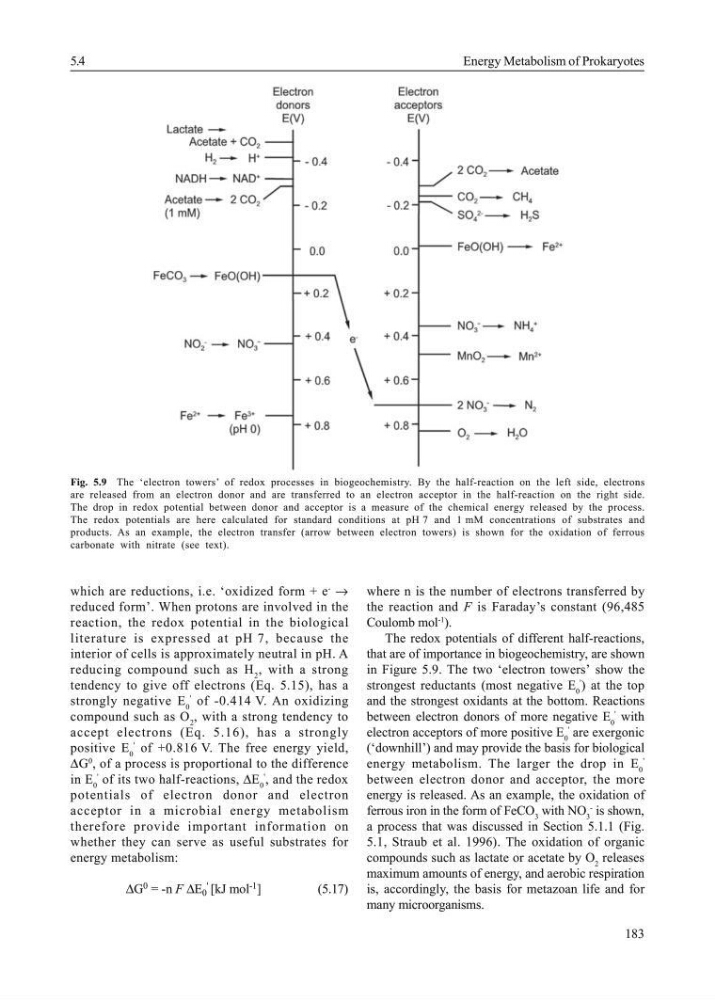
The redox potentials of different half-reactions,
that are of importance in biogeochemistry, are shown
in Figure 5.9. The two ‘electron towers’ show the
strongest reductants (most negative E 0
'
) at the top
and the strongest oxidants at the bottom. Reactions
between electron donors of more negative E 0
'
with
electron acceptors of more positive E 0
'
are exergonic
(‘downhill’) and may provide the basis for biological
energy metabolism. The larger the drop in E 0
'
between electron donor and acceptor, the more
energy is released. As an example, the oxidation of
ferrous iron in the form of FeCO 3 with NO 3
-
is shown,
a process that was discussed in Section 5.1.1 (Fig.
5.1, Straub et al. 1996). The oxidation of organic
compounds such as lactate or acetate by O 2 releases
maximum amounts of energy, and aerobic respiration
is, accordingly, the basis for metazoan life and for
many microorganisms.
Fig. 5.9 The ‘electron towers’ of redox processes in biogeochemistry. By the half-reaction on the left side, electrons
are released from an electron donor and are transferred to an electron acceptor in the half-reaction on the right side.
The drop in redox potential between donor and acceptor is a measure of the chemical energy released by the process.
The redox potentials are here calculated for standard conditions at pH 7 and 1 mM concentrations of substrates and
products. As an example, the electron transfer (arrow between electron towers) is shown for the oxidation of ferrous
carbonate with nitrate (see text).
5.4
Energy Metabolism of Prokaryotes
which are reductions, i.e. ‘oxidized form + e
-
→
reduced form’. When protons are involved in the
reaction, the redox potential in the biological
literature is expressed at pH 7, because the
interior of cells is approximately neutral in pH. A
reducing compound such as H 2 , with a strong
tendency to give off electrons (Eq. 5.15), has a
strongly negative E 0
'
of -0.414 V. An oxidizing
compound such as O 2 , with a strong tendency to
accept electrons (Eq. 5.16), has a strongly
positive E 0
'
of +0.816 V. The free energy yield,
∆G
0
, of a process is proportional to the difference
in E 0
'
of its two half-reactions, ∆E 0
'
, and the redox
potentials of electron donor and electron
acceptor in a microbial energy metabolism
therefore provide important information on
whether they can serve as useful substrates for
energy metabolism:
∆G 0 = -n F ∆E 0
' [kJ mol -1 ]
(5.17)
where n is the number of electrons transferred by
the reaction and F is Faraday’s constant (96,485
Coulomb mol
-1
).
The redox potentials of different half-reactions,
that are of importance in biogeochemistry, are shown
in Figure 5.9. The two ‘electron towers’ show the
strongest reductants (most negative E 0
'
) at the top
and the strongest oxidants at the bottom. Reactions
between electron donors of more negative E 0
'
with
electron acceptors of more positive E 0
'
are exergonic
(‘downhill’) and may provide the basis for biological
energy metabolism. The larger the drop in E 0
'
between electron donor and acceptor, the more
energy is released. As an example, the oxidation of
ferrous iron in the form of FeCO 3 with NO 3
-
is shown,
a process that was discussed in Section 5.1.1 (Fig.
5.1, Straub et al. 1996). The oxidation of organic
compounds such as lactate or acetate by O 2 releases
maximum amounts of energy, and aerobic respiration
is, accordingly, the basis for metazoan life and for
many microorganisms.
Fig. 5.9 The ‘electron towers’ of redox processes in biogeochemistry. By the half-reaction on the left side, electrons
are released from an electron donor and are transferred to an electron acceptor in the half-reaction on the right side.
The drop in redox potential between donor and acceptor is a measure of the chemical energy released by the process.
The redox potentials are here calculated for standard conditions at pH 7 and 1 mM concentrations of substrates and
products. As an example, the electron transfer (arrow between electron towers) is shown for the oxidation of ferrous
carbonate with nitrate (see text).
5.4
Energy Metabolism of Prokaryotes