

143
of geomacromolecules (Tegelaar et al. 1989; de Leeuw
and Largeau 1993). In a scheme modified from that of
Tissot and Welte (1984), more emphasis is placed on
the selective preservation of biopolymers (Fig. 4.10).
This means that the role of consecutive and random
polymerisation and polycondensation reactions of
biomonomers formed by hydrolysis or other degradative pathways may be less important than previously
thought. Support to this view is given by the detection
of the close morphological relationship between some
fossil ‘ultralaminae’ and the thin resistant outer cell
walls of green microalgae (Largeau et al. 1990).
To complete the modified view of geomacromolecule formation, the process of ‘natural vulcanisation’
(Fig. 4.10) has been proposed to play a major role under
suitable conditions (e.g. Sinninghe Damsté et al. 1989a,
1990; de Leeuw and Sinninghe Damsté 1990). Many
marine sediments contain high-molecular-weight
organic sulfur substances that are thought to be derived
from intermolecular incorporation of inorganic sulfur
species (HS
-
, polysulfides) into functionalized lipids
during early diagenesis. This requires the reduction of
seawater sulfate by sulfate-reducing microorganisms
under anoxic conditions (see Chap. 8). Sulfur
incorporation into organic matter is further enhanced
in depositional systems that are iron-limited, i.e.
organosulfur compounds are particularly abundant in
areas that receive little continental detritus with clays
enriched in iron and where instead biogenic carbonate
or opal is the dominant mineral component of the
sediment.
As a consequence of the discussion of organomineral interaction for the preservation of organic
matter in sediments (see Sect. 4.2), Collins et al. (1995)
raised the question if sorption of organic matter on
mineral surfaces did not lead to a rebirth of the classical
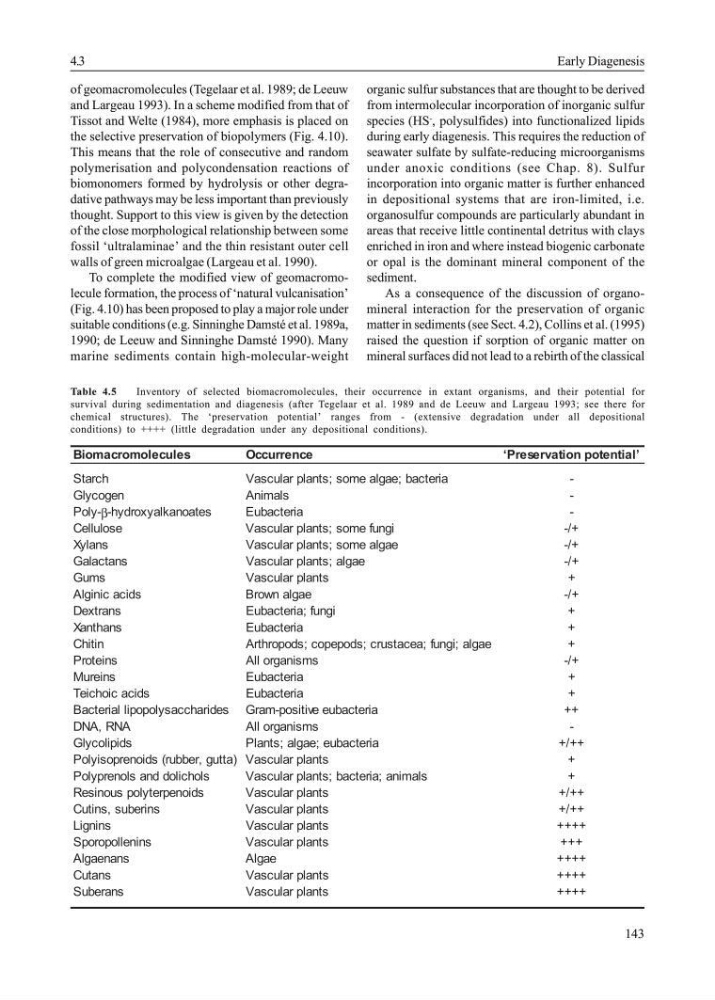
Table 4.5
Inventory of selected biomacromolecules, their occurrence in extant organisms, and their potential for
survival during sedimentation and diagenesis (after Tegelaar et al. 1989 and de Leeuw and Largeau 1993; see there for
chemical structures). The ‘preservation potential’ ranges from - (extensive degradation under all depositional
conditions) to ++++ (little degradation under any depositional conditions).
4.3
Early Diagenesis
Biomacromolecules
Occurrence
‘Preservation potential’
Starch
Vascular plants; some algae; bacteria
-
Glycogen
Animals
-
Poly-β-hydroxyalkanoates
Eubacteria
-
Cellulose
Vascular plants; some fungi
-/+
Xylans
Vascular plants; some algae
-/+
Galactans
Vascular plants; algae
-/+
Gums
Vascular plants
+
Alginic acids
Brown algae
-/+
Dextrans
Eubacteria; fungi
+
Xanthans
Eubacteria
+
Chitin
Arthropods; copepods; crustacea; fungi; algae
+
Proteins
All organisms
-/+
Mureins
Eubacteria
+
Teichoic acids
Eubacteria
+
Bacterial lipopolysaccharides Gram-positive eubacteria
++
DNA, RNA
All organisms
-
Glycolipids
Plants; algae; eubacteria
+/++
Polyisoprenoids (rubber, gutta) Vascular plants
+
Polyprenols and dolichols
Vascular plants; bacteria; animals
+
Resinous polyterpenoids
Vascular plants
+/++
Cutins, suberins
Vascular plants
+/++
Lignins
Vascular plants
++++
Sporopollenins
Vascular plants
+++
Algaenans
Algae
++++
Cutans
Vascular plants
++++
Suberans
Vascular plants
++++
of geomacromolecules (Tegelaar et al. 1989; de Leeuw
and Largeau 1993). In a scheme modified from that of
Tissot and Welte (1984), more emphasis is placed on
the selective preservation of biopolymers (Fig. 4.10).
This means that the role of consecutive and random
polymerisation and polycondensation reactions of
biomonomers formed by hydrolysis or other degradative pathways may be less important than previously
thought. Support to this view is given by the detection
of the close morphological relationship between some
fossil ‘ultralaminae’ and the thin resistant outer cell
walls of green microalgae (Largeau et al. 1990).
To complete the modified view of geomacromolecule formation, the process of ‘natural vulcanisation’
(Fig. 4.10) has been proposed to play a major role under
suitable conditions (e.g. Sinninghe Damsté et al. 1989a,
1990; de Leeuw and Sinninghe Damsté 1990). Many
marine sediments contain high-molecular-weight
organic sulfur substances that are thought to be derived
from intermolecular incorporation of inorganic sulfur
species (HS
-
, polysulfides) into functionalized lipids
during early diagenesis. This requires the reduction of
seawater sulfate by sulfate-reducing microorganisms
under anoxic conditions (see Chap. 8). Sulfur
incorporation into organic matter is further enhanced
in depositional systems that are iron-limited, i.e.
organosulfur compounds are particularly abundant in
areas that receive little continental detritus with clays
enriched in iron and where instead biogenic carbonate
or opal is the dominant mineral component of the
sediment.
As a consequence of the discussion of organomineral interaction for the preservation of organic
matter in sediments (see Sect. 4.2), Collins et al. (1995)
raised the question if sorption of organic matter on
mineral surfaces did not lead to a rebirth of the classical
Table 4.5
Inventory of selected biomacromolecules, their occurrence in extant organisms, and their potential for
survival during sedimentation and diagenesis (after Tegelaar et al. 1989 and de Leeuw and Largeau 1993; see there for
chemical structures). The ‘preservation potential’ ranges from - (extensive degradation under all depositional
conditions) to ++++ (little degradation under any depositional conditions).
4.3
Early Diagenesis
Biomacromolecules
Occurrence
‘Preservation potential’
Starch
Vascular plants; some algae; bacteria
-
Glycogen
Animals
-
Poly-β-hydroxyalkanoates
Eubacteria
-
Cellulose
Vascular plants; some fungi
-/+
Xylans
Vascular plants; some algae
-/+
Galactans
Vascular plants; algae
-/+
Gums
Vascular plants
+
Alginic acids
Brown algae
-/+
Dextrans
Eubacteria; fungi
+
Xanthans
Eubacteria
+
Chitin
Arthropods; copepods; crustacea; fungi; algae
+
Proteins
All organisms
-/+
Mureins
Eubacteria
+
Teichoic acids
Eubacteria
+
Bacterial lipopolysaccharides Gram-positive eubacteria
++
DNA, RNA
All organisms
-
Glycolipids
Plants; algae; eubacteria
+/++
Polyisoprenoids (rubber, gutta) Vascular plants
+
Polyprenols and dolichols
Vascular plants; bacteria; animals
+
Resinous polyterpenoids
Vascular plants
+/++
Cutins, suberins
Vascular plants
+/++
Lignins
Vascular plants
++++
Sporopollenins
Vascular plants
+++
Algaenans
Algae
++++
Cutans
Vascular plants
++++
Suberans
Vascular plants
++++