

4
Organic Matter: The Driving Force for Early Diagenesis
142
diagenesis are converted into the fully aromatized
porphyrins. Most porphyrins in sediments and crude oils
are derived from the green plant pigment chlorophyll a
and from bacteriochlorophylls.
4.3.3
The Principle of Selective
Preservation
Organic compounds and compound classes differ in
their potential to be preserved in sediments and to survive early diagenesis. As a general rule, water-soluble
organic compounds, or organic macromolecules, which
are easily hydrolyzed to water-soluble monomers, have
a low preservation potential. In contrast to this,
compounds with a low solubility in water such as lipids
and hydrolysis-resistant macromolecules are selectively enriched in the sedimentary organic matter. Table
4.5 is a compilation of the source and preservation
potential of some common organic compound types. It
is based on anticipated chemical stabilities related to
structures, reported biodegradability and reported
presence in the geosphere, but not on mechanisms of
preservation such as mechanical protection or
bacteriostatic activities of certain chemicals in the
(paleo)environment (de Leeuw and Largeau 1993).
The near-surface sediment layers represent the
transition zone where biological organic matter is
transformed into fossil organic matter. There are two
slightly differing views about the nature of this process.
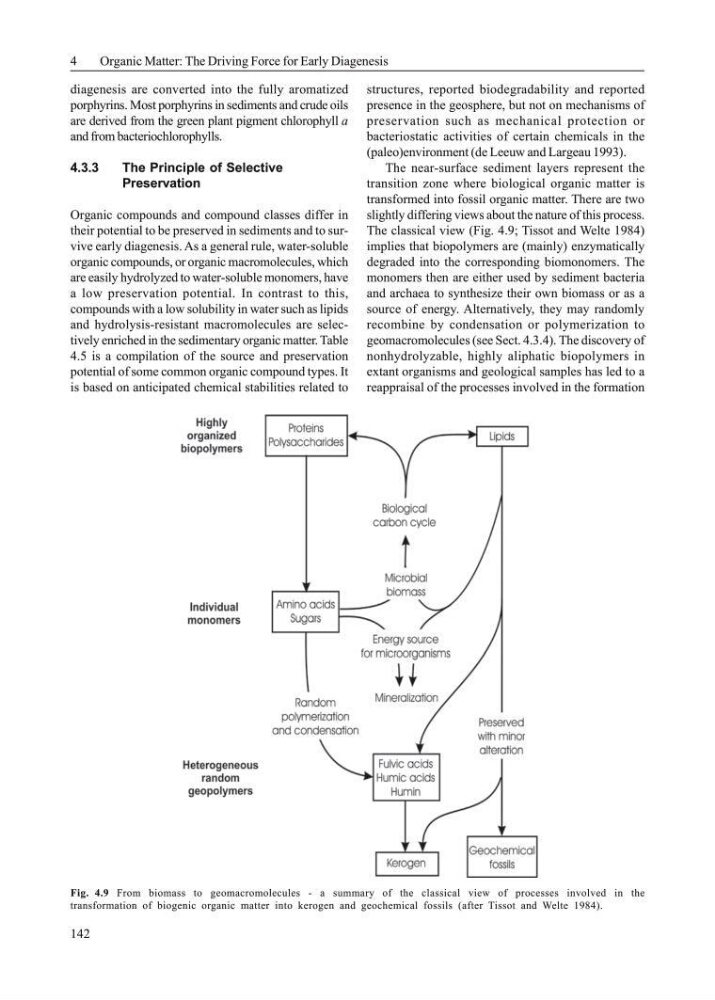
The classical view (Fig. 4.9; Tissot and Welte 1984)
implies that biopolymers are (mainly) enzymatically
degraded into the corresponding biomonomers. The
monomers then are either used by sediment bacteria
and archaea to synthesize their own biomass or as a
source of energy. Alternatively, they may randomly
recombine by condensation or polymerization to
geomacromolecules (see Sect. 4.3.4). The discovery of
nonhydrolyzable, highly aliphatic biopolymers in
extant organisms and geological samples has led to a
reappraisal of the processes involved in the formation
Fig. 4.9 From biomass to geomacromolecules - a summary of the classical view of processes involved in the
transformation of biogenic organic matter into kerogen and geochemical fossils (after Tissot and Welte 1984).
Organic Matter: The Driving Force for Early Diagenesis
142
diagenesis are converted into the fully aromatized
porphyrins. Most porphyrins in sediments and crude oils
are derived from the green plant pigment chlorophyll a
and from bacteriochlorophylls.
4.3.3
The Principle of Selective
Preservation
Organic compounds and compound classes differ in
their potential to be preserved in sediments and to survive early diagenesis. As a general rule, water-soluble
organic compounds, or organic macromolecules, which
are easily hydrolyzed to water-soluble monomers, have
a low preservation potential. In contrast to this,
compounds with a low solubility in water such as lipids
and hydrolysis-resistant macromolecules are selectively enriched in the sedimentary organic matter. Table
4.5 is a compilation of the source and preservation
potential of some common organic compound types. It
is based on anticipated chemical stabilities related to
structures, reported biodegradability and reported
presence in the geosphere, but not on mechanisms of
preservation such as mechanical protection or
bacteriostatic activities of certain chemicals in the
(paleo)environment (de Leeuw and Largeau 1993).
The near-surface sediment layers represent the
transition zone where biological organic matter is
transformed into fossil organic matter. There are two
slightly differing views about the nature of this process.
The classical view (Fig. 4.9; Tissot and Welte 1984)
implies that biopolymers are (mainly) enzymatically
degraded into the corresponding biomonomers. The
monomers then are either used by sediment bacteria
and archaea to synthesize their own biomass or as a
source of energy. Alternatively, they may randomly
recombine by condensation or polymerization to
geomacromolecules (see Sect. 4.3.4). The discovery of
nonhydrolyzable, highly aliphatic biopolymers in
extant organisms and geological samples has led to a
reappraisal of the processes involved in the formation
Fig. 4.9 From biomass to geomacromolecules - a summary of the classical view of processes involved in the
transformation of biogenic organic matter into kerogen and geochemical fossils (after Tissot and Welte 1984).