

137
cases ranges from about 30 to 85 % in the upper
sediment layers comprising, however, different time
ranges. They correspond to the range quoted for
continental shelf and estuarine sediments (20 to 90 %)
by Henrichs and Reeburgh (1987). Apparently, organic
carbon flux, bulk sedimentation rate, water depth,
oxygen concentration in the bottom water and related
extent of bioturbation of surface sediments all have an
influence on the intensity of organic matter remineralization during early diagenesis and on how much
organic matter is buried to a sediment depth where
further remineralization only proceeds very slowly.
Only that organic matter fraction can be considered to
become fossilized in a strict sense and to enter the
geological organic carbon cycle.
Methanogenesis
As indicated in Figure 4.6, the last step in the sedimentary metabolic pathway is methanogenesis. The
formation of methane at a depth level, where all sulfate
has been consumed, involves a group of strictly anaerobic archaea, collectively called methanogens. They
use a small number of different low-molecular-weight
substances for the biosynthesis of methane which,
together with elemental hydrogen, in turn are formed
by bacterial fermentation from more complex organic
substances during early diagenesis. The terminal
electron acceptor in methanogenesis is carbon. The
most prominent pathways are the reduction of carbon
dioxide with molecular hydrogen and the transformation
of acetic acid into methane and carbon dioxide (Eq.
4.7), although formic acid or methanol may be used as
substrates as well.
CO 2 + 4 H 2 →
→ →
→ → CH 4 + 2 H 2 O
CH 3 COOH →
→ →
→ → CH 4 + CO 2
(4.7)
Methanogenesis is widespread in the marine
environment, particularly on continental margins or in
stagnant basins, where sufficient organic matter is
deposited so that anoxic conditions occur at shallow
depth below the seafloor (e.g. D’Hondt et al. 2002).
The amounts of methane formed can be enormous in
certain areas. Under suitable conditions of low
temperature and high pressure this biogenic methane
and pore water may form a solid, ice-like substance
called methane clathrate or, more generally, gas hydrate
(see Chap. 14). Another important process which is
related to methanogenesis and of which many microbiological and biogeochemical details have only been
revealed in recent years and still are being investigated,
4.3
Early Diagenesis
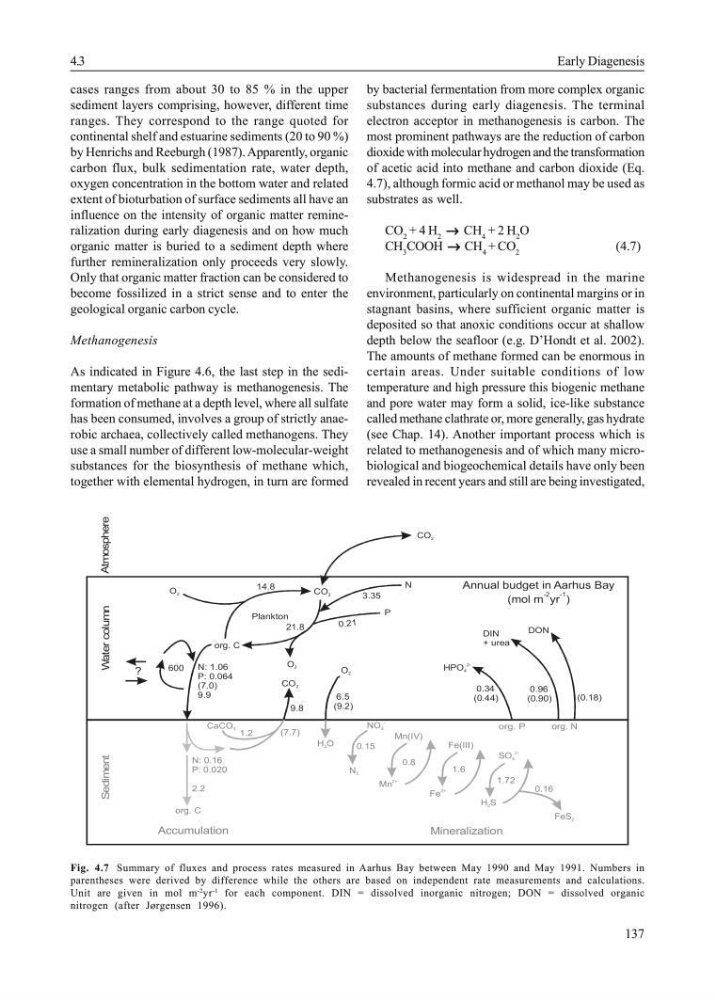
Fig. 4.7 Summary of fluxes and process rates measured in Aarhus Bay between May 1990 and May 1991. Numbers in
parentheses were derived by difference while the others are based on independent rate measurements and calculations.
Unit are given in mol m
-2 yr
-1 for each component. DIN = dissolved inorganic nitrogen; DON = dissolved organic
nitrogen (after Jørgensen 1996).
CO 2
CO 2
14.8
O 2
O 2
O 2
Plankton
Annual budget in Aarhus Bay
(mol m yr )
-2
-1
org. C
org. C
21.8
N
P
0.2 1
600
?
N: 1.06
P: 0.064
(7.0)
9.9
HPO 4
2DIN
+ urea
DON
(0.18)
0.96
(0.90)
0.34
(0.44)
org. N
CO 2
1.2
(7.7)
N: 0.16
P: 0.020
2.2
CaCO 3
H O
2
6.5
(9.2)
9.8
Sediment
Water column
Accumulation
Mineralization
3.35
N 2
NO 3
-
Mn(IV)
Mn
2+
Fe(III)
Fe
2+
SO 4
2H S
2
FeS 2
0.16
1.72
1.6
0.8
0.15
Atmosphere
cases ranges from about 30 to 85 % in the upper
sediment layers comprising, however, different time
ranges. They correspond to the range quoted for
continental shelf and estuarine sediments (20 to 90 %)
by Henrichs and Reeburgh (1987). Apparently, organic
carbon flux, bulk sedimentation rate, water depth,
oxygen concentration in the bottom water and related
extent of bioturbation of surface sediments all have an
influence on the intensity of organic matter remineralization during early diagenesis and on how much
organic matter is buried to a sediment depth where
further remineralization only proceeds very slowly.
Only that organic matter fraction can be considered to
become fossilized in a strict sense and to enter the
geological organic carbon cycle.
Methanogenesis
As indicated in Figure 4.6, the last step in the sedimentary metabolic pathway is methanogenesis. The
formation of methane at a depth level, where all sulfate
has been consumed, involves a group of strictly anaerobic archaea, collectively called methanogens. They
use a small number of different low-molecular-weight
substances for the biosynthesis of methane which,
together with elemental hydrogen, in turn are formed
by bacterial fermentation from more complex organic
substances during early diagenesis. The terminal
electron acceptor in methanogenesis is carbon. The
most prominent pathways are the reduction of carbon
dioxide with molecular hydrogen and the transformation
of acetic acid into methane and carbon dioxide (Eq.
4.7), although formic acid or methanol may be used as
substrates as well.
CO 2 + 4 H 2 →
→ →
→ → CH 4 + 2 H 2 O
CH 3 COOH →
→ →
→ → CH 4 + CO 2
(4.7)
Methanogenesis is widespread in the marine
environment, particularly on continental margins or in
stagnant basins, where sufficient organic matter is
deposited so that anoxic conditions occur at shallow
depth below the seafloor (e.g. D’Hondt et al. 2002).
The amounts of methane formed can be enormous in
certain areas. Under suitable conditions of low
temperature and high pressure this biogenic methane
and pore water may form a solid, ice-like substance
called methane clathrate or, more generally, gas hydrate
(see Chap. 14). Another important process which is
related to methanogenesis and of which many microbiological and biogeochemical details have only been
revealed in recent years and still are being investigated,
4.3
Early Diagenesis
Fig. 4.7 Summary of fluxes and process rates measured in Aarhus Bay between May 1990 and May 1991. Numbers in
parentheses were derived by difference while the others are based on independent rate measurements and calculations.
Unit are given in mol m
-2 yr
-1 for each component. DIN = dissolved inorganic nitrogen; DON = dissolved organic
nitrogen (after Jørgensen 1996).
CO 2
CO 2
14.8
O 2
O 2
O 2
Plankton
Annual budget in Aarhus Bay
(mol m yr )
-2
-1
org. C
org. C
21.8
N
P
0.2 1
600
?
N: 1.06
P: 0.064
(7.0)
9.9
HPO 4
2DIN
+ urea
DON
(0.18)
0.96
(0.90)
0.34
(0.44)
org. N
CO 2
1.2
(7.7)
N: 0.16
P: 0.020
2.2
CaCO 3
H O
2
6.5
(9.2)
9.8
Sediment
Water column
Accumulation
Mineralization
3.35
N 2
NO 3
-
Mn(IV)
Mn
2+
Fe(III)
Fe
2+
SO 4
2H S
2
FeS 2
0.16
1.72
1.6
0.8
0.15
Atmosphere