

4
Organic Matter: The Driving Force for Early Diagenesis
136
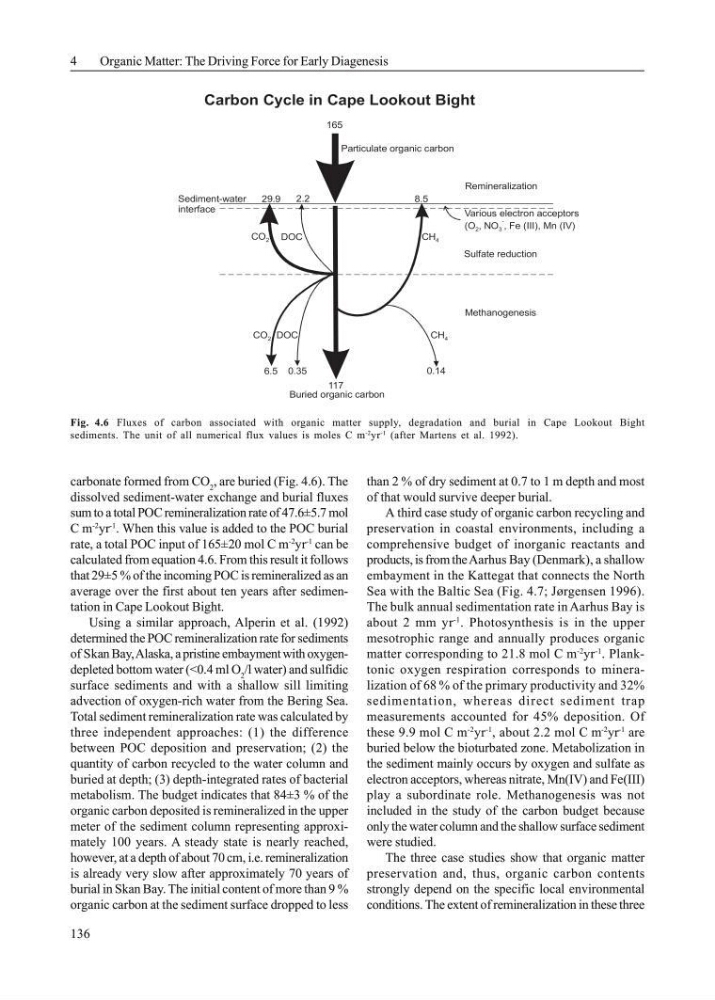
carbonate formed from CO 2 , are buried (Fig. 4.6). The
dissolved sediment-water exchange and burial fluxes
sum to a total POC remineralization rate of 47.6±5.7 mol
C m
-2
yr
-1
. When this value is added to the POC burial
rate, a total POC input of 165±20 mol C m
-2
yr
-1
can be
calculated from equation 4.6. From this result it follows
that 29±5 % of the incoming POC is remineralized as an
average over the first about ten years after sedimentation in Cape Lookout Bight.
Using a similar approach, Alperin et al. (1992)
determined the POC remineralization rate for sediments
of Skan Bay, Alaska, a pristine embayment with oxygendepleted bottom water (<0.4 ml O 2 /l water) and sulfidic
surface sediments and with a shallow sill limiting
advection of oxygen-rich water from the Bering Sea.
Total sediment remineralization rate was calculated by
three independent approaches: (1) the difference
between POC deposition and preservation; (2) the
quantity of carbon recycled to the water column and
buried at depth; (3) depth-integrated rates of bacterial
metabolism. The budget indicates that 84±3 % of the
organic carbon deposited is remineralized in the upper
meter of the sediment column representing approximately 100 years. A steady state is nearly reached,
however, at a depth of about 70 cm, i.e. remineralization
is already very slow after approximately 70 years of
burial in Skan Bay. The initial content of more than 9 %
organic carbon at the sediment surface dropped to less
than 2 % of dry sediment at 0.7 to 1 m depth and most
of that would survive deeper burial.
A third case study of organic carbon recycling and
preservation in coastal environments, including a
comprehensive budget of inorganic reactants and
products, is from the Aarhus Bay (Denmark), a shallow
embayment in the Kattegat that connects the North
Sea with the Baltic Sea (Fig. 4.7; Jørgensen 1996).
The bulk annual sedimentation rate in Aarhus Bay is
about 2 mm yr
-1
. Photosynthesis is in the upper
mesotrophic range and annually produces organic
matter corresponding to 21.8 mol C m
-2
yr
-1
. Planktonic oxygen respiration corresponds to mineralization of 68 % of the primary productivity and 32%
sedimentation, whereas direct sediment trap
measurements accounted for 45% deposition. Of
these 9.9 mol C m
-2
yr
-1
, about 2.2 mol C m
-2
yr
-1
are
buried below the bioturbated zone. Metabolization in
the sediment mainly occurs by oxygen and sulfate as
electron acceptors, whereas nitrate, Mn(IV) and Fe(III)
play a subordinate role. Methanogenesis was not
included in the study of the carbon budget because
only the water column and the shallow surface sediment
were studied.
The three case studies show that organic matter
preservation and, thus, organic carbon contents
strongly depend on the specific local environmental
conditions. The extent of remineralization in these three
Fig. 4.6 Fluxes of carbon associated with organic matter supply, degradation and burial in Cape Lookout Bight
sediments. The unit of all numerical flux values is moles C m
-2 yr
-1 (after Martens et al. 1992).
Carbon Cycle in Cape Lookout Bight
165
Particulate organic carbon
Sediment-water
interface
29.9
2.2
8.5
Remineralization
CO 2
CO 2
DOC
DOC
CH 4
CH 4
Sulfate reduction
Various electron acceptors
(O , NO , Fe (III), Mn (IV)
2
3
-
Methanogenesis
0.14
0.35
6.5
117
Buried organic carbon
Organic Matter: The Driving Force for Early Diagenesis
136
carbonate formed from CO 2 , are buried (Fig. 4.6). The
dissolved sediment-water exchange and burial fluxes
sum to a total POC remineralization rate of 47.6±5.7 mol
C m
-2
yr
-1
. When this value is added to the POC burial
rate, a total POC input of 165±20 mol C m
-2
yr
-1
can be
calculated from equation 4.6. From this result it follows
that 29±5 % of the incoming POC is remineralized as an
average over the first about ten years after sedimentation in Cape Lookout Bight.
Using a similar approach, Alperin et al. (1992)
determined the POC remineralization rate for sediments
of Skan Bay, Alaska, a pristine embayment with oxygendepleted bottom water (<0.4 ml O 2 /l water) and sulfidic
surface sediments and with a shallow sill limiting
advection of oxygen-rich water from the Bering Sea.
Total sediment remineralization rate was calculated by
three independent approaches: (1) the difference
between POC deposition and preservation; (2) the
quantity of carbon recycled to the water column and
buried at depth; (3) depth-integrated rates of bacterial
metabolism. The budget indicates that 84±3 % of the
organic carbon deposited is remineralized in the upper
meter of the sediment column representing approximately 100 years. A steady state is nearly reached,
however, at a depth of about 70 cm, i.e. remineralization
is already very slow after approximately 70 years of
burial in Skan Bay. The initial content of more than 9 %
organic carbon at the sediment surface dropped to less
than 2 % of dry sediment at 0.7 to 1 m depth and most
of that would survive deeper burial.
A third case study of organic carbon recycling and
preservation in coastal environments, including a
comprehensive budget of inorganic reactants and
products, is from the Aarhus Bay (Denmark), a shallow
embayment in the Kattegat that connects the North
Sea with the Baltic Sea (Fig. 4.7; Jørgensen 1996).
The bulk annual sedimentation rate in Aarhus Bay is
about 2 mm yr
-1
. Photosynthesis is in the upper
mesotrophic range and annually produces organic
matter corresponding to 21.8 mol C m
-2
yr
-1
. Planktonic oxygen respiration corresponds to mineralization of 68 % of the primary productivity and 32%
sedimentation, whereas direct sediment trap
measurements accounted for 45% deposition. Of
these 9.9 mol C m
-2
yr
-1
, about 2.2 mol C m
-2
yr
-1
are
buried below the bioturbated zone. Metabolization in
the sediment mainly occurs by oxygen and sulfate as
electron acceptors, whereas nitrate, Mn(IV) and Fe(III)
play a subordinate role. Methanogenesis was not
included in the study of the carbon budget because
only the water column and the shallow surface sediment
were studied.
The three case studies show that organic matter
preservation and, thus, organic carbon contents
strongly depend on the specific local environmental
conditions. The extent of remineralization in these three
Fig. 4.6 Fluxes of carbon associated with organic matter supply, degradation and burial in Cape Lookout Bight
sediments. The unit of all numerical flux values is moles C m
-2 yr
-1 (after Martens et al. 1992).
Carbon Cycle in Cape Lookout Bight
165
Particulate organic carbon
Sediment-water
interface
29.9
2.2
8.5
Remineralization
CO 2
CO 2
DOC
DOC
CH 4
CH 4
Sulfate reduction
Various electron acceptors
(O , NO , Fe (III), Mn (IV)
2
3
-
Methanogenesis
0.14
0.35
6.5
117
Buried organic carbon