

4
Organic Matter: The Driving Force for Early Diagenesis
132
conceivable, however, is that the relationship between
sedimentation rate and organic carbon content is based
on the protective effect of organic matter adsorption
on mineral (particularly clay) surfaces, so that organic
matter preservation increases with the increase of
mineral surface available for adsorption (Keil et al.
1994a, b; Mayer 1994,1999, 2005; Collins et al. 1995;
Ransom et al. 1998).
There is general agreement on the positive
relationship between sedimentation rate and organic
carbon content (e.g. Heath et al. 1977; Ibach 1982;
Stein 1986a, b; Bralower and Thierstein 1987; Littke et
al. 1991b). However, in cases where biostratigraphy
provides accurate time control, it has been noted by
Tyson (1987) that deposition of marine sediments with
very high organic matter contents (petroleum source
rocks) often appears to be associated with low rather
than high sedimentation rates. Very high sedimentation rates at some point may lead to low
organic matter concentrations in sediments due to
dilution even if much of the sinking organic matter
is preserved (Note difference between linear sedimentation rate [cm kyr
-1
] and sediment accumulation
rate [g cm
-2
yr
-1
], i.e. in a highly diluted sediment with
a moderate to low organic carbon content deposited
at a high linear bulk sedimentation rate, organic
matter accumulation (or preservation) with time may
still be high).
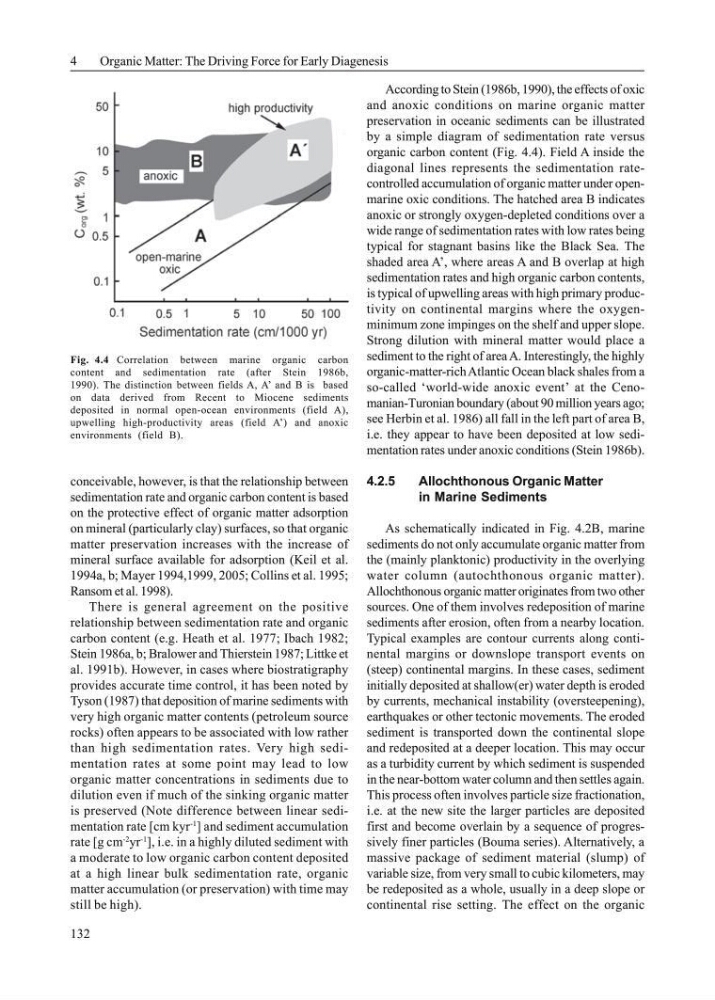
According to Stein (1986b, 1990), the effects of oxic
and anoxic conditions on marine organic matter
preservation in oceanic sediments can be illustrated
by a simple diagram of sedimentation rate versus
organic carbon content (Fig. 4.4). Field A inside the
diagonal lines represents the sedimentation ratecontrolled accumulation of organic matter under openmarine oxic conditions. The hatched area B indicates
anoxic or strongly oxygen-depleted conditions over a
wide range of sedimentation rates with low rates being
typical for stagnant basins like the Black Sea. The
shaded area A’, where areas A and B overlap at high
sedimentation rates and high organic carbon contents,
is typical of upwelling areas with high primary productivity on continental margins where the oxygenminimum zone impinges on the shelf and upper slope.
Strong dilution with mineral matter would place a
sediment to the right of area A. Interestingly, the highly
organic-matter-rich Atlantic Ocean black shales from a
so-called ‘world-wide anoxic event’ at the Cenomanian-Turonian boundary (about 90 million years ago;
see Herbin et al. 1986) all fall in the left part of area B,
i.e. they appear to have been deposited at low sedimentation rates under anoxic conditions (Stein 1986b).
4.2.5
Allochthonous Organic Matter
in Marine Sediments
As schematically indicated in Fig. 4.2B, marine
sediments do not only accumulate organic matter from
the (mainly planktonic) productivity in the overlying
water column (autochthonous organic matter).
Allochthonous organic matter originates from two other
sources. One of them involves redeposition of marine
sediments after erosion, often from a nearby location.
Typical examples are contour currents along continental margins or downslope transport events on
(steep) continental margins. In these cases, sediment
initially deposited at shallow(er) water depth is eroded
by currents, mechanical instability (oversteepening),
earthquakes or other tectonic movements. The eroded
sediment is transported down the continental slope
and redeposited at a deeper location. This may occur
as a turbidity current by which sediment is suspended
in the near-bottom water column and then settles again.
This process often involves particle size fractionation,
i.e. at the new site the larger particles are deposited
first and become overlain by a sequence of progressively finer particles (Bouma series). Alternatively, a
massive package of sediment material (slump) of
variable size, from very small to cubic kilometers, may
be redeposited as a whole, usually in a deep slope or
continental rise setting. The effect on the organic
Fig. 4.4 Correlation between marine organic carbon
content and sedimentation rate (after Stein 1986b,
1990). The distinction between fields A, A’ and B is based
on data derived from Recent to Miocene sediments
deposited in normal open-ocean environments (field A),
upwelling high-productivity areas (field A’) and anoxic
environments (field B).
Organic Matter: The Driving Force for Early Diagenesis
132
conceivable, however, is that the relationship between
sedimentation rate and organic carbon content is based
on the protective effect of organic matter adsorption
on mineral (particularly clay) surfaces, so that organic
matter preservation increases with the increase of
mineral surface available for adsorption (Keil et al.
1994a, b; Mayer 1994,1999, 2005; Collins et al. 1995;
Ransom et al. 1998).
There is general agreement on the positive
relationship between sedimentation rate and organic
carbon content (e.g. Heath et al. 1977; Ibach 1982;
Stein 1986a, b; Bralower and Thierstein 1987; Littke et
al. 1991b). However, in cases where biostratigraphy
provides accurate time control, it has been noted by
Tyson (1987) that deposition of marine sediments with
very high organic matter contents (petroleum source
rocks) often appears to be associated with low rather
than high sedimentation rates. Very high sedimentation rates at some point may lead to low
organic matter concentrations in sediments due to
dilution even if much of the sinking organic matter
is preserved (Note difference between linear sedimentation rate [cm kyr
-1
] and sediment accumulation
rate [g cm
-2
yr
-1
], i.e. in a highly diluted sediment with
a moderate to low organic carbon content deposited
at a high linear bulk sedimentation rate, organic
matter accumulation (or preservation) with time may
still be high).
According to Stein (1986b, 1990), the effects of oxic
and anoxic conditions on marine organic matter
preservation in oceanic sediments can be illustrated
by a simple diagram of sedimentation rate versus
organic carbon content (Fig. 4.4). Field A inside the
diagonal lines represents the sedimentation ratecontrolled accumulation of organic matter under openmarine oxic conditions. The hatched area B indicates
anoxic or strongly oxygen-depleted conditions over a
wide range of sedimentation rates with low rates being
typical for stagnant basins like the Black Sea. The
shaded area A’, where areas A and B overlap at high
sedimentation rates and high organic carbon contents,
is typical of upwelling areas with high primary productivity on continental margins where the oxygenminimum zone impinges on the shelf and upper slope.
Strong dilution with mineral matter would place a
sediment to the right of area A. Interestingly, the highly
organic-matter-rich Atlantic Ocean black shales from a
so-called ‘world-wide anoxic event’ at the Cenomanian-Turonian boundary (about 90 million years ago;
see Herbin et al. 1986) all fall in the left part of area B,
i.e. they appear to have been deposited at low sedimentation rates under anoxic conditions (Stein 1986b).
4.2.5
Allochthonous Organic Matter
in Marine Sediments
As schematically indicated in Fig. 4.2B, marine
sediments do not only accumulate organic matter from
the (mainly planktonic) productivity in the overlying
water column (autochthonous organic matter).
Allochthonous organic matter originates from two other
sources. One of them involves redeposition of marine
sediments after erosion, often from a nearby location.
Typical examples are contour currents along continental margins or downslope transport events on
(steep) continental margins. In these cases, sediment
initially deposited at shallow(er) water depth is eroded
by currents, mechanical instability (oversteepening),
earthquakes or other tectonic movements. The eroded
sediment is transported down the continental slope
and redeposited at a deeper location. This may occur
as a turbidity current by which sediment is suspended
in the near-bottom water column and then settles again.
This process often involves particle size fractionation,
i.e. at the new site the larger particles are deposited
first and become overlain by a sequence of progressively finer particles (Bouma series). Alternatively, a
massive package of sediment material (slump) of
variable size, from very small to cubic kilometers, may
be redeposited as a whole, usually in a deep slope or
continental rise setting. The effect on the organic
Fig. 4.4 Correlation between marine organic carbon
content and sedimentation rate (after Stein 1986b,
1990). The distinction between fields A, A’ and B is based
on data derived from Recent to Miocene sediments
deposited in normal open-ocean environments (field A),
upwelling high-productivity areas (field A’) and anoxic
environments (field B).