

131
gravity (m s
-2
), D is the particle diameter (cm) and η is
the dynamic viscosity (g cm
-1
s
-1
). Representative travel
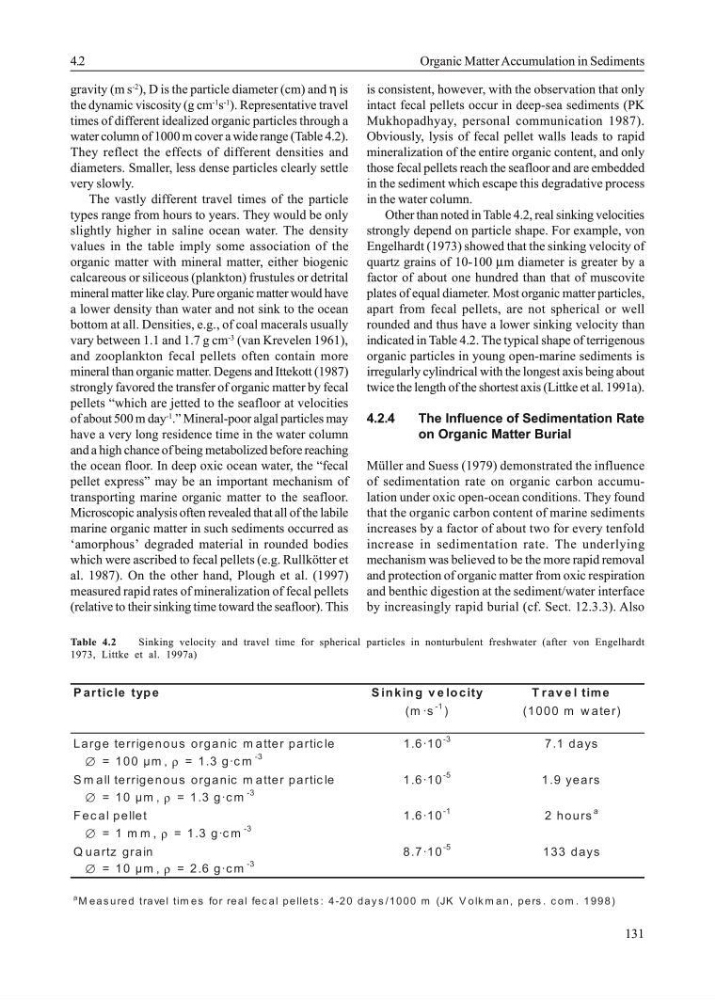
times of different idealized organic particles through a
water column of 1000 m cover a wide range (Table 4.2).
They reflect the effects of different densities and
diameters. Smaller, less dense particles clearly settle
very slowly.
The vastly different travel times of the particle
types range from hours to years. They would be only
slightly higher in saline ocean water. The density
values in the table imply some association of the
organic matter with mineral matter, either biogenic
calcareous or siliceous (plankton) frustules or detrital
mineral matter like clay. Pure organic matter would have
a lower density than water and not sink to the ocean
bottom at all. Densities, e.g., of coal macerals usually
vary between 1.1 and 1.7 g cm
-3
(van Krevelen 1961),
and zooplankton fecal pellets often contain more
mineral than organic matter. Degens and Ittekott (1987)
strongly favored the transfer of organic matter by fecal
pellets “which are jetted to the seafloor at velocities
of about 500 m day
-1
.” Mineral-poor algal particles may
have a very long residence time in the water column
and a high chance of being metabolized before reaching
the ocean floor. In deep oxic ocean water, the “fecal
pellet express” may be an important mechanism of
transporting marine organic matter to the seafloor.
Microscopic analysis often revealed that all of the labile
marine organic matter in such sediments occurred as
‘amorphous’ degraded material in rounded bodies
which were ascribed to fecal pellets (e.g. Rullkötter et
al. 1987). On the other hand, Plough et al. (1997)
measured rapid rates of mineralization of fecal pellets
(relative to their sinking time toward the seafloor). This
is consistent, however, with the observation that only
intact fecal pellets occur in deep-sea sediments (PK
Mukhopadhyay, personal communication 1987).
Obviously, lysis of fecal pellet walls leads to rapid
mineralization of the entire organic content, and only
those fecal pellets reach the seafloor and are embedded
in the sediment which escape this degradative process
in the water column.
Other than noted in Table 4.2, real sinking velocities
strongly depend on particle shape. For example, von
Engelhardt (1973) showed that the sinking velocity of
quartz grains of 10-100 µm diameter is greater by a
factor of about one hundred than that of muscovite
plates of equal diameter. Most organic matter particles,
apart from fecal pellets, are not spherical or well
rounded and thus have a lower sinking velocity than
indicated in Table 4.2. The typical shape of terrigenous
organic particles in young open-marine sediments is
irregularly cylindrical with the longest axis being about
twice the length of the shortest axis (Littke et al. 1991a).
4.2.4
The Influence of Sedimentation Rate
on Organic Matter Burial
Müller and Suess (1979) demonstrated the influence
of sedimentation rate on organic carbon accumulation under oxic open-ocean conditions. They found
that the organic carbon content of marine sediments
increases by a factor of about two for every tenfold
increase in sedimentation rate. The underlying
mechanism was believed to be the more rapid removal
and protection of organic matter from oxic respiration
and benthic digestion at the sediment/water interface
by increasingly rapid burial (cf. Sect. 12.3.3). Also
4.2
Organic Matter Accumulation in Sediments
P ar ticle typ e
S in kin g v e lo city
T r av e l time
(m ·s
-1 )
(1000 m w ater)
Large terrigenous organic m atter partic le
1.6·10
-3
7.1 days
∅ = 100 µm , ρ = 1.3 g·c m
-3
S m all terrigenous organic m atter partic le
1.6·10
-5
1.9 years
∅ = 10 µm , ρ = 1.3 g·c m
-3
F e c a l p e lle t
1 .6 ·1 0
-1
2 hours
a
∅ = 1 m m , ρ = 1.3 g·c m
-3
Q u a rtz gra in
8 .7 ·1 0
-5
133 days
∅ = 10 µm , ρ = 2.6 g·c m
-3
a M ea s u re d tra vel tim e s for re al fec al pe llets : 4 -2 0 da y s /10 00 m (JK V o lk m a n, pe rs . c o m . 1 99 8)
Table 4.2
Sinking velocity and travel time for spherical particles in nonturbulent freshwater (after von Engelhardt
1973, Littke et al. 1997a)
gravity (m s
-2
), D is the particle diameter (cm) and η is
the dynamic viscosity (g cm
-1
s
-1
). Representative travel
times of different idealized organic particles through a
water column of 1000 m cover a wide range (Table 4.2).
They reflect the effects of different densities and
diameters. Smaller, less dense particles clearly settle
very slowly.
The vastly different travel times of the particle
types range from hours to years. They would be only
slightly higher in saline ocean water. The density
values in the table imply some association of the
organic matter with mineral matter, either biogenic
calcareous or siliceous (plankton) frustules or detrital
mineral matter like clay. Pure organic matter would have
a lower density than water and not sink to the ocean
bottom at all. Densities, e.g., of coal macerals usually
vary between 1.1 and 1.7 g cm
-3
(van Krevelen 1961),
and zooplankton fecal pellets often contain more
mineral than organic matter. Degens and Ittekott (1987)
strongly favored the transfer of organic matter by fecal
pellets “which are jetted to the seafloor at velocities
of about 500 m day
-1
.” Mineral-poor algal particles may
have a very long residence time in the water column
and a high chance of being metabolized before reaching
the ocean floor. In deep oxic ocean water, the “fecal
pellet express” may be an important mechanism of
transporting marine organic matter to the seafloor.
Microscopic analysis often revealed that all of the labile
marine organic matter in such sediments occurred as
‘amorphous’ degraded material in rounded bodies
which were ascribed to fecal pellets (e.g. Rullkötter et
al. 1987). On the other hand, Plough et al. (1997)
measured rapid rates of mineralization of fecal pellets
(relative to their sinking time toward the seafloor). This
is consistent, however, with the observation that only
intact fecal pellets occur in deep-sea sediments (PK
Mukhopadhyay, personal communication 1987).
Obviously, lysis of fecal pellet walls leads to rapid
mineralization of the entire organic content, and only
those fecal pellets reach the seafloor and are embedded
in the sediment which escape this degradative process
in the water column.
Other than noted in Table 4.2, real sinking velocities
strongly depend on particle shape. For example, von
Engelhardt (1973) showed that the sinking velocity of
quartz grains of 10-100 µm diameter is greater by a
factor of about one hundred than that of muscovite
plates of equal diameter. Most organic matter particles,
apart from fecal pellets, are not spherical or well
rounded and thus have a lower sinking velocity than
indicated in Table 4.2. The typical shape of terrigenous
organic particles in young open-marine sediments is
irregularly cylindrical with the longest axis being about
twice the length of the shortest axis (Littke et al. 1991a).
4.2.4
The Influence of Sedimentation Rate
on Organic Matter Burial
Müller and Suess (1979) demonstrated the influence
of sedimentation rate on organic carbon accumulation under oxic open-ocean conditions. They found
that the organic carbon content of marine sediments
increases by a factor of about two for every tenfold
increase in sedimentation rate. The underlying
mechanism was believed to be the more rapid removal
and protection of organic matter from oxic respiration
and benthic digestion at the sediment/water interface
by increasingly rapid burial (cf. Sect. 12.3.3). Also
4.2
Organic Matter Accumulation in Sediments
P ar ticle typ e
S in kin g v e lo city
T r av e l time
(m ·s
-1 )
(1000 m w ater)
Large terrigenous organic m atter partic le
1.6·10
-3
7.1 days
∅ = 100 µm , ρ = 1.3 g·c m
-3
S m all terrigenous organic m atter partic le
1.6·10
-5
1.9 years
∅ = 10 µm , ρ = 1.3 g·c m
-3
F e c a l p e lle t
1 .6 ·1 0
-1
2 hours
a
∅ = 1 m m , ρ = 1.3 g·c m
-3
Q u a rtz gra in
8 .7 ·1 0
-5
133 days
∅ = 10 µm , ρ = 2.6 g·c m
-3
a M ea s u re d tra vel tim e s for re al fec al pe llets : 4 -2 0 da y s /10 00 m (JK V o lk m a n, pe rs . c o m . 1 99 8)
Table 4.2
Sinking velocity and travel time for spherical particles in nonturbulent freshwater (after von Engelhardt
1973, Littke et al. 1997a)