

4
Organic Matter: The Driving Force for Early Diagenesis
126
4.2
Organic Matter Accumulation
in Sediments
In the fossil record, dark-colored organic-matterrich layers (black shales, sapropels, petroleum
source rocks in general) witness periods of time
when conditions for organic matter accumulation
in sediments apparently were particularly favorable. As the other extreme, massive sequences of
white- or red-colored sedimentary rocks are
devoid of organic matter. Although these rocks
may contain abundant calcareous or siliceous
plankton fossils, the organic matter of the organisms apparently was destroyed before it could be
buried in the sediments.
Biogenic organic matter is considered labile (or
metastable) under most sedimentary conditions due to
its sensitivity to oxidative degradation, either chemically or biologically mediated. This is particularly true
in well-oxygenated oceanic waters as they presently
occur in the oceans almost worldwide. Thus, abundant
accumulation of organic matter today is the exception
rather than the rule. It is mainly restricted to the
upwelling areas on the western continental margins
and a few rather small oceanic deeps with anoxic
bottom waters (such as the Cariaco Trench off
Venezuela). In the geological past, more sluggish
circulation in the deep ocean or in shallow
epicontinental seas, accompanied by water column
stratification, was probably one of the main causes
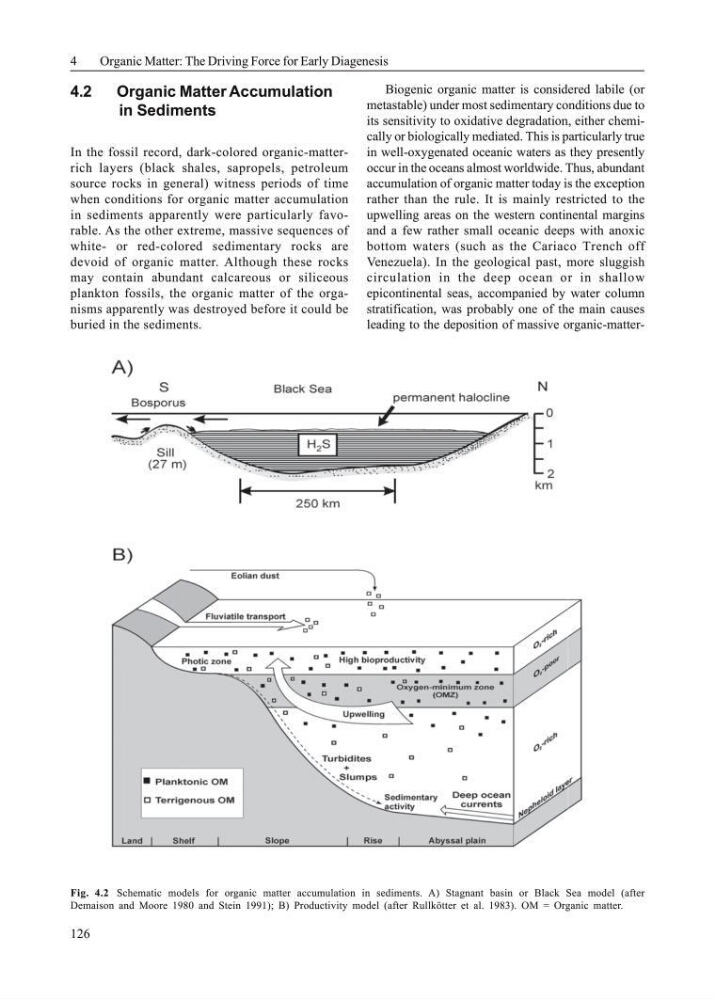
leading to the deposition of massive organic-matterFig. 4.2 Schematic models for organic matter accumulation in sediments. A) Stagnant basin or Black Sea model (after
Demaison and Moore 1980 and Stein 1991); B) Productivity model (after Rullkötter et al. 1983). OM = Organic matter.
Organic Matter: The Driving Force for Early Diagenesis
126
4.2
Organic Matter Accumulation
in Sediments
In the fossil record, dark-colored organic-matterrich layers (black shales, sapropels, petroleum
source rocks in general) witness periods of time
when conditions for organic matter accumulation
in sediments apparently were particularly favorable. As the other extreme, massive sequences of
white- or red-colored sedimentary rocks are
devoid of organic matter. Although these rocks
may contain abundant calcareous or siliceous
plankton fossils, the organic matter of the organisms apparently was destroyed before it could be
buried in the sediments.
Biogenic organic matter is considered labile (or
metastable) under most sedimentary conditions due to
its sensitivity to oxidative degradation, either chemically or biologically mediated. This is particularly true
in well-oxygenated oceanic waters as they presently
occur in the oceans almost worldwide. Thus, abundant
accumulation of organic matter today is the exception
rather than the rule. It is mainly restricted to the
upwelling areas on the western continental margins
and a few rather small oceanic deeps with anoxic
bottom waters (such as the Cariaco Trench off
Venezuela). In the geological past, more sluggish
circulation in the deep ocean or in shallow
epicontinental seas, accompanied by water column
stratification, was probably one of the main causes
leading to the deposition of massive organic-matterFig. 4.2 Schematic models for organic matter accumulation in sediments. A) Stagnant basin or Black Sea model (after
Demaison and Moore 1980 and Stein 1991); B) Productivity model (after Rullkötter et al. 1983). OM = Organic matter.