

125
4
Organic Matter:
The Driving Force for Early Diagenesis
JÜRGEN RULLKÖTTER
4.1
The Organic Carbon Cycle
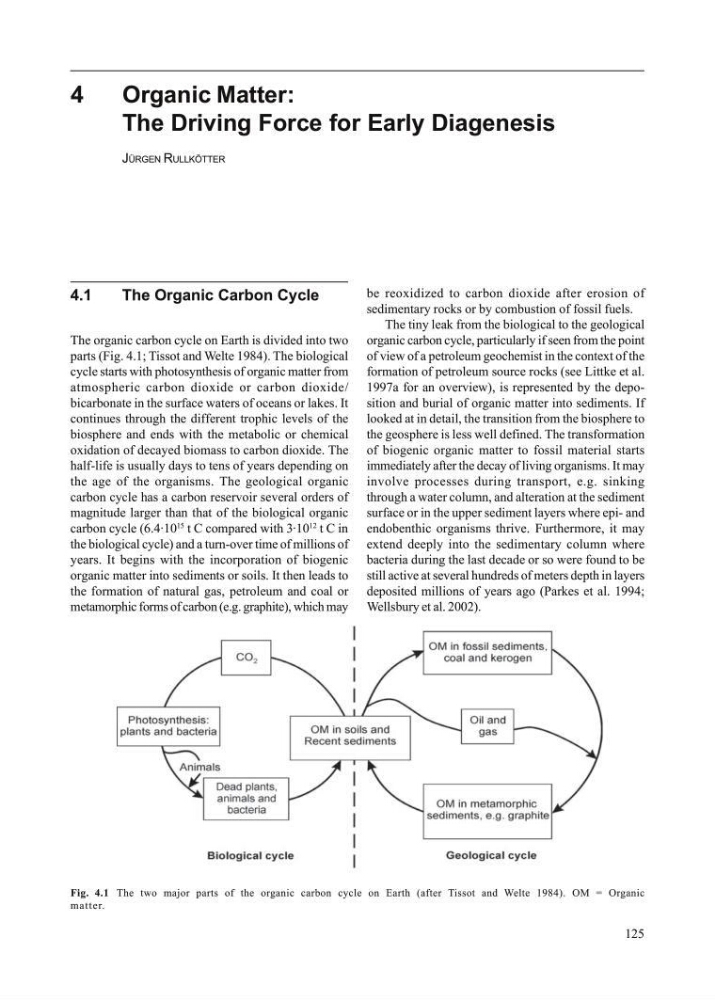
The organic carbon cycle on Earth is divided into two
parts (Fig. 4.1; Tissot and Welte 1984). The biological
cycle starts with photosynthesis of organic matter from
atmospheric carbon dioxide or carbon dioxide/
bicarbonate in the surface waters of oceans or lakes. It
continues through the different trophic levels of the
biosphere and ends with the metabolic or chemical
oxidation of decayed biomass to carbon dioxide. The
half-life is usually days to tens of years depending on
the age of the organisms. The geological organic
carbon cycle has a carbon reservoir several orders of
magnitude larger than that of the biological organic
carbon cycle (6.4·10
15
t C compared with 3·10
12
t C in
the biological cycle) and a turn-over time of millions of
years. It begins with the incorporation of biogenic
organic matter into sediments or soils. It then leads to
the formation of natural gas, petroleum and coal or
metamorphic forms of carbon (e.g. graphite), which may
be reoxidized to carbon dioxide after erosion of
sedimentary rocks or by combustion of fossil fuels.
The tiny leak from the biological to the geological
organic carbon cycle, particularly if seen from the point
of view of a petroleum geochemist in the context of the
formation of petroleum source rocks (see Littke et al.
1997a for an overview), is represented by the deposition and burial of organic matter into sediments. If
looked at in detail, the transition from the biosphere to
the geosphere is less well defined. The transformation
of biogenic organic matter to fossil material starts
immediately after the decay of living organisms. It may
involve processes during transport, e.g. sinking
through a water column, and alteration at the sediment
surface or in the upper sediment layers where epi- and
endobenthic organisms thrive. Furthermore, it may
extend deeply into the sedimentary column where
bacteria during the last decade or so were found to be
still active at several hundreds of meters depth in layers
deposited millions of years ago (Parkes et al. 1994;
Wellsbury et al. 2002).
Fig. 4.1 The two major parts of the organic carbon cycle on Earth (after Tissot and Welte 1984). OM = Organic
matter.
4
Organic Matter:
The Driving Force for Early Diagenesis
JÜRGEN RULLKÖTTER
4.1
The Organic Carbon Cycle
The organic carbon cycle on Earth is divided into two
parts (Fig. 4.1; Tissot and Welte 1984). The biological
cycle starts with photosynthesis of organic matter from
atmospheric carbon dioxide or carbon dioxide/
bicarbonate in the surface waters of oceans or lakes. It
continues through the different trophic levels of the
biosphere and ends with the metabolic or chemical
oxidation of decayed biomass to carbon dioxide. The
half-life is usually days to tens of years depending on
the age of the organisms. The geological organic
carbon cycle has a carbon reservoir several orders of
magnitude larger than that of the biological organic
carbon cycle (6.4·10
15
t C compared with 3·10
12
t C in
the biological cycle) and a turn-over time of millions of
years. It begins with the incorporation of biogenic
organic matter into sediments or soils. It then leads to
the formation of natural gas, petroleum and coal or
metamorphic forms of carbon (e.g. graphite), which may
be reoxidized to carbon dioxide after erosion of
sedimentary rocks or by combustion of fossil fuels.
The tiny leak from the biological to the geological
organic carbon cycle, particularly if seen from the point
of view of a petroleum geochemist in the context of the
formation of petroleum source rocks (see Littke et al.
1997a for an overview), is represented by the deposition and burial of organic matter into sediments. If
looked at in detail, the transition from the biosphere to
the geosphere is less well defined. The transformation
of biogenic organic matter to fossil material starts
immediately after the decay of living organisms. It may
involve processes during transport, e.g. sinking
through a water column, and alteration at the sediment
surface or in the upper sediment layers where epi- and
endobenthic organisms thrive. Furthermore, it may
extend deeply into the sedimentary column where
bacteria during the last decade or so were found to be
still active at several hundreds of meters depth in layers
deposited millions of years ago (Parkes et al. 1994;
Wellsbury et al. 2002).
Fig. 4.1 The two major parts of the organic carbon cycle on Earth (after Tissot and Welte 1984). OM = Organic
matter.