

120
3
Quantification of Early Diagenesis: Dissolved Constituents in Marine Pore Water
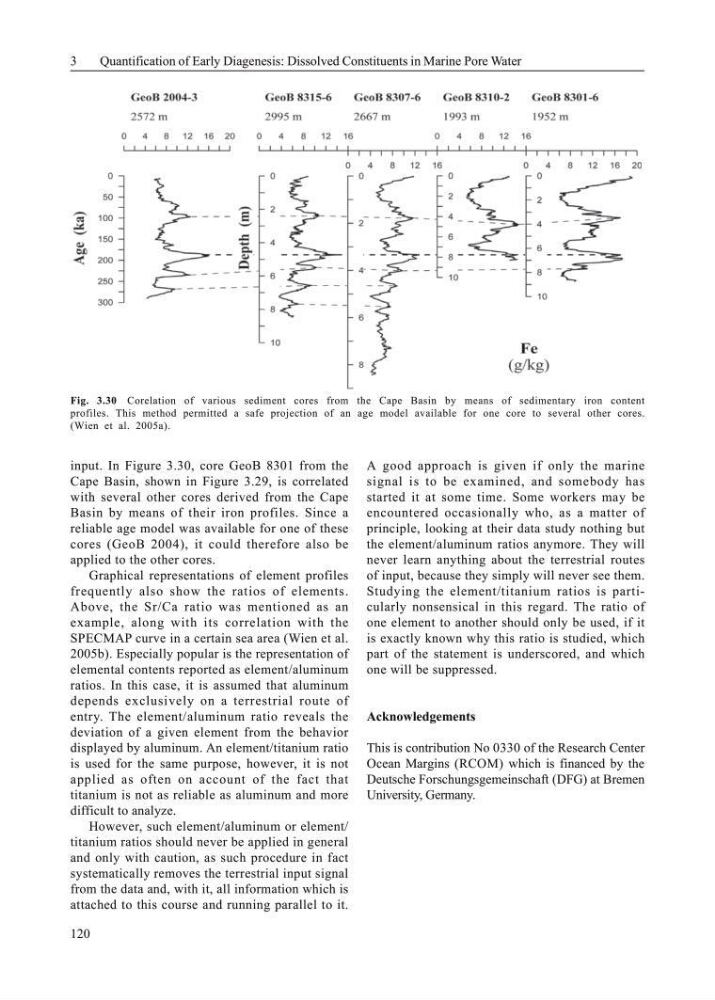
input. In Figure 3.30, core GeoB 8301 from the
Cape Basin, shown in Figure 3.29, is correlated
with several other cores derived from the Cape
Basin by means of their iron profiles. Since a
reliable age model was available for one of these
cores (GeoB 2004), it could therefore also be
applied to the other cores.
Graphical representations of element profiles
frequently also show the ratios of elements.
Above, the Sr/Ca ratio was mentioned as an
example, along with its correlation with the
SPECMAP curve in a certain sea area (Wien et al.
2005b). Especially popular is the representation of
elemental contents reported as element/aluminum
ratios. In this case, it is assumed that aluminum
depends exclusively on a terrestrial route of
entry. The element/aluminum ratio reveals the
deviation of a given element from the behavior
displayed by aluminum. An element/titanium ratio
is used for the same purpose, however, it is not
applied as often on account of the fact that
titanium is not as reliable as aluminum and more
difficult to analyze.
However, such element/aluminum or element/
titanium ratios should never be applied in general
and only with caution, as such procedure in fact
systematically removes the terrestrial input signal
from the data and, with it, all information which is
attached to this course and running parallel to it.
A good approach is given if only the marine
signal is to be examined, and somebody has
started it at some time. Some workers may be
encountered occasionally who, as a matter of
principle, looking at their data study nothing but
the element/aluminum ratios anymore. They will
never learn anything about the terrestrial routes
of input, because they simply will never see them.
Studying the element/titanium ratios is particularly nonsensical in this regard. The ratio of
one element to another should only be used, if it
is exactly known why this ratio is studied, which
part of the statement is underscored, and which
one will be suppressed.
Acknowledgements
This is contribution No 0330 of the Research Center
Ocean Margins (RCOM) which is financed by the
Deutsche Forschungsgemeinschaft (DFG) at Bremen
University, Germany.
Fig. 3.30 Corelation of various sediment cores from the Cape Basin by means of sedimentary iron content
profiles. This method permitted a safe projection of an age model available for one core to several other cores.
(Wien et al. 2005a).
3
Quantification of Early Diagenesis: Dissolved Constituents in Marine Pore Water
input. In Figure 3.30, core GeoB 8301 from the
Cape Basin, shown in Figure 3.29, is correlated
with several other cores derived from the Cape
Basin by means of their iron profiles. Since a
reliable age model was available for one of these
cores (GeoB 2004), it could therefore also be
applied to the other cores.
Graphical representations of element profiles
frequently also show the ratios of elements.
Above, the Sr/Ca ratio was mentioned as an
example, along with its correlation with the
SPECMAP curve in a certain sea area (Wien et al.
2005b). Especially popular is the representation of
elemental contents reported as element/aluminum
ratios. In this case, it is assumed that aluminum
depends exclusively on a terrestrial route of
entry. The element/aluminum ratio reveals the
deviation of a given element from the behavior
displayed by aluminum. An element/titanium ratio
is used for the same purpose, however, it is not
applied as often on account of the fact that
titanium is not as reliable as aluminum and more
difficult to analyze.
However, such element/aluminum or element/
titanium ratios should never be applied in general
and only with caution, as such procedure in fact
systematically removes the terrestrial input signal
from the data and, with it, all information which is
attached to this course and running parallel to it.
A good approach is given if only the marine
signal is to be examined, and somebody has
started it at some time. Some workers may be
encountered occasionally who, as a matter of
principle, looking at their data study nothing but
the element/aluminum ratios anymore. They will
never learn anything about the terrestrial routes
of input, because they simply will never see them.
Studying the element/titanium ratios is particularly nonsensical in this regard. The ratio of
one element to another should only be used, if it
is exactly known why this ratio is studied, which
part of the statement is underscored, and which
one will be suppressed.
Acknowledgements
This is contribution No 0330 of the Research Center
Ocean Margins (RCOM) which is financed by the
Deutsche Forschungsgemeinschaft (DFG) at Bremen
University, Germany.
Fig. 3.30 Corelation of various sediment cores from the Cape Basin by means of sedimentary iron content
profiles. This method permitted a safe projection of an age model available for one core to several other cores.
(Wien et al. 2005a).