

91
small metal box corers are about 10 cm and they
reach to that extent into the sediment. Larger box
corers (‘giant box corer’) possess lateral
dimensions and penetration depths of 50 cm,
respectively.
Apart from the large sample volume that is
collected, the giant box corer has the advantage
that the in situ temperature is kept stable at least
in the central zones of the sample, even if the
sample is raised at the equator, from a depth of
several thousand meters where the sediment is
about 2° C cold. This is about the only advantage
the box corer has with regard to the geochemical
pore water analysis, whereas various disadvantages are to be considered. The shutter on top of
the box corer is often not very tightly sealed, and
thus the entrapped bottom water might become
uncontrollably adulterated upon being raised
upwards through the water column. On hoisting
the loaded, heavy box corer out of the water, and
during its later transportation, onto the deck of a
ship, the sediment surface is mostly destroyed to
an extent that at least the upper 1-2 cm become
worthless for the subsequent pore water analysis.
The Multicorer
The multicorer is also employed from the ship
using steel wire ropes and can also be used for all
depths under water. On applying this tool, up to
12 plastic tubes (mostly acrylic polymers), each
measuring a length of about 60 cm and about 5-10
cm in diameter, are simultaneously inserted approximately 30 cm into the sediment. As with the box
corer, the first pull of the steel rope on lifting the
appliance is used to seal the plastic tubes on both
ends. These shutters are usually tight enough to
ensure that the entrapped water will later represent the genuine bottom water.
Variations to the in situ conditions are caused
in greater depths (about 1000 m and more ) by the
expansion of the pore water, which happens relative to the sediment, when the pressure diminishes. The uppermost millimeters of the profile
are then distorted. Moreover, the temperature rise
gives cause for disturbances upon raising the
samples upwards out of great depths, in the
course of which microbial activity is activated
within the sediment sample, which is distinctly
higher than under in situ conditions.
On the other hand, the multicorer provides, at
present, the best solution for ex situ sampling of
sediments from the sediment/water interface. The
nitrate profile shown in Figure 3.7 was measured
in pore water extracted from a sediment sample
which had been obtained by using the multicorer.
It shows clearly that the concentration profile can
be measured in pore water with an almost undisturbed depth resolution of 0.5 cm per each
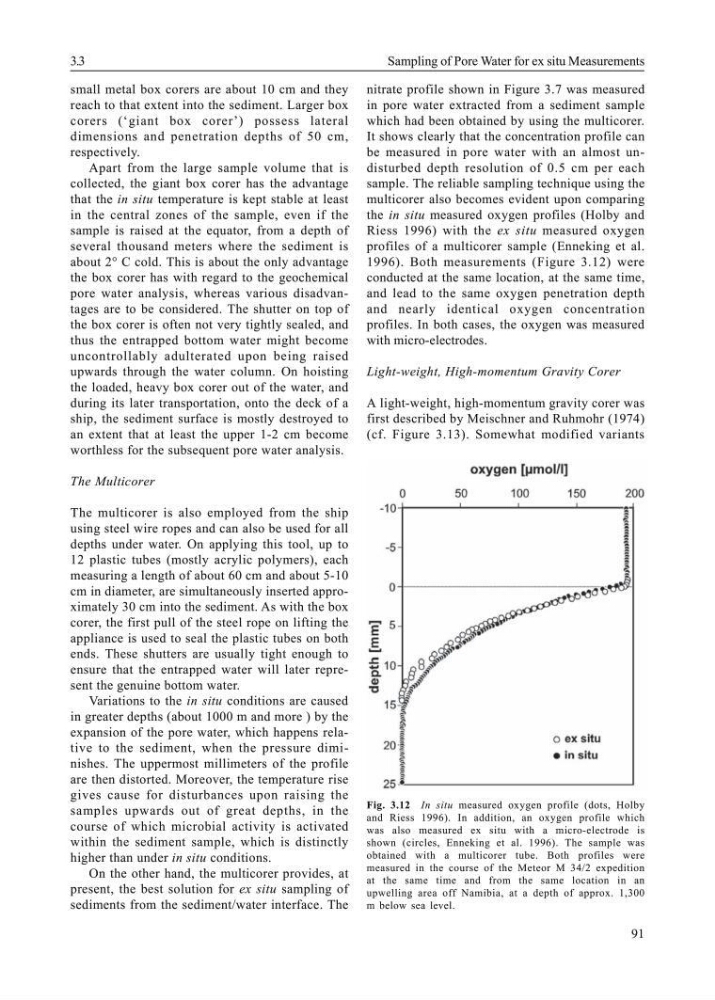
sample. The reliable sampling technique using the
multicorer also becomes evident upon comparing
the in situ measured oxygen profiles (Holby and
Riess 1996) with the ex situ measured oxygen
profiles of a multicorer sample (Enneking et al.
1996). Both measurements (Figure 3.12) were
conducted at the same location, at the same time,
and lead to the same oxygen penetration depth
and nearly identical oxygen concentration
profiles. In both cases, the oxygen was measured
with micro-electrodes.
Light-weight, High-momentum Gravity Corer
A light-weight, high-momentum gravity corer was
first described by Meischner and Ruhmohr (1974)
(cf. Figure 3.13). Somewhat modified variants
3.3
Sampling of Pore Water for ex situ Measurements
Fig. 3.12 In situ measured oxygen profile (dots, Holby
and Riess 1996). In addition, an oxygen profile which
was also measured ex situ with a micro-electrode is
shown (circles, Enneking et al. 1996). The sample was
obtained with a multicorer tube. Both profiles were
measured in the course of the Meteor M 34/2 expedition
at the same time and from the same location in an
upwelling area off Namibia, at a depth of approx. 1,300
m below sea level.
small metal box corers are about 10 cm and they
reach to that extent into the sediment. Larger box
corers (‘giant box corer’) possess lateral
dimensions and penetration depths of 50 cm,
respectively.
Apart from the large sample volume that is
collected, the giant box corer has the advantage
that the in situ temperature is kept stable at least
in the central zones of the sample, even if the
sample is raised at the equator, from a depth of
several thousand meters where the sediment is
about 2° C cold. This is about the only advantage
the box corer has with regard to the geochemical
pore water analysis, whereas various disadvantages are to be considered. The shutter on top of
the box corer is often not very tightly sealed, and
thus the entrapped bottom water might become
uncontrollably adulterated upon being raised
upwards through the water column. On hoisting
the loaded, heavy box corer out of the water, and
during its later transportation, onto the deck of a
ship, the sediment surface is mostly destroyed to
an extent that at least the upper 1-2 cm become
worthless for the subsequent pore water analysis.
The Multicorer
The multicorer is also employed from the ship
using steel wire ropes and can also be used for all
depths under water. On applying this tool, up to
12 plastic tubes (mostly acrylic polymers), each
measuring a length of about 60 cm and about 5-10
cm in diameter, are simultaneously inserted approximately 30 cm into the sediment. As with the box
corer, the first pull of the steel rope on lifting the
appliance is used to seal the plastic tubes on both
ends. These shutters are usually tight enough to
ensure that the entrapped water will later represent the genuine bottom water.
Variations to the in situ conditions are caused
in greater depths (about 1000 m and more ) by the
expansion of the pore water, which happens relative to the sediment, when the pressure diminishes. The uppermost millimeters of the profile
are then distorted. Moreover, the temperature rise
gives cause for disturbances upon raising the
samples upwards out of great depths, in the
course of which microbial activity is activated
within the sediment sample, which is distinctly
higher than under in situ conditions.
On the other hand, the multicorer provides, at
present, the best solution for ex situ sampling of
sediments from the sediment/water interface. The
nitrate profile shown in Figure 3.7 was measured
in pore water extracted from a sediment sample
which had been obtained by using the multicorer.
It shows clearly that the concentration profile can
be measured in pore water with an almost undisturbed depth resolution of 0.5 cm per each
sample. The reliable sampling technique using the
multicorer also becomes evident upon comparing
the in situ measured oxygen profiles (Holby and
Riess 1996) with the ex situ measured oxygen
profiles of a multicorer sample (Enneking et al.
1996). Both measurements (Figure 3.12) were
conducted at the same location, at the same time,
and lead to the same oxygen penetration depth
and nearly identical oxygen concentration
profiles. In both cases, the oxygen was measured
with micro-electrodes.
Light-weight, High-momentum Gravity Corer
A light-weight, high-momentum gravity corer was
first described by Meischner and Ruhmohr (1974)
(cf. Figure 3.13). Somewhat modified variants
3.3
Sampling of Pore Water for ex situ Measurements
Fig. 3.12 In situ measured oxygen profile (dots, Holby
and Riess 1996). In addition, an oxygen profile which
was also measured ex situ with a micro-electrode is
shown (circles, Enneking et al. 1996). The sample was
obtained with a multicorer tube. Both profiles were
measured in the course of the Meteor M 34/2 expedition
at the same time and from the same location in an
upwelling area off Namibia, at a depth of approx. 1,300
m below sea level.