

24
B. Fractionation Mechanisms of Selected Elements
1 a) Metabolic Effects.The exclusive carbon source during photosynthesis seems to be molecular CO2. Experiments carried out by PARK and
EpSTEIN (1960) (see also ABELSON and HOERING, 1961) on the extraction
of CO2 and on the fixation of CO2 by enzymes suggest that the major
fractionation in the photosynthetic fixation of CO2 occurs in two steps.
I. The first step involves the preferential intake of l2C02 from the
atmosphere. The fractionation accompanying the first step can vary over
a wide range.
II. In the second step 12C02 is preferentially fixed into the primary
photosynthetic product (known as "phosphoglyceric acid"), which is ultimately converted to carbohydrate. If all the dissolved CO2 were fixed,
no difference in the l3C/l2C ratio would exist between the CO2 and the
carbohydrate produced. Therefore, it is postulated that a portion of the
unreacted and l3C-enriched, dissolved CO2 has to be eliminated from the
plant. The more efficient the elimination is, the greater the fractionation
in the second step.
i b) Environmental Effects. OEGENS et al. (1968 a, b) concluded from
experiments with marine plankton that the fractionation is principally
controlled by pH, water temperature, concentration of carbonic acid
species, and growth rates of organisms. As a general trend, maximum
fractionation is achieved when pH and water temperature are low, the
dissolved CO2 concentration is high, and the growth rate is moderate.
In this connection it is interesting to note that UPHAUS and KATZ
(1967) have demonstrated that plants grown in 0 20 show a decreased
tendency to fractionate l3C during photosynthesis. The change in fractionation shown by deuterated organisms is most likely a consequence of
widespread changes in the cell. KATZ and CRESPI (1966) have demonstrated that deuterated plants show significant differences in morphology and biochemistry as compared to the same species of normal isotopic composition.
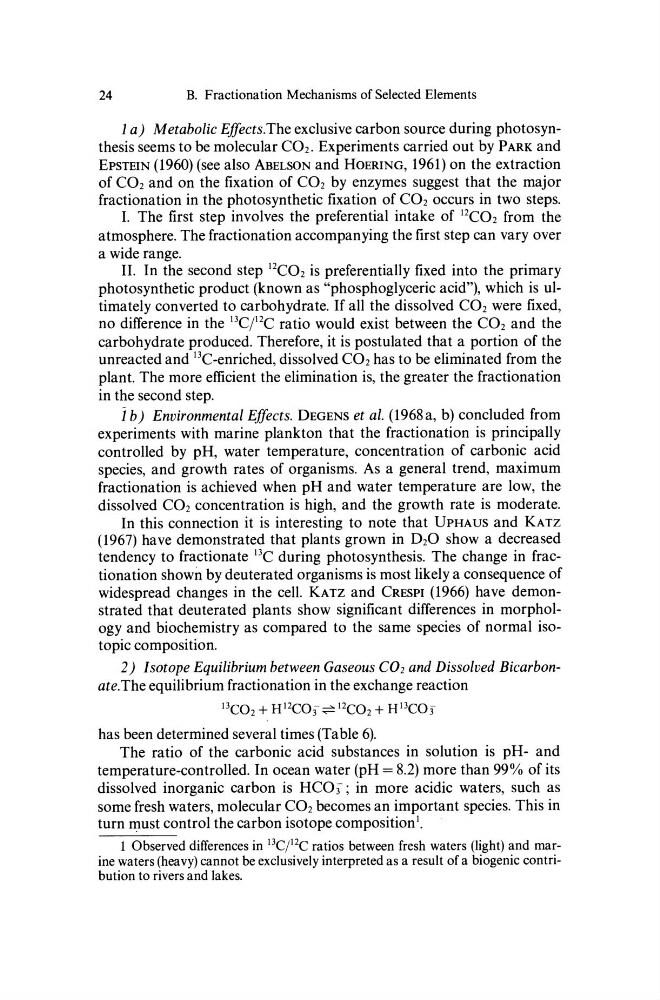
2) Isotope Equilibrium between Gaseous CO2 and Dissolved Bicarbonate.The equilibrium fractionation in the exchange reaction
l3eo2 + Hl2e03~ l2eoz + H l3 e03
has been determined several times (Table 6).
The ratio of the carbonic acid substances in solution is pH- and
temperature-controlled. In ocean water (pH = 8.2) more than 99% of its
dissolved inorganic carbon is HCO:l"; in more acidic waters, such as
some fresh waters, molecular CO2 becomes an important species. This in
turn must control the carbon isotope composition I.
1 Observed differences in I3c; l2 e ratios between fresh waters (light) and marine waters (heavy) cannot be exclusively interpreted as a result of a biogenic contribution to rivers and lakes.
B. Fractionation Mechanisms of Selected Elements
1 a) Metabolic Effects.The exclusive carbon source during photosynthesis seems to be molecular CO2. Experiments carried out by PARK and
EpSTEIN (1960) (see also ABELSON and HOERING, 1961) on the extraction
of CO2 and on the fixation of CO2 by enzymes suggest that the major
fractionation in the photosynthetic fixation of CO2 occurs in two steps.
I. The first step involves the preferential intake of l2C02 from the
atmosphere. The fractionation accompanying the first step can vary over
a wide range.
II. In the second step 12C02 is preferentially fixed into the primary
photosynthetic product (known as "phosphoglyceric acid"), which is ultimately converted to carbohydrate. If all the dissolved CO2 were fixed,
no difference in the l3C/l2C ratio would exist between the CO2 and the
carbohydrate produced. Therefore, it is postulated that a portion of the
unreacted and l3C-enriched, dissolved CO2 has to be eliminated from the
plant. The more efficient the elimination is, the greater the fractionation
in the second step.
i b) Environmental Effects. OEGENS et al. (1968 a, b) concluded from
experiments with marine plankton that the fractionation is principally
controlled by pH, water temperature, concentration of carbonic acid
species, and growth rates of organisms. As a general trend, maximum
fractionation is achieved when pH and water temperature are low, the
dissolved CO2 concentration is high, and the growth rate is moderate.
In this connection it is interesting to note that UPHAUS and KATZ
(1967) have demonstrated that plants grown in 0 20 show a decreased
tendency to fractionate l3C during photosynthesis. The change in fractionation shown by deuterated organisms is most likely a consequence of
widespread changes in the cell. KATZ and CRESPI (1966) have demonstrated that deuterated plants show significant differences in morphology and biochemistry as compared to the same species of normal isotopic composition.
2) Isotope Equilibrium between Gaseous CO2 and Dissolved Bicarbonate.The equilibrium fractionation in the exchange reaction
l3eo2 + Hl2e03~ l2eoz + H l3 e03
has been determined several times (Table 6).
The ratio of the carbonic acid substances in solution is pH- and
temperature-controlled. In ocean water (pH = 8.2) more than 99% of its
dissolved inorganic carbon is HCO:l"; in more acidic waters, such as
some fresh waters, molecular CO2 becomes an important species. This in
turn must control the carbon isotope composition I.
1 Observed differences in I3c; l2 e ratios between fresh waters (light) and marine waters (heavy) cannot be exclusively interpreted as a result of a biogenic contribution to rivers and lakes.