

Fractionation Mechanisms of Carbon Isotopes
23
2. Preparation Technique
The gas used in all I3C/l2c measurements is CO2, for which the
following preparation methods exist:
1) Carbonates react with 100% pure phosphoric acid at room temperature
(25° C, MCCREA, 1950) to liberate C02. Some carbonates, like siderite, react very
slowly with H3P04, and the yields after a 24-hour period are much below the
theoretical maximum. In the case of siderite, WEBER et al. (1964) argued that after
20 min of reaction, the I3C/l2C ratio lies within the experimental error range with
the theoretical value.
2) Organic compounds are generally oxidized in a stream of oxygen at temperatures between 900 and 1000° C. In addition to CO2, CO is liberated and must be
completely oxidized to C02 over a catalyst or through a "sparking technique"
(CRAIG, 1953). Another technique has been used by HOEFS and SCHIDLOWSKI
(1967), who mixed organic compounds, with V20 5 as the oxidizing substance, and
reacted the mixture at 1000° C.
3. Standards
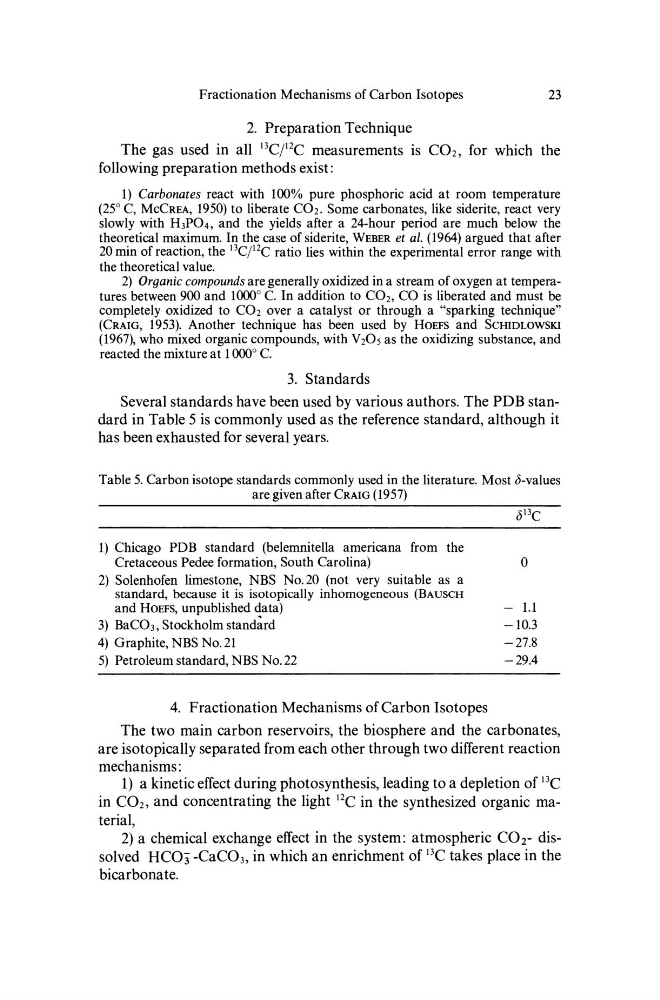
Several standards have been used by various authors. The PDB standard in Table 5 is commonly used as the reference standard, although it
has been exhausted for several years.
Table 5. Carbon isotope standards commonly used in the literature. Most b-values
are given after CRAIG (1957)
1) Chicago PDB standard (belemnitella americana from the
Cretaceous Pedee formation, South Carolina)
2) Solenhofen limestone, NBS No.20 (not very suitable as a
standard, because it is isotopically inhomogeneous (BAUSCH
and HOEFS, unpublished data)
3) BaC03, Stockholm stand~rd
4) Graphite, NBS No.21
5) Petroleum standard, NBS No.22
4. Fractionation Mechanisms of Carbon Isotopes
o
- 1.1
-10.3
-27.8
-29.4
The two main carbon reservoirs, the biosphere and the carbonates,
are isotopically separated from each other through two different reaction
mechanisms:
1) a kinetic effect during photosynthesis, leading to a depletion of I3C
in CO2, and concentrating the light 12C in the synthesized organic material,
2) a chemical exchange effect in the system: atmospheric CO 2- dissolved HC03" -CaC03, in which an enrichment of I3C takes place in the
bicarbonate.
23
2. Preparation Technique
The gas used in all I3C/l2c measurements is CO2, for which the
following preparation methods exist:
1) Carbonates react with 100% pure phosphoric acid at room temperature
(25° C, MCCREA, 1950) to liberate C02. Some carbonates, like siderite, react very
slowly with H3P04, and the yields after a 24-hour period are much below the
theoretical maximum. In the case of siderite, WEBER et al. (1964) argued that after
20 min of reaction, the I3C/l2C ratio lies within the experimental error range with
the theoretical value.
2) Organic compounds are generally oxidized in a stream of oxygen at temperatures between 900 and 1000° C. In addition to CO2, CO is liberated and must be
completely oxidized to C02 over a catalyst or through a "sparking technique"
(CRAIG, 1953). Another technique has been used by HOEFS and SCHIDLOWSKI
(1967), who mixed organic compounds, with V20 5 as the oxidizing substance, and
reacted the mixture at 1000° C.
3. Standards
Several standards have been used by various authors. The PDB standard in Table 5 is commonly used as the reference standard, although it
has been exhausted for several years.
Table 5. Carbon isotope standards commonly used in the literature. Most b-values
are given after CRAIG (1957)
1) Chicago PDB standard (belemnitella americana from the
Cretaceous Pedee formation, South Carolina)
2) Solenhofen limestone, NBS No.20 (not very suitable as a
standard, because it is isotopically inhomogeneous (BAUSCH
and HOEFS, unpublished data)
3) BaC03, Stockholm stand~rd
4) Graphite, NBS No.21
5) Petroleum standard, NBS No.22
4. Fractionation Mechanisms of Carbon Isotopes
o
- 1.1
-10.3
-27.8
-29.4
The two main carbon reservoirs, the biosphere and the carbonates,
are isotopically separated from each other through two different reaction
mechanisms:
1) a kinetic effect during photosynthesis, leading to a depletion of I3C
in CO2, and concentrating the light 12C in the synthesized organic material,
2) a chemical exchange effect in the system: atmospheric CO 2- dissolved HC03" -CaC03, in which an enrichment of I3C takes place in the
bicarbonate.