

98
C. Variations of Stable Isotope Ratios in Nature
NEY and JENSEN, 1965) and carbonate concretions quite often found in
clays and shales (HODGSON, 1966; MURATA et aI., 1967; HOEFS, 1970).
Carbon and oxygen isotope composition of marine and freshwater
limestones have been used as environmental indicators (CLAYTON and
OEGENS, 1959; KEITH and WEBER, 1964).
The environmental interpretation of sedimentary rocks is one of the
principle objectives of sedimentary petrology. In the past such interpretations have been based primarily on certain specific fossils and on
certain trace element contents - criteria that have obvious limitations.
Therefore, it is quite natural to study the application of stable isotope
measurements as possible environmental indicators (i.e., CLAYTON and
OEGENS, 1959; KEITH and WEBER, 1964).
Since fresh water is in general depleted in 18 0 relative to ocean water
and more variable in the 13CrC ratio due to a possible relatively high
contribution of organic derived CO2, it should be possible, in principle,
to differentiate between the marine, brackish, and freshwater environments.
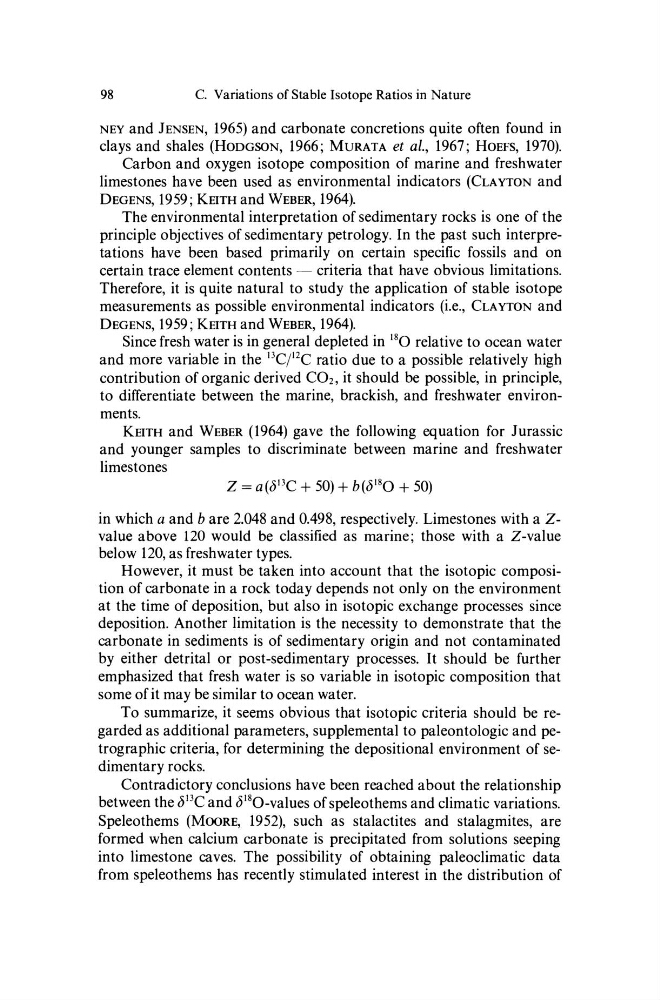
KEITH and WEBER (1964) gave the following equation for Jurassic
and younger samples to discriminate between marine and freshwater
limestones
in which a and bare 2.048 and 0.498, respectively. Limestones with a Zvalue above 120 would be classified as marine; those with a Z-value
below 120, as freshwater types.
However, it must be taken into account that the isotopic composition of carbonate in a rock today depends not only on the environment
at the time of deposition, but also in isotopic exchange processes since
deposition. Another limitation is the necessity to demonstrate that the
carbonate in sediments is of sedimentary origin and not contaminated
by either detrital or post-sedimentary processes. It should be further
emphasized that fresh water is so variable in isotopic composition that
some of it may be similar to ocean water.
To summarize, it seems obvious that isotopic criteria should be regarded as additional parameters, supplemental to paleontologic and petrographic criteria, for determining the depositional environment of sedimentary rocks.
Contradictory conclusions have been reached about the relationship
between the J 13 C and Jl80-values of speleothems and climatic variations.
Speleothems (MOORE, 1952), such as stalactites and stalagmites, are
formed when calcium carbonate is precipitated from solutions seeping
into limestone caves. The possibility of obtaining paleoclimatic data
from speleothems has recently stimulated interest in the distribution of
C. Variations of Stable Isotope Ratios in Nature
NEY and JENSEN, 1965) and carbonate concretions quite often found in
clays and shales (HODGSON, 1966; MURATA et aI., 1967; HOEFS, 1970).
Carbon and oxygen isotope composition of marine and freshwater
limestones have been used as environmental indicators (CLAYTON and
OEGENS, 1959; KEITH and WEBER, 1964).
The environmental interpretation of sedimentary rocks is one of the
principle objectives of sedimentary petrology. In the past such interpretations have been based primarily on certain specific fossils and on
certain trace element contents - criteria that have obvious limitations.
Therefore, it is quite natural to study the application of stable isotope
measurements as possible environmental indicators (i.e., CLAYTON and
OEGENS, 1959; KEITH and WEBER, 1964).
Since fresh water is in general depleted in 18 0 relative to ocean water
and more variable in the 13CrC ratio due to a possible relatively high
contribution of organic derived CO2, it should be possible, in principle,
to differentiate between the marine, brackish, and freshwater environments.
KEITH and WEBER (1964) gave the following equation for Jurassic
and younger samples to discriminate between marine and freshwater
limestones
in which a and bare 2.048 and 0.498, respectively. Limestones with a Zvalue above 120 would be classified as marine; those with a Z-value
below 120, as freshwater types.
However, it must be taken into account that the isotopic composition of carbonate in a rock today depends not only on the environment
at the time of deposition, but also in isotopic exchange processes since
deposition. Another limitation is the necessity to demonstrate that the
carbonate in sediments is of sedimentary origin and not contaminated
by either detrital or post-sedimentary processes. It should be further
emphasized that fresh water is so variable in isotopic composition that
some of it may be similar to ocean water.
To summarize, it seems obvious that isotopic criteria should be regarded as additional parameters, supplemental to paleontologic and petrographic criteria, for determining the depositional environment of sedimentary rocks.
Contradictory conclusions have been reached about the relationship
between the J 13 C and Jl80-values of speleothems and climatic variations.
Speleothems (MOORE, 1952), such as stalactites and stalagmites, are
formed when calcium carbonate is precipitated from solutions seeping
into limestone caves. The possibility of obtaining paleoclimatic data
from speleothems has recently stimulated interest in the distribution of