

CI>
CI
C
o
CI
o
o
CI>
C)
Freshwater Carbonates
b 18 0 (SMOW)
20
22
24
26
28
30
Quaternary
I
I
I
I
I
I
I
I
. . . -----o-----~
-
Tertiary
I
J---"'j-------o----------. .
Cretaceous
I
~--------~-------~
I
• I
I
Jurassic
~ ______ o(» __ L ___ -I
•
I
Triassic
I
•
"",_oO..l-l
Permian
... ------.L-o-!----I---t
Carboniferous
. . . ----!~-----I
-
Devonian
1----.(>---1'
-
Silurian
I
• I
Ordovician
"'-0-.
-
Cambrian
I
•
I
Limestones
_
Marine
Precambrian
... -0-... Freshwater
-
I
X
I
o
1 00
200
3000
i
400
500
600
-10
-8
-6
-4
-2
o
b 18 0,%o(PDS)
97
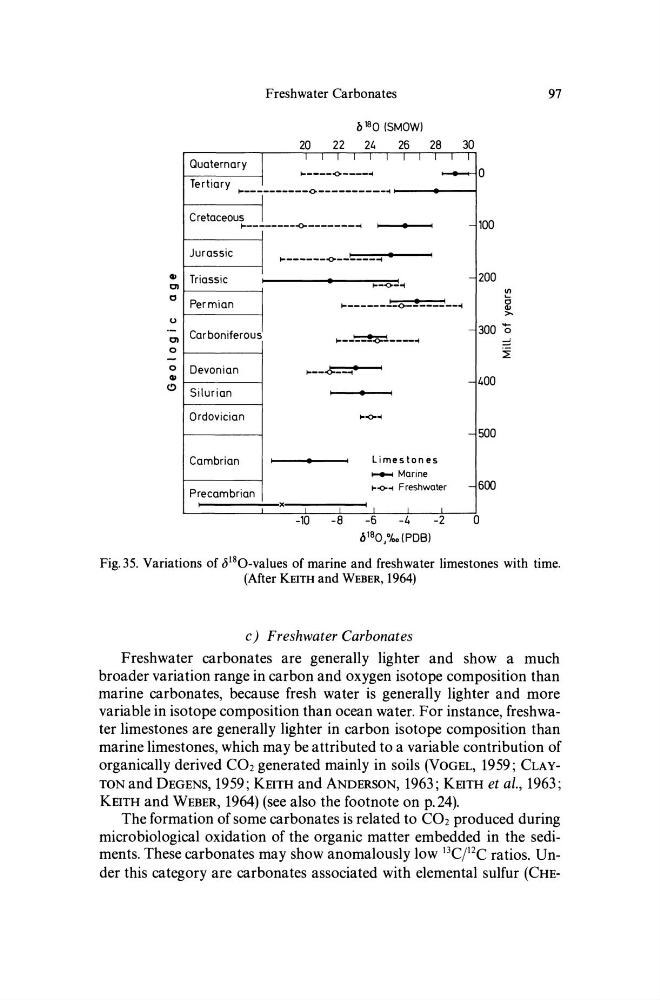
Fig. 35. Variations of b 18 0-values of marine and freshwater limestones with time.
(After KEITH and WEBER, 1964)
c) Freshwater Carbonates
Freshwater carbonates are generally lighter and show a much
broader variation range in carbon and oxygen isotope composition than
marine carbonates, because fresh water is generally lighter and more
variable in isotope composition than ocean water. For instance, freshwater limestones are generally lighter in carbon isotope composition than
marine limestones, which may be attributed to a variable contribution of
organically derived CO2 generated mainly in soils (VOGEL, 1959; CLAYTON and DEGENS, 1959; KEITH and ANDERSON, 1963; KEITH et al., 1963;
KEITH and WEBER, 1964) (see also the footnote on p.24).
The formation of some carbonates is related to CO2 produced during
microbiological oxidation of the organic matter embedded in the sediments. These carbonates may show anomalously low 13Cj12c ratios. Under this category are carbonates associated with elemental sulfur (CHE-
CI
C
o
CI
o
o
CI>
C)
Freshwater Carbonates
b 18 0 (SMOW)
20
22
24
26
28
30
Quaternary
I
I
I
I
I
I
I
I
. . . -----o-----~
-
Tertiary
I
J---"'j-------o----------. .
Cretaceous
I
~--------~-------~
I
• I
I
Jurassic
~ ______ o(» __ L ___ -I
•
I
Triassic
I
•
"",_oO..l-l
Permian
... ------.L-o-!----I---t
Carboniferous
. . . ----!~-----I
-
Devonian
1----.(>---1'
-
Silurian
I
• I
Ordovician
"'-0-.
-
Cambrian
I
•
I
Limestones
_
Marine
Precambrian
... -0-... Freshwater
-
I
X
I
o
1 00
200
3000
i
400
500
600
-10
-8
-6
-4
-2
o
b 18 0,%o(PDS)
97
Fig. 35. Variations of b 18 0-values of marine and freshwater limestones with time.
(After KEITH and WEBER, 1964)
c) Freshwater Carbonates
Freshwater carbonates are generally lighter and show a much
broader variation range in carbon and oxygen isotope composition than
marine carbonates, because fresh water is generally lighter and more
variable in isotope composition than ocean water. For instance, freshwater limestones are generally lighter in carbon isotope composition than
marine limestones, which may be attributed to a variable contribution of
organically derived CO2 generated mainly in soils (VOGEL, 1959; CLAYTON and DEGENS, 1959; KEITH and ANDERSON, 1963; KEITH et al., 1963;
KEITH and WEBER, 1964) (see also the footnote on p.24).
The formation of some carbonates is related to CO2 produced during
microbiological oxidation of the organic matter embedded in the sediments. These carbonates may show anomalously low 13Cj12c ratios. Under this category are carbonates associated with elemental sulfur (CHE-