

Aside from aerosol origin, it is possible to distinguish classification due to
particle sizes. SSA particles exist in two main ranges of sizes, the so called coarse
and accumulation modes (particle diameters >2.5 μm, and from 0.1 to 2.5 μm,
respectively, Seinfeld and Pandis 2012). The lifetime of SSA in troposphere ranges
from 1 day to 1 week. SSA scatters the solar radiation, it has very hygroscopic
properties so that means it is very active cloud condensation nuclei (CCN). As
regards the chemical composition, according to Seinfeld and Pandis (2012) SSA
contains by weight 55.7 % Cl, 0.19 % Br, and 0.00002 % I. The SSA has also
primary organic aerosol (POA) compound which is difficult to parameterize
(O’Dowd et al. 2004; Gantt et al. 2011; Ovadnevaite et al. 2011; Westervelt et al.
2012; Schmitt-Kopplin et al. 2012). The POA separately has quite different properties. It is observed as Aitken (from 0.01 to 0.1 μm) and accumulation mode and it
comes from biologically active marine regions. The POA represents the smallest
aerosol particles so they lifetime is approximately 1 week and they are active CCN.
Another very important aerosol species with the second largest global emission
is mineral dust. The mineral dust aerosol species exist especially in coarse and super
coarse modes. Similarly to SSA mineral dust lives from 1 day to 1 week, depending
on particle size and takes part not only in light scattering but also in absorption. It
can be active ice nuclei (IN) and takes active role in greenhouse effect (Boucher
et al. 2013). Terrestrial primary biological aerosol particles (PBAP) are mainly
coarse particles. It has the same lifetime as SSA and mineral dust and may form
large CCN and be active IN. Precise description of all atmospheric aerosol compound are presented in (Seinfeld and Pandis 2012).
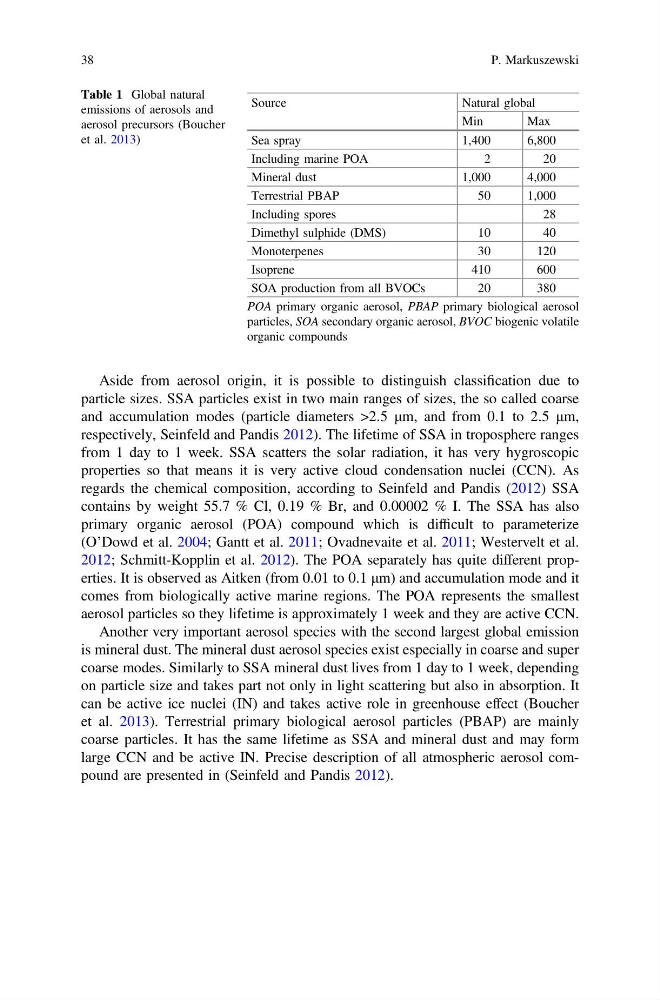
Table 1 Global natural
emissions of aerosols and
aerosol precursors (Boucher
et al. 2013)
Source
Natural global
Min
Max
Sea spray
1,400
6,800
Including marine POA
2
20
Mineral dust
1,000
4,000
Terrestrial PBAP
50
1,000
Including spores
28
Dimethyl sulphide (DMS)
10
40
Monoterpenes
30
120
Isoprene
410
600
SOA production from all BVOCs
20
380
POA primary organic aerosol, PBAP primary biological aerosol
particles, SOA secondary organic aerosol, BVOC biogenic volatile
organic compounds
38
P. Markuszewski
particle sizes. SSA particles exist in two main ranges of sizes, the so called coarse
and accumulation modes (particle diameters >2.5 μm, and from 0.1 to 2.5 μm,
respectively, Seinfeld and Pandis 2012). The lifetime of SSA in troposphere ranges
from 1 day to 1 week. SSA scatters the solar radiation, it has very hygroscopic
properties so that means it is very active cloud condensation nuclei (CCN). As
regards the chemical composition, according to Seinfeld and Pandis (2012) SSA
contains by weight 55.7 % Cl, 0.19 % Br, and 0.00002 % I. The SSA has also
primary organic aerosol (POA) compound which is difficult to parameterize
(O’Dowd et al. 2004; Gantt et al. 2011; Ovadnevaite et al. 2011; Westervelt et al.
2012; Schmitt-Kopplin et al. 2012). The POA separately has quite different properties. It is observed as Aitken (from 0.01 to 0.1 μm) and accumulation mode and it
comes from biologically active marine regions. The POA represents the smallest
aerosol particles so they lifetime is approximately 1 week and they are active CCN.
Another very important aerosol species with the second largest global emission
is mineral dust. The mineral dust aerosol species exist especially in coarse and super
coarse modes. Similarly to SSA mineral dust lives from 1 day to 1 week, depending
on particle size and takes part not only in light scattering but also in absorption. It
can be active ice nuclei (IN) and takes active role in greenhouse effect (Boucher
et al. 2013). Terrestrial primary biological aerosol particles (PBAP) are mainly
coarse particles. It has the same lifetime as SSA and mineral dust and may form
large CCN and be active IN. Precise description of all atmospheric aerosol compound are presented in (Seinfeld and Pandis 2012).
Table 1 Global natural
emissions of aerosols and
aerosol precursors (Boucher
et al. 2013)
Source
Natural global
Min
Max
Sea spray
1,400
6,800
Including marine POA
2
20
Mineral dust
1,000
4,000
Terrestrial PBAP
50
1,000
Including spores
28
Dimethyl sulphide (DMS)
10
40
Monoterpenes
30
120
Isoprene
410
600
SOA production from all BVOCs
20
380
POA primary organic aerosol, PBAP primary biological aerosol
particles, SOA secondary organic aerosol, BVOC biogenic volatile
organic compounds
38
P. Markuszewski