

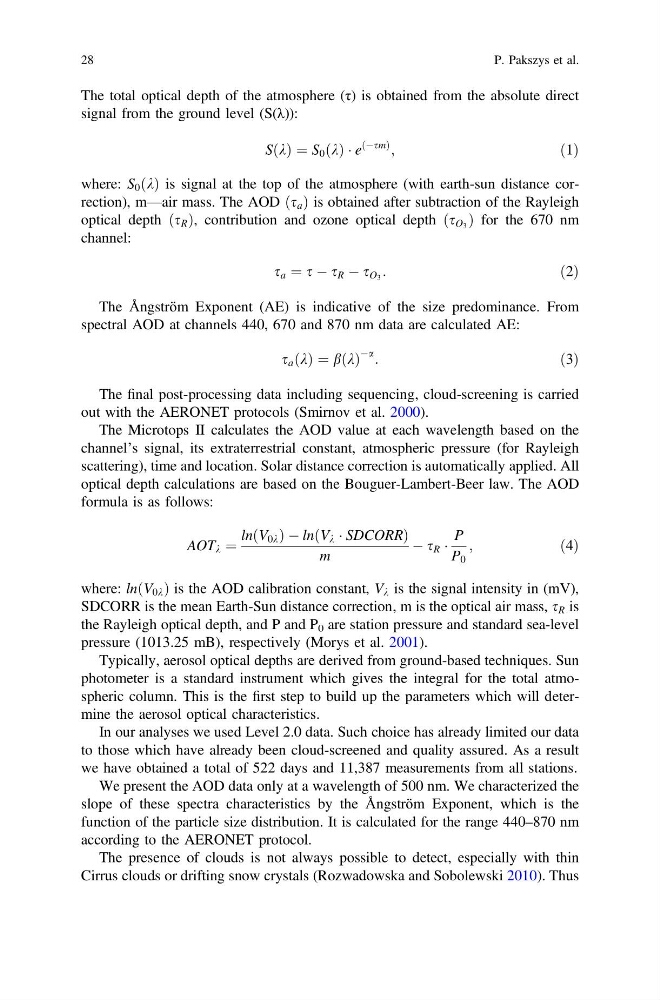
The total optical depth of the atmosphere (τ) is obtained from the absolute direct
signal from the ground level (S(λ)):
S k
ð Þ ¼ S 0 k
ð Þ Á e
Àsm
ð
Þ
;
ð1Þ
where: S 0 k
ð Þ is signal at the top of the atmosphere (with earth-sun distance correction), m—air mass. The AOD ðs a Þ is obtained after subtraction of the Rayleigh
optical depth ðs R Þ, contribution and ozone optical depth ðs O 3 Þ for the 670 nm
channel:
s a ¼ s À s R À s O 3 :
ð2Þ
The Ångström Exponent (AE) is indicative of the size predominance. From
spectral AOD at channels 440, 670 and 870 nm data are calculated AE:
s a k
ð Þ ¼ b k
ð Þ
Àa :
ð3Þ
The final post-processing data including sequencing, cloud-screening is carried
out with the AERONET protocols (Smirnov et al. 2000).
The Microtops II calculates the AOD value at each wavelength based on the
channel’s signal, its extraterrestrial constant, atmospheric pressure (for Rayleigh
scattering), time and location. Solar distance correction is automatically applied. All
optical depth calculations are based on the Bouguer-Lambert-Beer law. The AOD
formula is as follows:
AOT k ¼
ln V 0k
ð ÞÀln V k Á SDCORR
ð
Þ
m
À s R Á
P
P 0
;
ð4Þ
where: ln V 0k
ð Þ is the AOD calibration constant, V k is the signal intensity in (mV),
SDCORR is the mean Earth-Sun distance correction, m is the optical air mass, s R is
the Rayleigh optical depth, and P and P 0 are station pressure and standard sea-level
pressure (1013.25 mB), respectively (Morys et al. 2001).
Typically, aerosol optical depths are derived from ground-based techniques. Sun
photometer is a standard instrument which gives the integral for the total atmospheric column. This is the first step to build up the parameters which will determine the aerosol optical characteristics.
In our analyses we used Level 2.0 data. Such choice has already limited our data
to those which have already been cloud-screened and quality assured. As a result
we have obtained a total of 522 days and 11,387 measurements from all stations.
We present the AOD data only at a wavelength of 500 nm. We characterized the
slope of these spectra characteristics by the Ångström Exponent, which is the
function of the particle size distribution. It is calculated for the range 440–870 nm
according to the AERONET protocol.
The presence of clouds is not always possible to detect, especially with thin
Cirrus clouds or drifting snow crystals (Rozwadowska and Sobolewski 2010). Thus
28
P. Pakszys et al.
signal from the ground level (S(λ)):
S k
ð Þ ¼ S 0 k
ð Þ Á e
Àsm
ð
Þ
;
ð1Þ
where: S 0 k
ð Þ is signal at the top of the atmosphere (with earth-sun distance correction), m—air mass. The AOD ðs a Þ is obtained after subtraction of the Rayleigh
optical depth ðs R Þ, contribution and ozone optical depth ðs O 3 Þ for the 670 nm
channel:
s a ¼ s À s R À s O 3 :
ð2Þ
The Ångström Exponent (AE) is indicative of the size predominance. From
spectral AOD at channels 440, 670 and 870 nm data are calculated AE:
s a k
ð Þ ¼ b k
ð Þ
Àa :
ð3Þ
The final post-processing data including sequencing, cloud-screening is carried
out with the AERONET protocols (Smirnov et al. 2000).
The Microtops II calculates the AOD value at each wavelength based on the
channel’s signal, its extraterrestrial constant, atmospheric pressure (for Rayleigh
scattering), time and location. Solar distance correction is automatically applied. All
optical depth calculations are based on the Bouguer-Lambert-Beer law. The AOD
formula is as follows:
AOT k ¼
ln V 0k
ð ÞÀln V k Á SDCORR
ð
Þ
m
À s R Á
P
P 0
;
ð4Þ
where: ln V 0k
ð Þ is the AOD calibration constant, V k is the signal intensity in (mV),
SDCORR is the mean Earth-Sun distance correction, m is the optical air mass, s R is
the Rayleigh optical depth, and P and P 0 are station pressure and standard sea-level
pressure (1013.25 mB), respectively (Morys et al. 2001).
Typically, aerosol optical depths are derived from ground-based techniques. Sun
photometer is a standard instrument which gives the integral for the total atmospheric column. This is the first step to build up the parameters which will determine the aerosol optical characteristics.
In our analyses we used Level 2.0 data. Such choice has already limited our data
to those which have already been cloud-screened and quality assured. As a result
we have obtained a total of 522 days and 11,387 measurements from all stations.
We present the AOD data only at a wavelength of 500 nm. We characterized the
slope of these spectra characteristics by the Ångström Exponent, which is the
function of the particle size distribution. It is calculated for the range 440–870 nm
according to the AERONET protocol.
The presence of clouds is not always possible to detect, especially with thin
Cirrus clouds or drifting snow crystals (Rozwadowska and Sobolewski 2010). Thus
28
P. Pakszys et al.