

The experiment lasted between 17 and 27 July 2012. The research team measured the aerosol optical depth (AOD) using a Microtops II sun photometer each
measurement day started early in the morning and lasted till late afternoon weather
permitted (no clouds or rain). Additionally, information on meteorological data
(temperature, pressure, relative humidity) were collected from the appropriate
weather services (e.g. www.rp5.kz) and the air mass back trajectories have been
calculated using HYSPLIT (Draxler and Rolph 2014). Information on the AOD and
types of aerosol particles were taken from the AERONET Birkenes station in
southern Norway. Finally, the MODIS images were used to verify the AOD for the
studied area.
The Microtops II sun photometer (produced by Solar Light Company USA) is a
hand-held device capable of measuring aerosol optical depth of atmospheric
aerosols, direct irradiance in each band and the water vapor column. The device is
equipped with five channels and each of channels has different wavelength value
(380, 440, 500, 675, 870 nm). The measurement procedure results in quick, lasting
only 10 s, scanning of vertical column of atmosphere. Microtops II measurements
were made in a series of five “shots”. The scans are completed one after another and
group into series for two minute time intervals. Only the lowest value is used since
such value guarantees the least disturbed measurement of all 5. The full information
on the Microtops II sun photometer and the Langley calibration technique used by
the authors have been described in Morys et al. (2001), Zielinski et al. (2012),
Strzalkowska et al. (2014).
The aerosol optical depth, a dimensionless, wavelength dependent parameter
which refers to the weakening of direct sunlight passing through the atmosphere is a
function of concentration of particles, their size distribution and chemical composition. The AOD value changes with the height above the sea level and similarly the
Ängström parameter have been described in details before by e.g. Smirnov et al.
(2009), Zielinski and Zielinski (2002), Zawadzka et al. (2014), Strzalkowska et al.
(2014). The wavelength dependence of aerosol optical depth can be expressed using
an empirical formula described by Ängström as follows (Weller and Leiterer 1988;
Smirnov et al. 1994; Eck et al. 1999; Carlund et al. 2005):
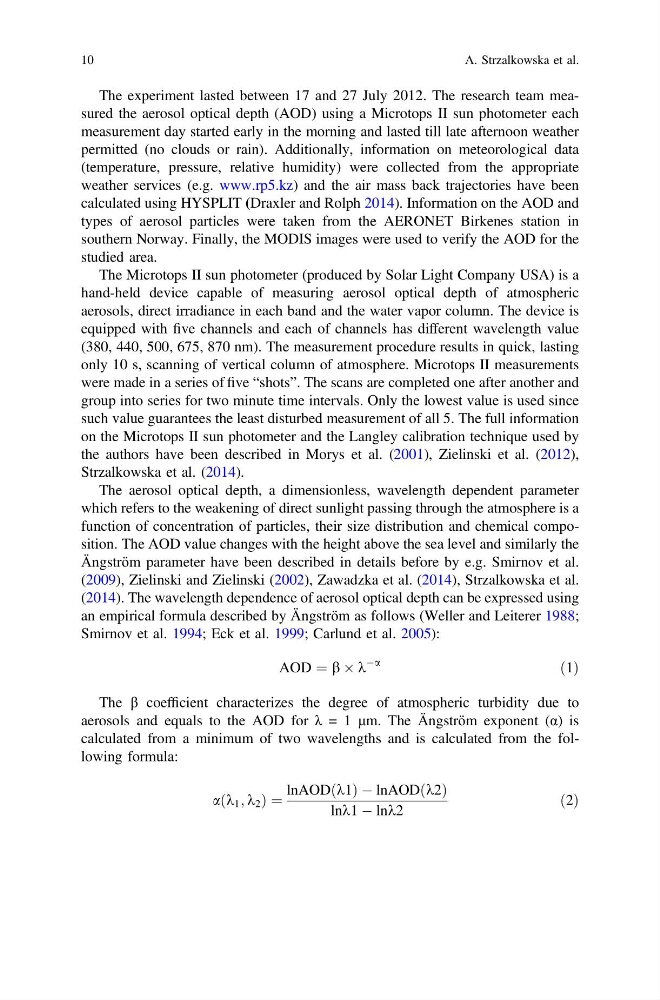
AOD ¼ b  k
Àa
ð1Þ
The β coefficient characterizes the degree of atmospheric turbidity due to
aerosols and equals to the AOD for λ = 1 μm. The Ängström exponent (α) is
calculated from a minimum of two wavelengths and is calculated from the following formula:
aðk 1 ; k 2 Þ ¼
lnAOD k1
ð Þ À lnAODðk2Þ
lnk1 À lnk2
ð2Þ
10
A. Strzalkowska et al.
measurement day started early in the morning and lasted till late afternoon weather
permitted (no clouds or rain). Additionally, information on meteorological data
(temperature, pressure, relative humidity) were collected from the appropriate
weather services (e.g. www.rp5.kz) and the air mass back trajectories have been
calculated using HYSPLIT (Draxler and Rolph 2014). Information on the AOD and
types of aerosol particles were taken from the AERONET Birkenes station in
southern Norway. Finally, the MODIS images were used to verify the AOD for the
studied area.
The Microtops II sun photometer (produced by Solar Light Company USA) is a
hand-held device capable of measuring aerosol optical depth of atmospheric
aerosols, direct irradiance in each band and the water vapor column. The device is
equipped with five channels and each of channels has different wavelength value
(380, 440, 500, 675, 870 nm). The measurement procedure results in quick, lasting
only 10 s, scanning of vertical column of atmosphere. Microtops II measurements
were made in a series of five “shots”. The scans are completed one after another and
group into series for two minute time intervals. Only the lowest value is used since
such value guarantees the least disturbed measurement of all 5. The full information
on the Microtops II sun photometer and the Langley calibration technique used by
the authors have been described in Morys et al. (2001), Zielinski et al. (2012),
Strzalkowska et al. (2014).
The aerosol optical depth, a dimensionless, wavelength dependent parameter
which refers to the weakening of direct sunlight passing through the atmosphere is a
function of concentration of particles, their size distribution and chemical composition. The AOD value changes with the height above the sea level and similarly the
Ängström parameter have been described in details before by e.g. Smirnov et al.
(2009), Zielinski and Zielinski (2002), Zawadzka et al. (2014), Strzalkowska et al.
(2014). The wavelength dependence of aerosol optical depth can be expressed using
an empirical formula described by Ängström as follows (Weller and Leiterer 1988;
Smirnov et al. 1994; Eck et al. 1999; Carlund et al. 2005):
AOD ¼ b  k
Àa
ð1Þ
The β coefficient characterizes the degree of atmospheric turbidity due to
aerosols and equals to the AOD for λ = 1 μm. The Ängström exponent (α) is
calculated from a minimum of two wavelengths and is calculated from the following formula:
aðk 1 ; k 2 Þ ¼
lnAOD k1
ð Þ À lnAODðk2Þ
lnk1 À lnk2
ð2Þ
10
A. Strzalkowska et al.