

In this paper we discuss the results of the studies of aerosol optical properties
under the conditions of breaking waves in the coastal area of the Polish coast on
Baltic Sea. We show that the sea salt production in the coastal area significantly
changes the optical properties of aerosols, hence influencing the radiative budget on
a local scale.
2 Methodology
The studies took place at the Coastal Research Station (CRS) in Lubiatowo on the
Polish Baltic coast (54°48′42.0″N, 017°50′25.6″E), which is located about 70 km
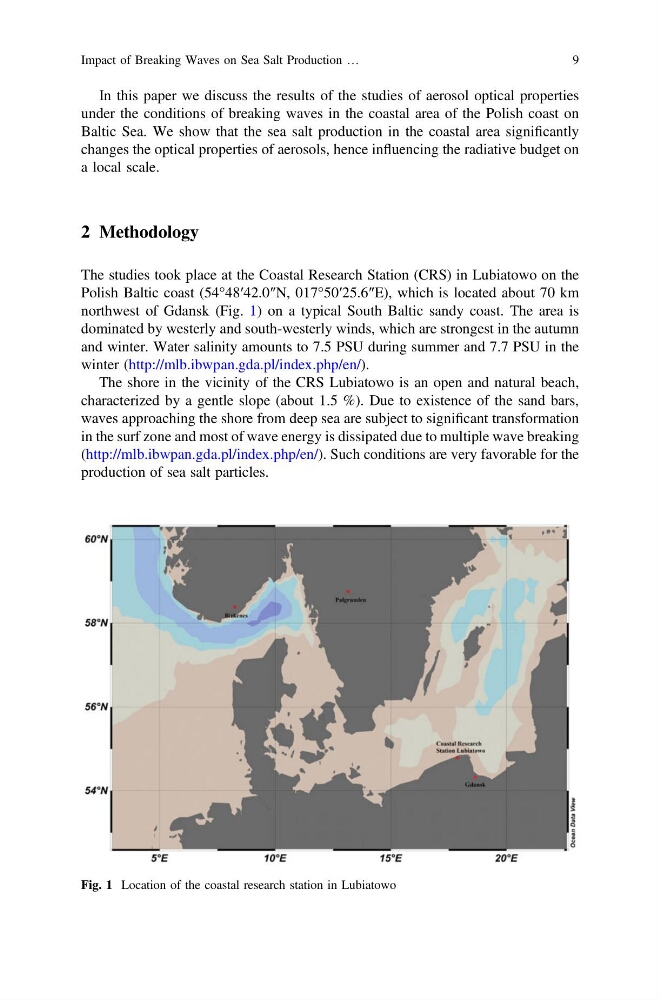
northwest of Gdansk (Fig. 1) on a typical South Baltic sandy coast. The area is
dominated by westerly and south-westerly winds, which are strongest in the autumn
and winter. Water salinity amounts to 7.5 PSU during summer and 7.7 PSU in the
winter (http://mlb.ibwpan.gda.pl/index.php/en/).
The shore in the vicinity of the CRS Lubiatowo is an open and natural beach,
characterized by a gentle slope (about 1.5 %). Due to existence of the sand bars,
waves approaching the shore from deep sea are subject to significant transformation
in the surf zone and most of wave energy is dissipated due to multiple wave breaking
(http://mlb.ibwpan.gda.pl/index.php/en/). Such conditions are very favorable for the
production of sea salt particles.
Fig. 1 Location of the coastal research station in Lubiatowo
Impact of Breaking Waves on Sea Salt Production …
9
under the conditions of breaking waves in the coastal area of the Polish coast on
Baltic Sea. We show that the sea salt production in the coastal area significantly
changes the optical properties of aerosols, hence influencing the radiative budget on
a local scale.
2 Methodology
The studies took place at the Coastal Research Station (CRS) in Lubiatowo on the
Polish Baltic coast (54°48′42.0″N, 017°50′25.6″E), which is located about 70 km
northwest of Gdansk (Fig. 1) on a typical South Baltic sandy coast. The area is
dominated by westerly and south-westerly winds, which are strongest in the autumn
and winter. Water salinity amounts to 7.5 PSU during summer and 7.7 PSU in the
winter (http://mlb.ibwpan.gda.pl/index.php/en/).
The shore in the vicinity of the CRS Lubiatowo is an open and natural beach,
characterized by a gentle slope (about 1.5 %). Due to existence of the sand bars,
waves approaching the shore from deep sea are subject to significant transformation
in the surf zone and most of wave energy is dissipated due to multiple wave breaking
(http://mlb.ibwpan.gda.pl/index.php/en/). Such conditions are very favorable for the
production of sea salt particles.
Fig. 1 Location of the coastal research station in Lubiatowo
Impact of Breaking Waves on Sea Salt Production …
9