

Typically, crossing from a brackish to freshwater regime is characterised by the
disappearance of Foraminifera other than organic-walled Allogromiidae (Sen Gupta
2003) or/and other agglutinated forms. Most allogromids are widespread in marine
environments, but some genera have been described from freshwater or even terrestrial habitats (Meisterfeld et al. 2001; Lejzerowicz et al. 2010). The allogromid
test is usually membranous or proteinaceous, which in some cases, may be covered
with agglutinated foreign particles (Loeblich and Tapan 1987; Holzmann and
Pawlowski 2002). In ostracods the main difference between non-marine and marine
carapace is the proportion of calcium carbonate and organic components. In
freshwater species the content of CaCO 3 is significantly lower and valves consist of
mainly chitinous fibres (Keyser and Walter 2004).
Agglutinated Foraminifera are defined according to the specific structure of their
test. The cement that binds the wall of the test together may be organic (e.g. Astrorhizida), calcareous (e.g. Textulariida) or of a mixed nature (e.g. Lituolida) containing
organically-cemented, calcareous and microgranular types (Kaminski 2004).
Agglutinated species build their test using ambient components. Many species do not
select or only weakly select the grains that are incorporated into their test (Thomsen
and Rasmusen 2008), but some may be strongly selective (Murray 1963). Grains used
by Foraminifera are composed mainly of feldspar (70 % plagioclase and 30 % alkali
orthoclase). Other grains comprise pure silica and Ca, Fe, Mg-silicates (du Châtelet
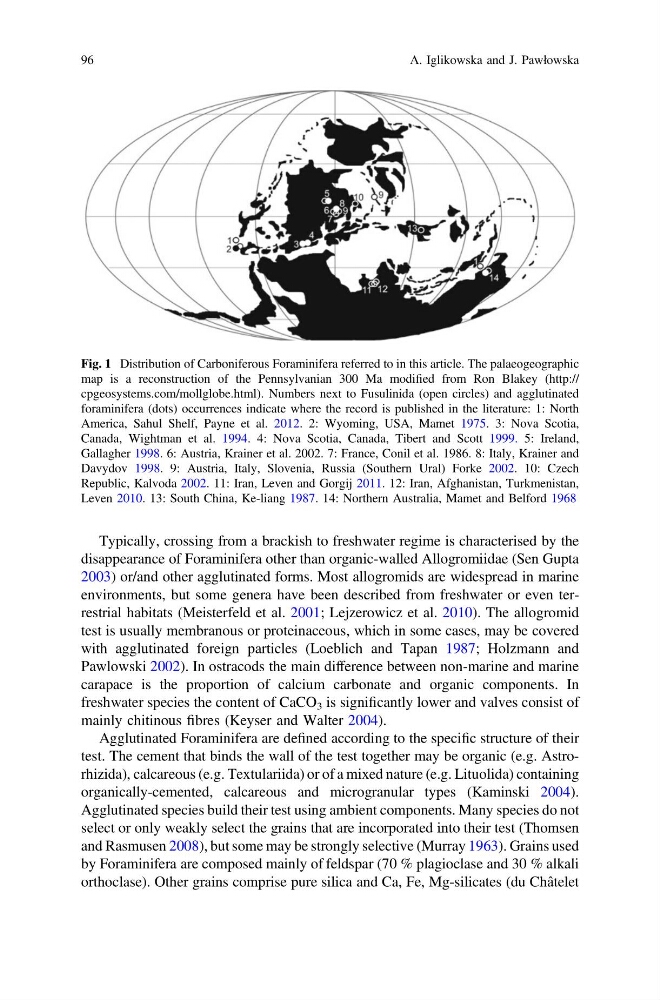
Fig. 1 Distribution of Carboniferous Foraminifera referred to in this article. The palaeogeographic
map is a reconstruction of the Pennsylvanian 300 Ma modified from Ron Blakey (http://
cpgeosystems.com/mollglobe.html). Numbers next to Fusulinida (open circles) and agglutinated
foraminifera (dots) occurrences indicate where the record is published in the literature: 1: North
America, Sahul Shelf, Payne et al. 2012. 2: Wyoming, USA, Mamet 1975. 3: Nova Scotia,
Canada, Wightman et al. 1994. 4: Nova Scotia, Canada, Tibert and Scott 1999. 5: Ireland,
Gallagher 1998. 6: Austria, Krainer et al. 2002. 7: France, Conil et al. 1986. 8: Italy, Krainer and
Davydov 1998. 9: Austria, Italy, Slovenia, Russia (Southern Ural) Forke 2002. 10: Czech
Republic, Kalvoda 2002. 11: Iran, Leven and Gorgij 2011. 12: Iran, Afghanistan, Turkmenistan,
Leven 2010. 13: South China, Ke-liang 1987. 14: Northern Australia, Mamet and Belford 1968
96
A. Iglikowska and J. Pawłowska
disappearance of Foraminifera other than organic-walled Allogromiidae (Sen Gupta
2003) or/and other agglutinated forms. Most allogromids are widespread in marine
environments, but some genera have been described from freshwater or even terrestrial habitats (Meisterfeld et al. 2001; Lejzerowicz et al. 2010). The allogromid
test is usually membranous or proteinaceous, which in some cases, may be covered
with agglutinated foreign particles (Loeblich and Tapan 1987; Holzmann and
Pawlowski 2002). In ostracods the main difference between non-marine and marine
carapace is the proportion of calcium carbonate and organic components. In
freshwater species the content of CaCO 3 is significantly lower and valves consist of
mainly chitinous fibres (Keyser and Walter 2004).
Agglutinated Foraminifera are defined according to the specific structure of their
test. The cement that binds the wall of the test together may be organic (e.g. Astrorhizida), calcareous (e.g. Textulariida) or of a mixed nature (e.g. Lituolida) containing
organically-cemented, calcareous and microgranular types (Kaminski 2004).
Agglutinated species build their test using ambient components. Many species do not
select or only weakly select the grains that are incorporated into their test (Thomsen
and Rasmusen 2008), but some may be strongly selective (Murray 1963). Grains used
by Foraminifera are composed mainly of feldspar (70 % plagioclase and 30 % alkali
orthoclase). Other grains comprise pure silica and Ca, Fe, Mg-silicates (du Châtelet
Fig. 1 Distribution of Carboniferous Foraminifera referred to in this article. The palaeogeographic
map is a reconstruction of the Pennsylvanian 300 Ma modified from Ron Blakey (http://
cpgeosystems.com/mollglobe.html). Numbers next to Fusulinida (open circles) and agglutinated
foraminifera (dots) occurrences indicate where the record is published in the literature: 1: North
America, Sahul Shelf, Payne et al. 2012. 2: Wyoming, USA, Mamet 1975. 3: Nova Scotia,
Canada, Wightman et al. 1994. 4: Nova Scotia, Canada, Tibert and Scott 1999. 5: Ireland,
Gallagher 1998. 6: Austria, Krainer et al. 2002. 7: France, Conil et al. 1986. 8: Italy, Krainer and
Davydov 1998. 9: Austria, Italy, Slovenia, Russia (Southern Ural) Forke 2002. 10: Czech
Republic, Kalvoda 2002. 11: Iran, Leven and Gorgij 2011. 12: Iran, Afghanistan, Turkmenistan,
Leven 2010. 13: South China, Ke-liang 1987. 14: Northern Australia, Mamet and Belford 1968
96
A. Iglikowska and J. Pawłowska