

288
Chapter 15: Multivariate Statistical Modeling:
15.3.3 Cross-Spectrum Matrix in POP-Basis:
Its Diagonal Components
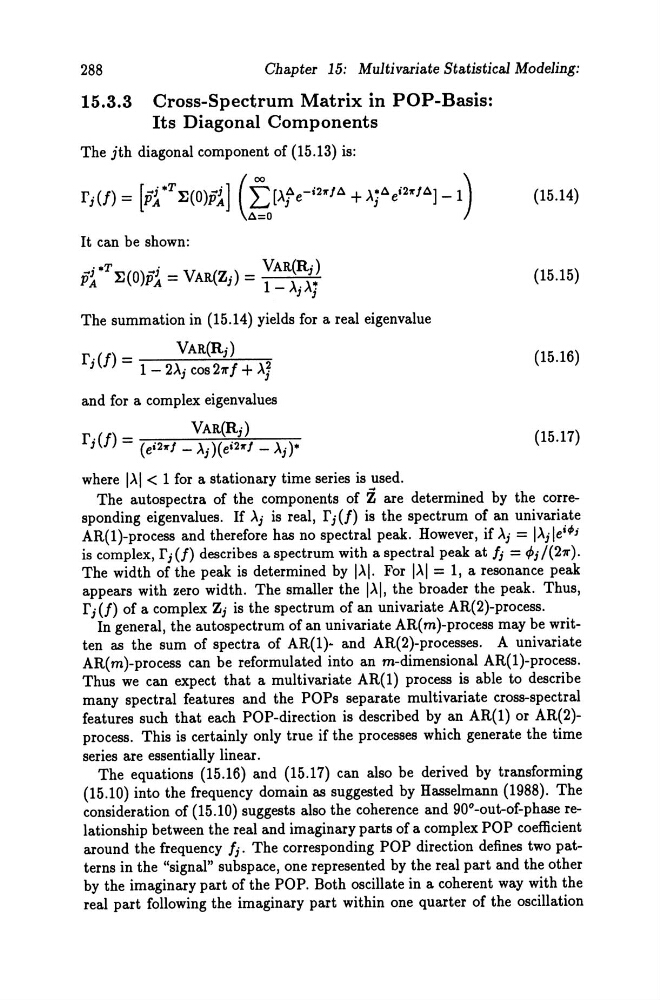
The jth diagonal component of (15.13) is:
rj(f) = [p'f
T
E(O)p'i 1 (t, [.lf·-"<'" + .li " ."<' "1- 1)
It can be shown:
~j.T E(O)~j = VAR(Z.) = VAR(Rj)
PA
PA
)
1 - Aj Aj
The summation in (15.14) yields for areal eigenvalue
r.(I) _
VAR(Rj)
J
- 1- 2Aj cos27r/ + AI
and for a complex eigenvalues
r.(I) _
VAR(Rj)
)
- (ei211' J - Aj)(ei211' J - Aj)·
where lAI< 1 for a stationary time series is used.
(15.14)
(15.15)
(15.16)
(15.17)
The autospectra of the components of Z are determined by the corresponding eigenvalues. If Aj is real, rj(l) is the spectrum of an univariate
AR(l)-process and therefore has no spectral peak. However, if Aj = IAjle i "';
is complex, rj (I) describes a spectrum with a spectral peak at /j = q,j j(27r).
The width of the peak is determined by lAI. For lAI = 1, a resonance peak
appears with zero width. The sm aller the lAI, the broader the peak. Thus,
r j (I) of a complex Zj is the spectrum of an univariate AR(2)-process.
In general, the autospectrum of an univariate AR(m)-process may be written as the sum of spectra of AR(l)- and AR(2)-processes. A univariate
AR(m)-process can be reformulated into an m-dimensional AR(l)-process.
Thus we can expect that a multivariate AR(l) process is able to describe
many spectral features and the POPs separate multivariate cross-spectral
features such that each POP-direction is described by an AR(l) or AR(2)process. This is certainly only true if the processes which generate the time
series are essentially linear.
The equations (15.16) and (15.17) can also be derived by transforming
(15.10) into the frequency domain as suggested by Hasselmann (1988). The
consideration of (15.10) suggests also the coherence and 90 o -out-of-phase relationship between the real and imaginary parts of a complex POP coefficient
around the frequency /j. The corresponding POP direction defines two patterns in the "signal" subspace, one represented by the real part and the other
by the imaginary part of the POP. Both oscillate in a coherent way with the
real part following the imaginary part within one quarter of the oscillation
Chapter 15: Multivariate Statistical Modeling:
15.3.3 Cross-Spectrum Matrix in POP-Basis:
Its Diagonal Components
The jth diagonal component of (15.13) is:
rj(f) = [p'f
T
E(O)p'i 1 (t, [.lf·-"<'" + .li " ."<' "1- 1)
It can be shown:
~j.T E(O)~j = VAR(Z.) = VAR(Rj)
PA
PA
)
1 - Aj Aj
The summation in (15.14) yields for areal eigenvalue
r.(I) _
VAR(Rj)
J
- 1- 2Aj cos27r/ + AI
and for a complex eigenvalues
r.(I) _
VAR(Rj)
)
- (ei211' J - Aj)(ei211' J - Aj)·
where lAI< 1 for a stationary time series is used.
(15.14)
(15.15)
(15.16)
(15.17)
The autospectra of the components of Z are determined by the corresponding eigenvalues. If Aj is real, rj(l) is the spectrum of an univariate
AR(l)-process and therefore has no spectral peak. However, if Aj = IAjle i "';
is complex, rj (I) describes a spectrum with a spectral peak at /j = q,j j(27r).
The width of the peak is determined by lAI. For lAI = 1, a resonance peak
appears with zero width. The sm aller the lAI, the broader the peak. Thus,
r j (I) of a complex Zj is the spectrum of an univariate AR(2)-process.
In general, the autospectrum of an univariate AR(m)-process may be written as the sum of spectra of AR(l)- and AR(2)-processes. A univariate
AR(m)-process can be reformulated into an m-dimensional AR(l)-process.
Thus we can expect that a multivariate AR(l) process is able to describe
many spectral features and the POPs separate multivariate cross-spectral
features such that each POP-direction is described by an AR(l) or AR(2)process. This is certainly only true if the processes which generate the time
series are essentially linear.
The equations (15.16) and (15.17) can also be derived by transforming
(15.10) into the frequency domain as suggested by Hasselmann (1988). The
consideration of (15.10) suggests also the coherence and 90 o -out-of-phase relationship between the real and imaginary parts of a complex POP coefficient
around the frequency /j. The corresponding POP direction defines two patterns in the "signal" subspace, one represented by the real part and the other
by the imaginary part of the POP. Both oscillate in a coherent way with the
real part following the imaginary part within one quarter of the oscillation