

Section 15.3: Multivariate AR(l) Process
287
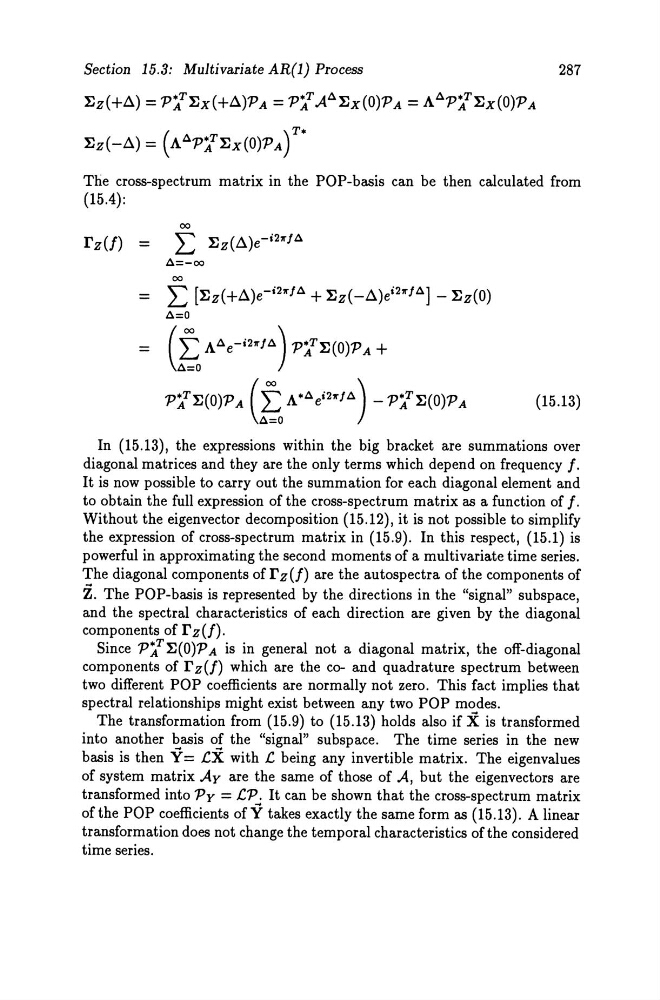
:Ez( +Ll) = p::l:Ex( +Ll)P A = P*1 A~:Ex(O)P A = A~p*l:Ex(O)p A
( ~ T
)T*
:Ez( -Ll) = A P~ :Ex (O)P A
The cross-spectrum matrix in the POP-basis can be then calculated from
(15.4):
rz(l)
~=-oo
00
L [:Ez(+Ll)e-i2l\'J~ + :Ez(_Ll)ei2l\'J~] - :Ez(O)
~=O
( f: A~e-i2l\'J~) p~T:E(O)PA +
~=O
'P;t 1:(0)1' A (~ A·· ,;2. J. ) - 'P:t 1:(0)1' A
(15.13)
In (15.13), the expressions within the big bracket are summations over
diagonal matrices and they are the only terms which depend on frequency f.
It is now possible to carry out the summation for each diagonal element and
to obtain the full expression of the cross-spectrum matrix as a function of f.
Without the eigenvector decomposition (15.12), it is not possible to simplify
the expression of cross-spectrum matrix in (15.9). In this respect, (15.1) is
powerful in approximating the second moments of a multivariate time series.
The diagonal components of r z (I) are the autospectra of the components of
Z. The POP-basis is represented by the directions in the "signal" subspace,
and the spectral characteristics of each direction are given by the diagonal
components of rz(l).
Since p~T:E(O)p A is in general not a diagonal matrix, the off-diagonal
components of rz(l) which are the co- and quadrature spectrum between
two different POP coeflicients are normally not zero. This fact implies that
spectral relationships might exist between any two POP modes.
The transformation from (15.9) to (15.13) holds also if X is transformed
into another basis of the "signal" subspace. The time series in the new
basis is then Y = .cX with .c being any invertible matrix. The eigenvalues
of system matrix Ay are the same of those of A, but the eigenvectors are
transformed into Py = .cP. It can be shown that the cross-spectrum matrix
of the POP coeflicients of Y takes exactly the same form as (15.13). A linear
transformation does not change the temporal characteristics of the considered
time series.
287
:Ez( +Ll) = p::l:Ex( +Ll)P A = P*1 A~:Ex(O)P A = A~p*l:Ex(O)p A
( ~ T
)T*
:Ez( -Ll) = A P~ :Ex (O)P A
The cross-spectrum matrix in the POP-basis can be then calculated from
(15.4):
rz(l)
~=-oo
00
L [:Ez(+Ll)e-i2l\'J~ + :Ez(_Ll)ei2l\'J~] - :Ez(O)
~=O
( f: A~e-i2l\'J~) p~T:E(O)PA +
~=O
'P;t 1:(0)1' A (~ A·· ,;2. J. ) - 'P:t 1:(0)1' A
(15.13)
In (15.13), the expressions within the big bracket are summations over
diagonal matrices and they are the only terms which depend on frequency f.
It is now possible to carry out the summation for each diagonal element and
to obtain the full expression of the cross-spectrum matrix as a function of f.
Without the eigenvector decomposition (15.12), it is not possible to simplify
the expression of cross-spectrum matrix in (15.9). In this respect, (15.1) is
powerful in approximating the second moments of a multivariate time series.
The diagonal components of r z (I) are the autospectra of the components of
Z. The POP-basis is represented by the directions in the "signal" subspace,
and the spectral characteristics of each direction are given by the diagonal
components of rz(l).
Since p~T:E(O)p A is in general not a diagonal matrix, the off-diagonal
components of rz(l) which are the co- and quadrature spectrum between
two different POP coeflicients are normally not zero. This fact implies that
spectral relationships might exist between any two POP modes.
The transformation from (15.9) to (15.13) holds also if X is transformed
into another basis of the "signal" subspace. The time series in the new
basis is then Y = .cX with .c being any invertible matrix. The eigenvalues
of system matrix Ay are the same of those of A, but the eigenvectors are
transformed into Py = .cP. It can be shown that the cross-spectrum matrix
of the POP coeflicients of Y takes exactly the same form as (15.13). A linear
transformation does not change the temporal characteristics of the considered
time series.