

Section 15.3: Multivariate AR(l) Process
285
frequeney f = 2 2 to f = O. This eauses immense diffieulties in deseribing the
full temporal eharaeteristies of a multivariate time series. A simplifieation of
the problem ean be aehieved by eonsidering the approximation (15.1).
15.3 M ultivariate AR( 1) Process
and its Cross-Covariance
and Cross-Spectrum Matrices
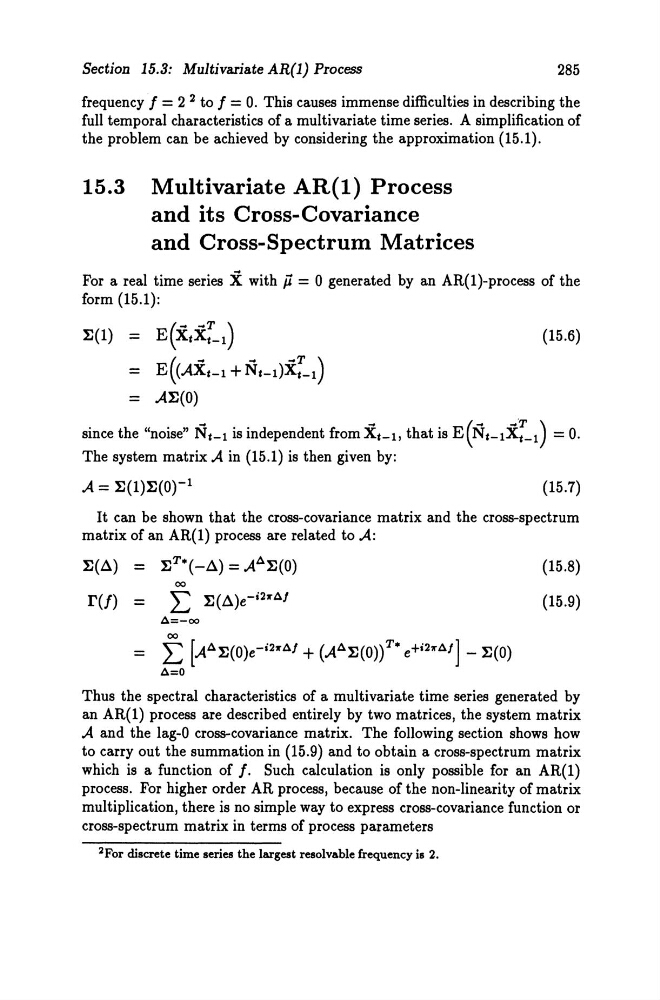
For a real time series X with j1 = 0 generated by an AR(I)-proeess of the
form (15.1):
E(I)
E(XtX;_l)
= E((AXt-1 + Nt-t)X;_l)
= AE(O)
(15.6)
sinee the "noise" Nt-1 is independent from Xt-l. that is E(Nt-1:i;_1) = O.
The system matrix A in (15.1) is then given by:
A = E(I)E(O)-l
(15.7)
It ean be shown that the eross-eovarianee matrix and the eross-speetrum
matrix of an AR(I) proeess are related to A:
00
r(f)
A=-oo
00
:L: [AAE(O)e- i2 ,.-Aj + (AAE(O))T* e+ i2 ,.-AJ] - E(O)
A=O
(15.8)
(15.9)
Thus the spectral eharaeteristies of a multivariate time series generated by
an AR(I) proeess Are deseribed entirely by two matriees, the system matrix
A and the lag-O eross-eovarianee matrix. The following seetion shows how
to earry out the summation in (15.9) and to obtain a eross-speetrum matrix
which is a funetion of f. Such ealculation is only possible for an AR(I)
proeess. For higher order AR proeess, beeause of the non-linearity of matrix
multiplieation, there is no simple way to express eross-eovarianee function or
eross-speetrum matrix in terms of proeess parameters
2For discrete time series the largest resolvable frequency is 2.
285
frequeney f = 2 2 to f = O. This eauses immense diffieulties in deseribing the
full temporal eharaeteristies of a multivariate time series. A simplifieation of
the problem ean be aehieved by eonsidering the approximation (15.1).
15.3 M ultivariate AR( 1) Process
and its Cross-Covariance
and Cross-Spectrum Matrices
For a real time series X with j1 = 0 generated by an AR(I)-proeess of the
form (15.1):
E(I)
E(XtX;_l)
= E((AXt-1 + Nt-t)X;_l)
= AE(O)
(15.6)
sinee the "noise" Nt-1 is independent from Xt-l. that is E(Nt-1:i;_1) = O.
The system matrix A in (15.1) is then given by:
A = E(I)E(O)-l
(15.7)
It ean be shown that the eross-eovarianee matrix and the eross-speetrum
matrix of an AR(I) proeess are related to A:
00
r(f)
A=-oo
00
:L: [AAE(O)e- i2 ,.-Aj + (AAE(O))T* e+ i2 ,.-AJ] - E(O)
A=O
(15.8)
(15.9)
Thus the spectral eharaeteristies of a multivariate time series generated by
an AR(I) proeess Are deseribed entirely by two matriees, the system matrix
A and the lag-O eross-eovarianee matrix. The following seetion shows how
to earry out the summation in (15.9) and to obtain a eross-speetrum matrix
which is a funetion of f. Such ealculation is only possible for an AR(I)
proeess. For higher order AR proeess, beeause of the non-linearity of matrix
multiplieation, there is no simple way to express eross-eovarianee function or
eross-speetrum matrix in terms of proeess parameters
2For discrete time series the largest resolvable frequency is 2.