

266
Chapter 14: Patterns in Time: SSA and MSSA
14.3.4 Spectral Properties
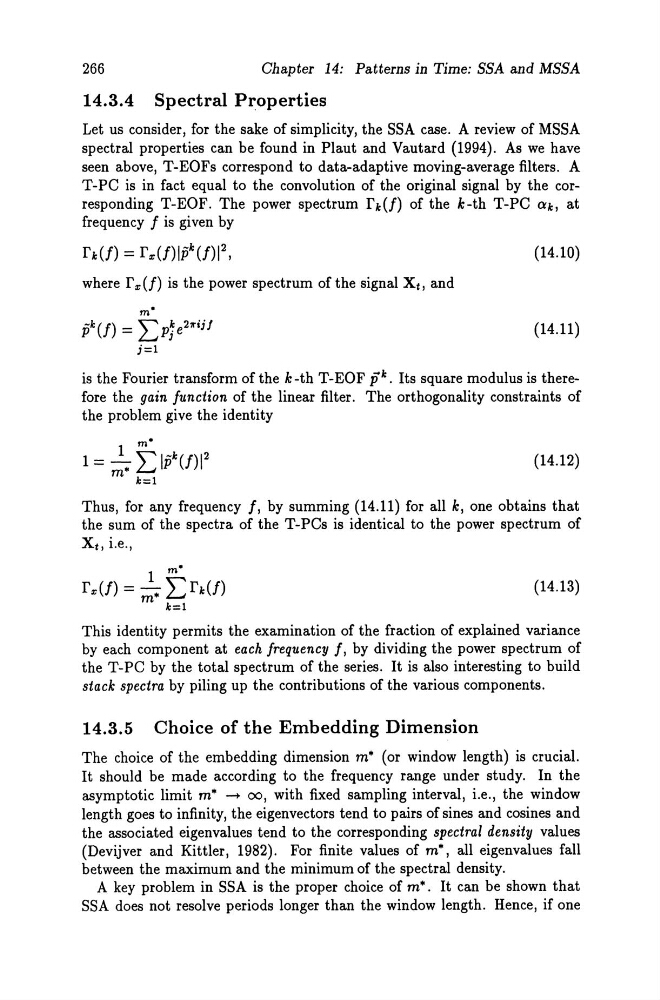
Let us consider, for the sake of simplicity, the SSA case. A review of MSSA
spectral properties can be found in Plaut and Vautard (1994). As we have
seen above, T-EOFs correspond to data-adaptive moving-average filters. A
T-PC is in fact equal to the convolution of the original signal by the corresponding T-EOF. The power spectrum rk(l) of the k-th T-PC ak, at
frequency J is given by
(14.10)
w here r x (I) is the power spectrum of the signal X t , and
m·
pk (I) = L: pJ e 27fijJ
(14.11)
j=l
is the Fourier transform of the k-th T-EOF pk. Its square modulus is therefore the gain Junction of the linear filter. The orthogonality constraints of
the problem give the identity
m·
1 = _1 ' " J pk(l)J2
m* L...J
k=l
(14.12)
Thus, for any frequency J, by summing (14.11) for all k, one obtains that
the sum of the spectra of the T-PCs is identical to the power spectrum of
Xt, i.e.,
m·
r x(l) = ~* L: rk(l)
k=l
(14.13)
This identity permits the examination of the fr action of explained variance
by each component at each Jrequency J, by dividing the power spectrum of
the T-PC by the total spectrum of the series. It is also interesting to build
stack spectra by piling up the contributions of the various components.
14.3.5 Choice of the Embedding Dimension
The choice of the embedding dimension m* (or window length) is crucial.
It should be made according to the frequency range under study. In the
asymptotic limit m* -+ 00, with fixed sampling interval, i.e., the window
length go es to infinity, the eigenvectors tend to pairs of sines and eosines and
the associated eigenvalues tend to the corresponding spectral density values
(Devijver and Kittler, 1982). For finite values of m*, all eigenvalues fall
between the maximum and the minimum of the spectral density.
A key problem in SSA is the proper choice of m*. It can be shown that
SSA does not resolve periods longer than the window length. Hence, if one
Chapter 14: Patterns in Time: SSA and MSSA
14.3.4 Spectral Properties
Let us consider, for the sake of simplicity, the SSA case. A review of MSSA
spectral properties can be found in Plaut and Vautard (1994). As we have
seen above, T-EOFs correspond to data-adaptive moving-average filters. A
T-PC is in fact equal to the convolution of the original signal by the corresponding T-EOF. The power spectrum rk(l) of the k-th T-PC ak, at
frequency J is given by
(14.10)
w here r x (I) is the power spectrum of the signal X t , and
m·
pk (I) = L: pJ e 27fijJ
(14.11)
j=l
is the Fourier transform of the k-th T-EOF pk. Its square modulus is therefore the gain Junction of the linear filter. The orthogonality constraints of
the problem give the identity
m·
1 = _1 ' " J pk(l)J2
m* L...J
k=l
(14.12)
Thus, for any frequency J, by summing (14.11) for all k, one obtains that
the sum of the spectra of the T-PCs is identical to the power spectrum of
Xt, i.e.,
m·
r x(l) = ~* L: rk(l)
k=l
(14.13)
This identity permits the examination of the fr action of explained variance
by each component at each Jrequency J, by dividing the power spectrum of
the T-PC by the total spectrum of the series. It is also interesting to build
stack spectra by piling up the contributions of the various components.
14.3.5 Choice of the Embedding Dimension
The choice of the embedding dimension m* (or window length) is crucial.
It should be made according to the frequency range under study. In the
asymptotic limit m* -+ 00, with fixed sampling interval, i.e., the window
length go es to infinity, the eigenvectors tend to pairs of sines and eosines and
the associated eigenvalues tend to the corresponding spectral density values
(Devijver and Kittler, 1982). For finite values of m*, all eigenvalues fall
between the maximum and the minimum of the spectral density.
A key problem in SSA is the proper choice of m*. It can be shown that
SSA does not resolve periods longer than the window length. Hence, if one