

Section 14.3: Singular Spectrum Analysis
265
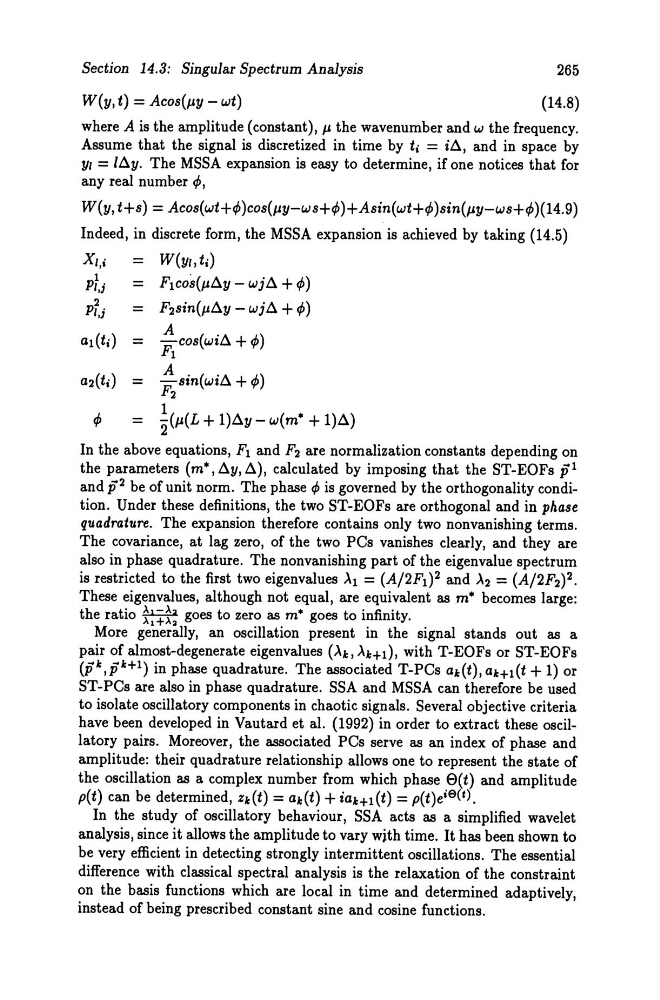
W(y, t) = Acos(JJY - wt)
(14.8)
where A is the amplitude (constant), JJ the wavenumber and w the frequency.
Assume that the signal is discretized in time by ti = i6o, and in space by
YI = l6oy. The MSSA expansion is easy to determine, if one notices that for
any real number cf;,
W(y, t+s) = Acos(wt+cf;)cos(JJY-ws+cf; )+Asin(wt+cf; )sin(JJY-ws+cf; )(14.9)
Indeed, in discrete form, the MSSA expansion is achieved by taking (14.5)
X',i
1
PI,;
2
PI,;
W(YI, ti)
Flcos(JJ6oY - wj60 + cf;)
= F2sin(JJ6oY - wj60 + cf;)
= ~ cos(wi6o + cf;)
~ sin(wi6o + cf;)
1
= '2(JJ(L + 1)6oY - w(m* + 1)60)
In the above equations, Fl and F2 are normalization constants depending on
the parameters (m*, 6oy, 60), calculated by imposing that the ST-EOFs pl
and p2 be of unit norm. The phase cf; is governed by the orthogonality condition. Under these definitions, the two ST-EOFs are orthogonal and in phase
quadrature. The expansion therefore contains only two nonvanishing terms.
The covariance, at lag zero, of the two PCs vanishes clearly, and they are
also in phase quadrature. The nonvanishing part of the eigenvalue spectrum
is restricted to the first two eigenvalues Al = (A/2F1)2 and A2 = (A/2F2)2.
These eigenvalues, although not equal, are equivalent as m* becomes large:
the ratio ~I +~2 goes to zero as m* goes to infinity.
More ge~er~lly, an oscillation present in the signal stands out as a
pair of almost-degenerate eigenvalues (Ak' Ak+d, with T-EOFs or ST-EOFs
(pk,pk+l) in phase quadrature. The associated T-PCs ak(t),ak+1(t + 1) or
ST-PCs are also in phase quadrature. SSA and MSSA can therefore be used
to isolate oscillatory components in chaotic signals. Several objective criteria
have been developed in Vautard et al. (1992) in order to extract these oscillatory pairs. Moreover, the associated PCs serve as an index of phase and
amplitude: their quadrature relationship allows one to represent the state of
the oscillation as a complex number from which phase 8(t) and amplitude
p(t) can be determined, Zk(t) = ak(t) + iak+l(t) = p(t)eiEl(t).
In the study of oscillatory behaviour, SSA acts as a simplified wavelet
analysis, since it allows the amplitude to vary wjth time. It has been shown to
be very efficient in detecting strongly intermittent oscillations. The essential
difference with classical spectral analysis is the relaxation of the constraint
on the basis functions which are local in time and determined adaptively,
instead of being prescribed constant sine and eosine functions.
265
W(y, t) = Acos(JJY - wt)
(14.8)
where A is the amplitude (constant), JJ the wavenumber and w the frequency.
Assume that the signal is discretized in time by ti = i6o, and in space by
YI = l6oy. The MSSA expansion is easy to determine, if one notices that for
any real number cf;,
W(y, t+s) = Acos(wt+cf;)cos(JJY-ws+cf; )+Asin(wt+cf; )sin(JJY-ws+cf; )(14.9)
Indeed, in discrete form, the MSSA expansion is achieved by taking (14.5)
X',i
1
PI,;
2
PI,;
W(YI, ti)
Flcos(JJ6oY - wj60 + cf;)
= F2sin(JJ6oY - wj60 + cf;)
= ~ cos(wi6o + cf;)
~ sin(wi6o + cf;)
1
= '2(JJ(L + 1)6oY - w(m* + 1)60)
In the above equations, Fl and F2 are normalization constants depending on
the parameters (m*, 6oy, 60), calculated by imposing that the ST-EOFs pl
and p2 be of unit norm. The phase cf; is governed by the orthogonality condition. Under these definitions, the two ST-EOFs are orthogonal and in phase
quadrature. The expansion therefore contains only two nonvanishing terms.
The covariance, at lag zero, of the two PCs vanishes clearly, and they are
also in phase quadrature. The nonvanishing part of the eigenvalue spectrum
is restricted to the first two eigenvalues Al = (A/2F1)2 and A2 = (A/2F2)2.
These eigenvalues, although not equal, are equivalent as m* becomes large:
the ratio ~I +~2 goes to zero as m* goes to infinity.
More ge~er~lly, an oscillation present in the signal stands out as a
pair of almost-degenerate eigenvalues (Ak' Ak+d, with T-EOFs or ST-EOFs
(pk,pk+l) in phase quadrature. The associated T-PCs ak(t),ak+1(t + 1) or
ST-PCs are also in phase quadrature. SSA and MSSA can therefore be used
to isolate oscillatory components in chaotic signals. Several objective criteria
have been developed in Vautard et al. (1992) in order to extract these oscillatory pairs. Moreover, the associated PCs serve as an index of phase and
amplitude: their quadrature relationship allows one to represent the state of
the oscillation as a complex number from which phase 8(t) and amplitude
p(t) can be determined, Zk(t) = ak(t) + iak+l(t) = p(t)eiEl(t).
In the study of oscillatory behaviour, SSA acts as a simplified wavelet
analysis, since it allows the amplitude to vary wjth time. It has been shown to
be very efficient in detecting strongly intermittent oscillations. The essential
difference with classical spectral analysis is the relaxation of the constraint
on the basis functions which are local in time and determined adaptively,
instead of being prescribed constant sine and eosine functions.