

252
Ghapter 13: Spatial Patterns: EOFs and GGA
-k _ C'S-l-k
PA - v
PA
(13.50)
In general we have S =F S-l so that neither the property "self adjoint" , Le,
- T -
p~ = pk, nor the property "orthogonal", Le. pk p' = 0 if k =F I, are valid
after the backtransformation into the Euclidean space.
In the EOF coordinates we can establish a connection to the EOF calculus
(Vautard; pers. communication). For convenience we drop now the - marking
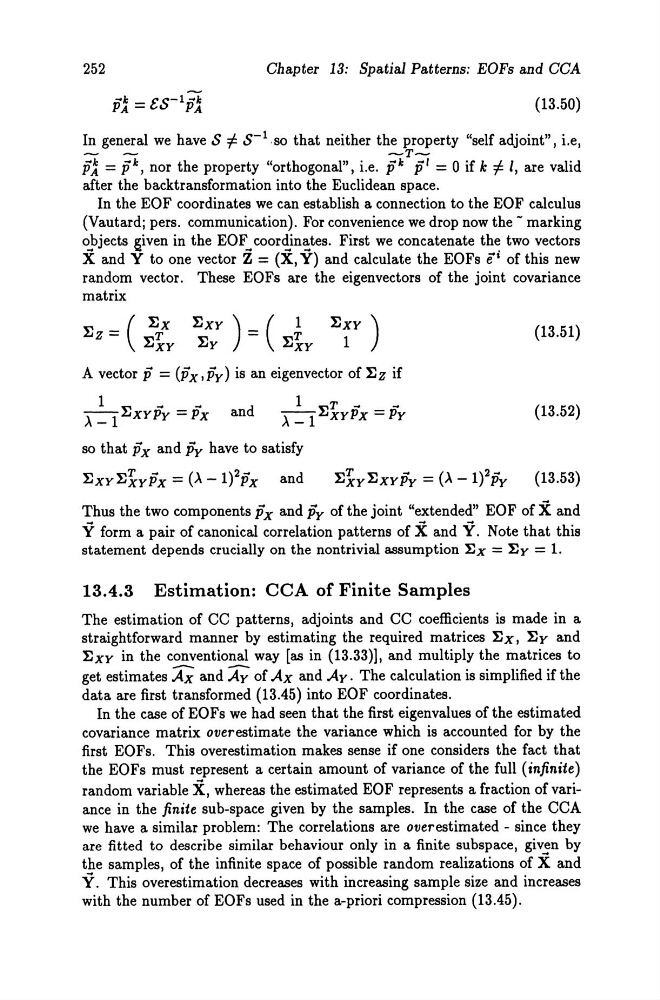
o_bjects ~iven in the EOF_ coor X and Y to one vector Z = (X, Y) and calculate the EOFs e' of this new
random vector. These EOFs are the eigenvectors of the joint covariance
matrix
A vector p = (p x' py) is an eigenvector of E z if
1 E
-
-
d
>. _ 1 XYPy = Px an
so that px and py have to satisfy
Exy EkYPx = (>' - 1)2px and
(13.51)
(13.52)
(13.53)
Thus the two components Px and py of the joint "extended" EOF of X and
Y form a pair of canonical correlation patterns of X and Y. Note that this
statement depends crucially on the nontrivial assumption Ex = Ey = 1.
13.4.3 Estimation: CCA of Finite Sampies
The estimation of CC patterns, adjoints and CC coefficients is made in a
straightforward manner by estimating the required matrices Ex, Ey and
Exy in the conventional way [as in (13.33)], and multiply the matrices to
get estimates Ax and k ofAx and Ay. The calculation is simplified if the
data are first transformed (13.45) into EOF coordinates.
In the case of EOFs we had seen that the first eigenvalues of the estimated
covariance matrix overestimate the variance which is accounted for by the
first EOFs. This overestimation makes sense if one considers the fact that
the EOFs must represent a certain amount of variance of the fuH (infinite)
random variable X, whereas the estimated EOF represents a fr action of variance in the finite sub-space given by the sampies. In the case of the CCA
we have a similar problem: The correlations are overestimated - since they
are fitted to describe similar behaviour only in a finite subspace, given by
the sam pies , of the infinite space of possible random realizations of X and
Y. This overestimation decreases with increasing sampie size and increases
with the number of EOFs used in the a-priori compression (13.45).
Ghapter 13: Spatial Patterns: EOFs and GGA
-k _ C'S-l-k
PA - v
PA
(13.50)
In general we have S =F S-l so that neither the property "self adjoint" , Le,
- T -
p~ = pk, nor the property "orthogonal", Le. pk p' = 0 if k =F I, are valid
after the backtransformation into the Euclidean space.
In the EOF coordinates we can establish a connection to the EOF calculus
(Vautard; pers. communication). For convenience we drop now the - marking
o_bjects ~iven in the EOF_ coor X and Y to one vector Z = (X, Y) and calculate the EOFs e' of this new
random vector. These EOFs are the eigenvectors of the joint covariance
matrix
A vector p = (p x' py) is an eigenvector of E z if
1 E
-
-
d
>. _ 1 XYPy = Px an
so that px and py have to satisfy
Exy EkYPx = (>' - 1)2px and
(13.51)
(13.52)
(13.53)
Thus the two components Px and py of the joint "extended" EOF of X and
Y form a pair of canonical correlation patterns of X and Y. Note that this
statement depends crucially on the nontrivial assumption Ex = Ey = 1.
13.4.3 Estimation: CCA of Finite Sampies
The estimation of CC patterns, adjoints and CC coefficients is made in a
straightforward manner by estimating the required matrices Ex, Ey and
Exy in the conventional way [as in (13.33)], and multiply the matrices to
get estimates Ax and k ofAx and Ay. The calculation is simplified if the
data are first transformed (13.45) into EOF coordinates.
In the case of EOFs we had seen that the first eigenvalues of the estimated
covariance matrix overestimate the variance which is accounted for by the
first EOFs. This overestimation makes sense if one considers the fact that
the EOFs must represent a certain amount of variance of the fuH (infinite)
random variable X, whereas the estimated EOF represents a fr action of variance in the finite sub-space given by the sampies. In the case of the CCA
we have a similar problem: The correlations are overestimated - since they
are fitted to describe similar behaviour only in a finite subspace, given by
the sam pies , of the infinite space of possible random realizations of X and
Y. This overestimation decreases with increasing sampie size and increases
with the number of EOFs used in the a-priori compression (13.45).