

Section 13.4: Ganonical Gorrelation Analysis
251
13.4.2 CCA in EOF Coordinates
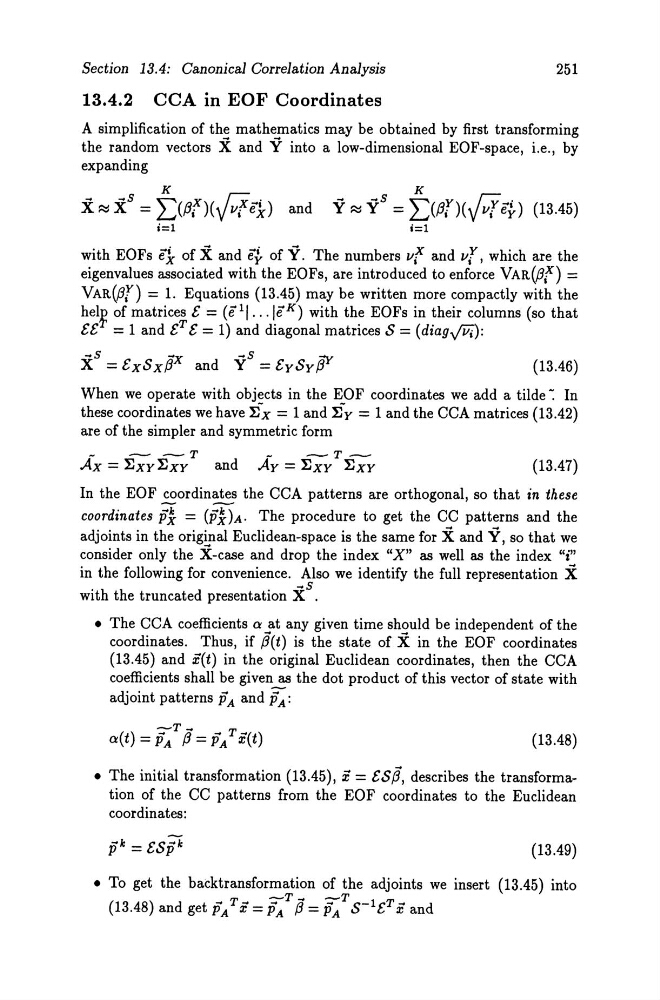
A simplification of the mathematics may be obtained by first transforming
the random vectors X and Y into a low-dimensional EOF-space, i.e., by
expanding
K
...
... S
~ Y
Ci ... ;
Y R:1 Y = ~(ß; )( V Vi ey) (13.45)
;=1
with EOFs ek of X and 4- of Y. The numbers vf and vT, which are the
eigenvalues associated with the EOFs, are introduced to enforce VAR.(f3f) =
VAR.(f3n = 1. Equations (13.45) may be written more compactly with the
hel~ of matrices & = (e 1 1 .. . jeK) with the EOFs in their columns (so that
&& = 1 and &T & = 1) and diagonal matrices S = (diagy'iii):
... S
"'x
... S
Qy
X = &xSxß and Y = &ySyß
(13.46)
When we operate with objects in the EOF coordinates we add a tilde -: In
these coordinates we have E~ = 1 and E-y = 1 and the CCA matrices (13.42)
are of the simpler and symmetrie form
-
-
- T
-
- T -
Ax = Exy Exy and Ay = Exy Exy
(13.47)
In the EOF ~ordin~ the CCA patterns are orthogonal, so that in these
coordinates p} = (P~)A. The procedure to get the CC patterns and the
adjoints in the original Euclidean-space is the same for X and Y, so that we
consider only the X-case and drop the index "X" as weH as the index "i"
in the foHowing for convenience. Also we identify the fuH representation X
with the truncated presentation X S •
• The CCA coeflicients Cl' at any given time should be independent of the
coordinates. Thus, if ß(t) is the state of X in the EOF coordinates
(13.45) and i(t) in the original Euclidean coordinates, then the CCA
coeflicients shall be given~ the dot product of this vector of state with
adjoint patterns PA and PA:
-T...
T
Cl'(t) = PA ß = PA i(t)
(13.48)
• The initial transformation (13.45), i = &Sß, describes the transformation of the ce patterns from the EOF coordinates to the Euclidean
coordinates:
(13.49)
• To get the backtransformation of the adjoints we insert (13.45) into
T
-T ...
- T
1 T
(13.48) and get ~ i = PA ß = PA S- t: i and
251
13.4.2 CCA in EOF Coordinates
A simplification of the mathematics may be obtained by first transforming
the random vectors X and Y into a low-dimensional EOF-space, i.e., by
expanding
K
...
... S
~ Y
Ci ... ;
Y R:1 Y = ~(ß; )( V Vi ey) (13.45)
;=1
with EOFs ek of X and 4- of Y. The numbers vf and vT, which are the
eigenvalues associated with the EOFs, are introduced to enforce VAR.(f3f) =
VAR.(f3n = 1. Equations (13.45) may be written more compactly with the
hel~ of matrices & = (e 1 1 .. . jeK) with the EOFs in their columns (so that
&& = 1 and &T & = 1) and diagonal matrices S = (diagy'iii):
... S
"'x
... S
Qy
X = &xSxß and Y = &ySyß
(13.46)
When we operate with objects in the EOF coordinates we add a tilde -: In
these coordinates we have E~ = 1 and E-y = 1 and the CCA matrices (13.42)
are of the simpler and symmetrie form
-
-
- T
-
- T -
Ax = Exy Exy and Ay = Exy Exy
(13.47)
In the EOF ~ordin~ the CCA patterns are orthogonal, so that in these
coordinates p} = (P~)A. The procedure to get the CC patterns and the
adjoints in the original Euclidean-space is the same for X and Y, so that we
consider only the X-case and drop the index "X" as weH as the index "i"
in the foHowing for convenience. Also we identify the fuH representation X
with the truncated presentation X S •
• The CCA coeflicients Cl' at any given time should be independent of the
coordinates. Thus, if ß(t) is the state of X in the EOF coordinates
(13.45) and i(t) in the original Euclidean coordinates, then the CCA
coeflicients shall be given~ the dot product of this vector of state with
adjoint patterns PA and PA:
-T...
T
Cl'(t) = PA ß = PA i(t)
(13.48)
• The initial transformation (13.45), i = &Sß, describes the transformation of the ce patterns from the EOF coordinates to the Euclidean
coordinates:
(13.49)
• To get the backtransformation of the adjoints we insert (13.45) into
T
-T ...
- T
1 T
(13.48) and get ~ i = PA ß = PA S- t: i and