

Section 12.3: Teleconnections
223
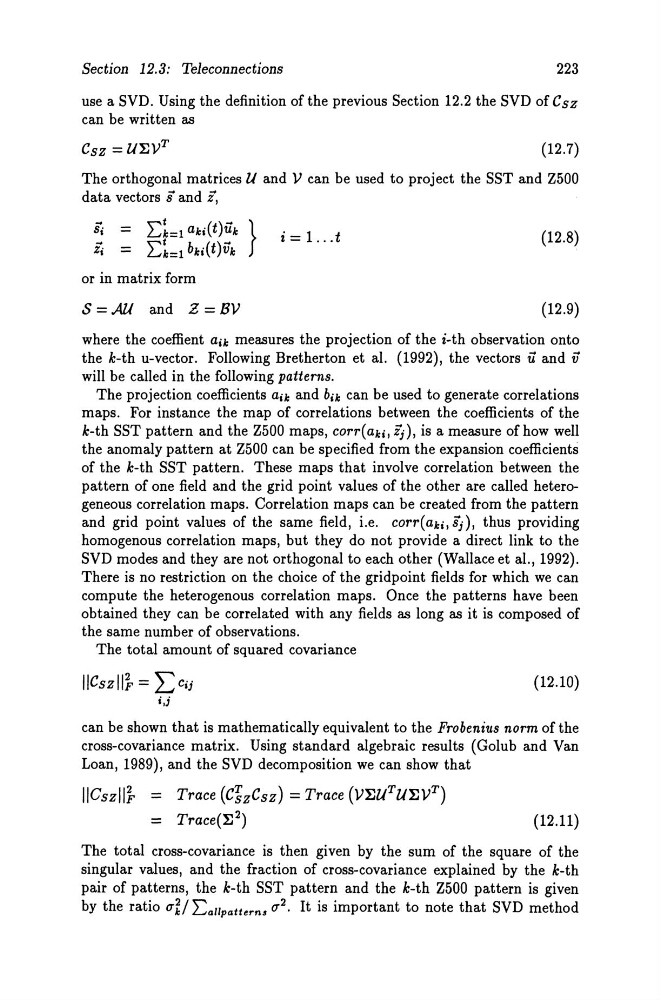
use a SVD. Using the definition of the previous Section 12.2 the SVD of Cs z
ean be written as
(12.7)
The orthogonal matriees U and V ean be used to projeet the SST and Z500
data veetors sand z,
(12.8)
or in matrix form
S = AU and Z = BV
(12.9)
where the eoeffient aik measures the projeetion of the i-th observation onto
the k-th u-veetor. Following Bretherton et al. (1992), the vectors ü and v
will be ealled in the following patterns.
The projection eoeffieients aik and bik ean be used to generate eorrelations
maps. For instanee the map of eorrelations between the eoeffieients of the
k-th SST pattern and the Z500 maps, corr( aki, Zj), is a measure of how weIl
the anomaly pattern at Z500 ean be speeified from the expansion eoeffieients
of the k-th SST pattern. These maps that involve eorrelation between the
pattern of one field and the grid point values of the other are ealled heterogeneous eorrelation maps. Correlation maps ean be ereated from the pattern
and grid point values of the same field, i.e. corr( aki, Sj ), thus providing
homogenous eorrelation maps, but they do not provide a direct link to the
SVD mo des and they are not orthogonal to eaeh other (Wallace et al., 1992).
There is no rest riet ion on the choice of the gridpoint fields for which we ean
compute the heterogenous correlation maps. Once the patterns have been
obtained they can be correlated with any fields as long as it is composed of
the same number of observations.
The total amount of squared covariance
IICszll} = L Cij
i,j
(12.10)
can be shown that is mathematieally equivalent to the Frobenius norm of the
cross-covariance matrix. Using standard algebraic results (Golub and Van
Loan, 1989), and the SVD decomposition we can show that
IICszll}
Trace (C~zCsz) = Trace (VEUTUEV T )
Trace(E 2 )
(12.11)
The total cross-eovariance is then given by the sum of the square of the
singular values, and the fr action of eross-eovariance explained by the k-th
pair of patterns, the k-th SST pattern and the k-th Z500 pattern is given
by the ratio (J'V LaI/pattern. (J'2. It is important to note that SVD method
223
use a SVD. Using the definition of the previous Section 12.2 the SVD of Cs z
ean be written as
(12.7)
The orthogonal matriees U and V ean be used to projeet the SST and Z500
data veetors sand z,
(12.8)
or in matrix form
S = AU and Z = BV
(12.9)
where the eoeffient aik measures the projeetion of the i-th observation onto
the k-th u-veetor. Following Bretherton et al. (1992), the vectors ü and v
will be ealled in the following patterns.
The projection eoeffieients aik and bik ean be used to generate eorrelations
maps. For instanee the map of eorrelations between the eoeffieients of the
k-th SST pattern and the Z500 maps, corr( aki, Zj), is a measure of how weIl
the anomaly pattern at Z500 ean be speeified from the expansion eoeffieients
of the k-th SST pattern. These maps that involve eorrelation between the
pattern of one field and the grid point values of the other are ealled heterogeneous eorrelation maps. Correlation maps ean be ereated from the pattern
and grid point values of the same field, i.e. corr( aki, Sj ), thus providing
homogenous eorrelation maps, but they do not provide a direct link to the
SVD mo des and they are not orthogonal to eaeh other (Wallace et al., 1992).
There is no rest riet ion on the choice of the gridpoint fields for which we ean
compute the heterogenous correlation maps. Once the patterns have been
obtained they can be correlated with any fields as long as it is composed of
the same number of observations.
The total amount of squared covariance
IICszll} = L Cij
i,j
(12.10)
can be shown that is mathematieally equivalent to the Frobenius norm of the
cross-covariance matrix. Using standard algebraic results (Golub and Van
Loan, 1989), and the SVD decomposition we can show that
IICszll}
Trace (C~zCsz) = Trace (VEUTUEV T )
Trace(E 2 )
(12.11)
The total cross-eovariance is then given by the sum of the square of the
singular values, and the fr action of eross-eovariance explained by the k-th
pair of patterns, the k-th SST pattern and the k-th Z500 pattern is given
by the ratio (J'V LaI/pattern. (J'2. It is important to note that SVD method