

Section 12.2: Singular Value Decomposition
221
numbers ordered in decreasing magnitude and are called singular values. The
columns of U and V form an orthonormal basis and they are called u-vectors
and v-vectors, respectively.
Ifwe put U = (üli'u2",Ümin(n,m)), and V = (V!/V2",Vmin(n,m)), the
following relations hold
AVi
= (TiÜi}
A T....
....
Ui = (Ti Vi
i = 1 .. . min(n,m)
(12.2)
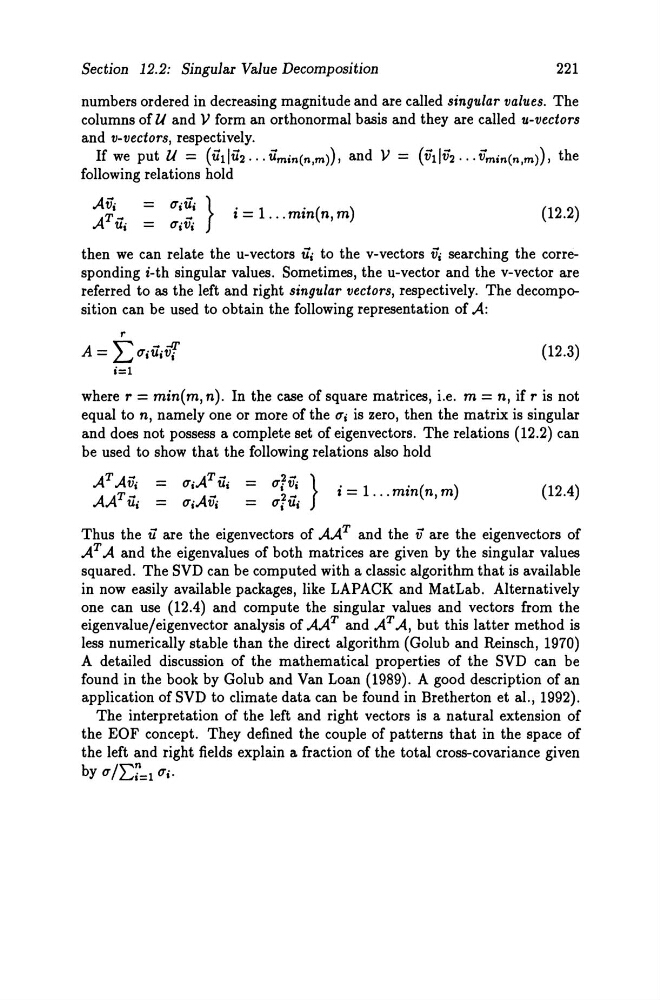
then we can relate the u-vectors Üi to the v-vectors Vi searching the corresponding i-th singular values. Sometimes, the u-vector and the v-vector are
referred to as the left and right singular vectors, respectively. The decomposition can be used to obtain the following representation of A:
r
A = L: (Tiüiif{
(12.3)
i=1
where r = min(m, n). In the case of square matrices, i.e. m = n, if r is not
equal to n, namely one or more of the (Ti is zero, then the matrix is singular
and does not possess a complete set of eigenvectors. The relations (12.2) can
be used to show that the following relations also hold
Vi
= (Ti Ui = (Ti Vi
•
1
. (
)
A TA....
AT....
2 .... }
A T....
A....
2....
Z = ... mzn n,m
A Ui = (Ti Vi = (Ti Ui
(12.4)
Thus the Ü are the eigenvectors of AA T and the V are the eigenvectors of
AT A and the eigenvalues of both matrices are given by the singular values
squared. The SVD can be computed with a classic algorithm that is available
in now easily available packages, like LAPACK and MatLab. Alternatively
one can use (12.4) and compute the singular values and vectors from the
eigenvaluejeigenvector analysis of AA T and AT A, but this latter method is
less numerically stable than the direct algorithm (Golub and Reinsch, 1970)
A detailed discussion of the mathematical properties of the SVD can be
found in the book by Golub and Van Loan (1989). A good description of an
application of SVD to climate data can be found in Bretherton et al., 1992).
The interpretation of the left and right vectors is a natural extension of
the EOF concept. They defined the couple of patterns that in the space of
the left and right fields explain a fraction of the total cross-covariance given
by (T /L'..?=1 (Ti·
221
numbers ordered in decreasing magnitude and are called singular values. The
columns of U and V form an orthonormal basis and they are called u-vectors
and v-vectors, respectively.
Ifwe put U = (üli'u2",Ümin(n,m)), and V = (V!/V2",Vmin(n,m)), the
following relations hold
AVi
= (TiÜi}
A T....
....
Ui = (Ti Vi
i = 1 .. . min(n,m)
(12.2)
then we can relate the u-vectors Üi to the v-vectors Vi searching the corresponding i-th singular values. Sometimes, the u-vector and the v-vector are
referred to as the left and right singular vectors, respectively. The decomposition can be used to obtain the following representation of A:
r
A = L: (Tiüiif{
(12.3)
i=1
where r = min(m, n). In the case of square matrices, i.e. m = n, if r is not
equal to n, namely one or more of the (Ti is zero, then the matrix is singular
and does not possess a complete set of eigenvectors. The relations (12.2) can
be used to show that the following relations also hold
Vi
= (Ti Ui = (Ti Vi
•
1
. (
)
A TA....
AT....
2 .... }
A T....
A....
2....
Z = ... mzn n,m
A Ui = (Ti Vi = (Ti Ui
(12.4)
Thus the Ü are the eigenvectors of AA T and the V are the eigenvectors of
AT A and the eigenvalues of both matrices are given by the singular values
squared. The SVD can be computed with a classic algorithm that is available
in now easily available packages, like LAPACK and MatLab. Alternatively
one can use (12.4) and compute the singular values and vectors from the
eigenvaluejeigenvector analysis of AA T and AT A, but this latter method is
less numerically stable than the direct algorithm (Golub and Reinsch, 1970)
A detailed discussion of the mathematical properties of the SVD can be
found in the book by Golub and Van Loan (1989). A good description of an
application of SVD to climate data can be found in Bretherton et al., 1992).
The interpretation of the left and right vectors is a natural extension of
the EOF concept. They defined the couple of patterns that in the space of
the left and right fields explain a fraction of the total cross-covariance given
by (T /L'..?=1 (Ti·