

Section 11.4: Stochastic Precipitation Models
209
are Markov. R t can be a vector of rainfaIl occurrences at multiple stations, in
which case a model for its (spatial) covariance is required. The shortcoming
of the HMM is that the hidden states are unknown, and even though they
may weIl be similar to weather states, they· cannot be imposed externaIly.
Therefore, only unconditional simulations are possible, and in this respect
the model is similar to the unconditional models of the precipitation arrival
process discussed in Section 11.3.
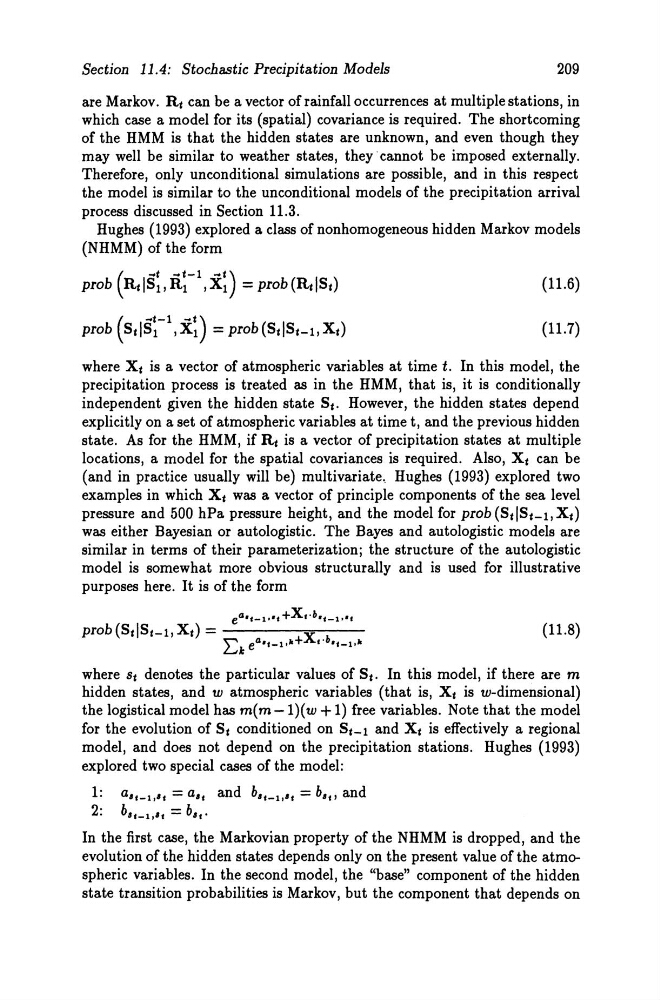
Hughes (1993) explored a dass of nonhomogeneous hidden Markov models
(NHMM) of the form
(11.6)
(11.7)
where X t is a vector of atmospheric variables at time t. In this model, the
precipitation process is treated as in the HMM, that is, it is conditionaIly
independent given the hidden state St. However, the hidden states depend
explicitly on a set of atmospheric variables at time t, and the previous hidden
state. As for the HMM, if R t is a vector of precipitation states at multiple
locations, a model for the spatial covariances is required. Also, X t can be
(and in practice usually will be) multivariate . . Hughes (1993) explored two
examples in which X t was a vector of principle components of the sea level
pressure and 500 hPa pressure height, and the model for prob (StISt-l, X t )
was either Bayesian or autologistic. The Bayes and autologistic models are
similar in terms of their parameterizationj the structure of the autologistic
model is somewhat more obvious structurally and is used for illustrative
purposes here. It is of the form
(11.8)
where St denotes the particular values of St. In this model, if there are m
hidden states, and w atmospheric variables (that is, X t is w-dimensional)
the logistical model has m(m-1)(w + 1) free variables. Note that the model
for the evolution of St conditioned on St-l and X t is effectively a regional
model, and does not depend on the precipitation stations. Hughes (1993)
explored two special cases of the model:
1: a'i_l,'i = a'i and b'i_1"i = b,., and
2: b'i_l ,'i = b'i·
In the first case, the Markovian property of the NHMM is dropped, and the
evolution of the hidden states depends only on the present value of the atmospheric variables. In the second model, the "base" component of the hidden
state transition probabilities is Markov, but the component that depends on
209
are Markov. R t can be a vector of rainfaIl occurrences at multiple stations, in
which case a model for its (spatial) covariance is required. The shortcoming
of the HMM is that the hidden states are unknown, and even though they
may weIl be similar to weather states, they· cannot be imposed externaIly.
Therefore, only unconditional simulations are possible, and in this respect
the model is similar to the unconditional models of the precipitation arrival
process discussed in Section 11.3.
Hughes (1993) explored a dass of nonhomogeneous hidden Markov models
(NHMM) of the form
(11.6)
(11.7)
where X t is a vector of atmospheric variables at time t. In this model, the
precipitation process is treated as in the HMM, that is, it is conditionaIly
independent given the hidden state St. However, the hidden states depend
explicitly on a set of atmospheric variables at time t, and the previous hidden
state. As for the HMM, if R t is a vector of precipitation states at multiple
locations, a model for the spatial covariances is required. Also, X t can be
(and in practice usually will be) multivariate . . Hughes (1993) explored two
examples in which X t was a vector of principle components of the sea level
pressure and 500 hPa pressure height, and the model for prob (StISt-l, X t )
was either Bayesian or autologistic. The Bayes and autologistic models are
similar in terms of their parameterizationj the structure of the autologistic
model is somewhat more obvious structurally and is used for illustrative
purposes here. It is of the form
(11.8)
where St denotes the particular values of St. In this model, if there are m
hidden states, and w atmospheric variables (that is, X t is w-dimensional)
the logistical model has m(m-1)(w + 1) free variables. Note that the model
for the evolution of St conditioned on St-l and X t is effectively a regional
model, and does not depend on the precipitation stations. Hughes (1993)
explored two special cases of the model:
1: a'i_l,'i = a'i and b'i_1"i = b,., and
2: b'i_l ,'i = b'i·
In the first case, the Markovian property of the NHMM is dropped, and the
evolution of the hidden states depends only on the present value of the atmospheric variables. In the second model, the "base" component of the hidden
state transition probabilities is Markov, but the component that depends on