

208
Chapter 11: Stochastic Modeling oE Precipitation
parameters ofthe model (N, n, M, m, and w) are conditioned on the weather
state and the wet-dry status of the higher stations in the hierarchy, but the
memory is "lost" when the state (combination of weather state and wet-dry
status of higher stations in the hierarchy) changes. The model was applied
to three precipitation stations in the state of Washington, using a principal
components-based weather classification scheme for a region similar to that
used by Wilson et al. (1991). The precipitation amounts were reproduced
reasonably well, especially for the seasons with the most precipitation. The
dry and wet period lengths were also modeled reasonably well, although there
was a persistent downward bias, especially for the lowest stations in the hierarchy. The major drawback of this model is that the number of parameters
grows rapidly (power of two) with the number of stations. Also, the model
performs best for the highest stations in the hierarchy, but there may not be
an obvious way of determining the ordering of stations.
All of the above models define the weather states externally, that is, the
selection of the weather states does not utilize station information. Hughes
et al. (1993) linked the selection of the weather states with observed precipitation occurrence information at a set of index stations using the CART
procedure described above. Precipitation occurrences and amounts were initially modeled assuming conditional independence, by simply resampling at
random from the historical observations of precipitation at a set of target
stations, given the weather states. They found that this model tended to
underestimate the persistence of wet and dry periods. Model performance
was improved by resampling precipitation amounts conditional on the present
day's weather state and the previous day's rain state. Unlike the models of
Bardossy and Plate (1991; 1992) the Markovian persistence was retained regardless of shifts in the weather state. Inclusion of the previous rain state
reduced the problem with simulation of wet and dry period persistence. However, by incorporating information about the previous day's rain state the
number of parameters grows rapidly with the number of stations.
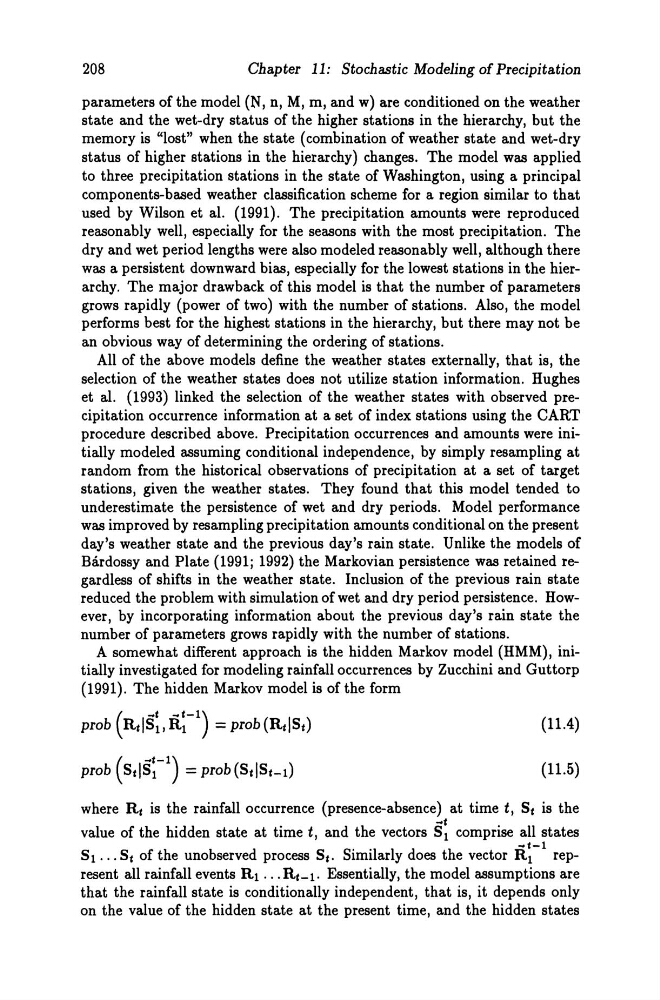
A somewhat different approach is the hidden Markov model (HMM), initially investigated for modeling rainfall occurrences by Zucchini and Guttorp
(1991). The hidden Markov model is of the form
(
~t ~t-1)
prob R t IS 1 ,R 1
= prob (RtlSt)
(11.4)
(11.5)
where R t is the rainfall occurrence (presence-absence) at time t, St is the
~t
value of the hidden state at time t, and the vectors Sl comprise all states
~t-1
Sl ... St of the unobserved process S,. Similarly does the vector R 1 represent all rainfall events R 1 ... Rt - 1 . Essentially, the model assumptions are
that the rainfall state is conditionally independent, that is, it depends only
on the value of the hidden state at the present time, and the hidden states
Chapter 11: Stochastic Modeling oE Precipitation
parameters ofthe model (N, n, M, m, and w) are conditioned on the weather
state and the wet-dry status of the higher stations in the hierarchy, but the
memory is "lost" when the state (combination of weather state and wet-dry
status of higher stations in the hierarchy) changes. The model was applied
to three precipitation stations in the state of Washington, using a principal
components-based weather classification scheme for a region similar to that
used by Wilson et al. (1991). The precipitation amounts were reproduced
reasonably well, especially for the seasons with the most precipitation. The
dry and wet period lengths were also modeled reasonably well, although there
was a persistent downward bias, especially for the lowest stations in the hierarchy. The major drawback of this model is that the number of parameters
grows rapidly (power of two) with the number of stations. Also, the model
performs best for the highest stations in the hierarchy, but there may not be
an obvious way of determining the ordering of stations.
All of the above models define the weather states externally, that is, the
selection of the weather states does not utilize station information. Hughes
et al. (1993) linked the selection of the weather states with observed precipitation occurrence information at a set of index stations using the CART
procedure described above. Precipitation occurrences and amounts were initially modeled assuming conditional independence, by simply resampling at
random from the historical observations of precipitation at a set of target
stations, given the weather states. They found that this model tended to
underestimate the persistence of wet and dry periods. Model performance
was improved by resampling precipitation amounts conditional on the present
day's weather state and the previous day's rain state. Unlike the models of
Bardossy and Plate (1991; 1992) the Markovian persistence was retained regardless of shifts in the weather state. Inclusion of the previous rain state
reduced the problem with simulation of wet and dry period persistence. However, by incorporating information about the previous day's rain state the
number of parameters grows rapidly with the number of stations.
A somewhat different approach is the hidden Markov model (HMM), initially investigated for modeling rainfall occurrences by Zucchini and Guttorp
(1991). The hidden Markov model is of the form
(
~t ~t-1)
prob R t IS 1 ,R 1
= prob (RtlSt)
(11.4)
(11.5)
where R t is the rainfall occurrence (presence-absence) at time t, St is the
~t
value of the hidden state at time t, and the vectors Sl comprise all states
~t-1
Sl ... St of the unobserved process S,. Similarly does the vector R 1 represent all rainfall events R 1 ... Rt - 1 . Essentially, the model assumptions are
that the rainfall state is conditionally independent, that is, it depends only
on the value of the hidden state at the present time, and the hidden states