

Section 10.4: Measures and Relationships
193
The last line of (10.9) is called the anomaly correlation.
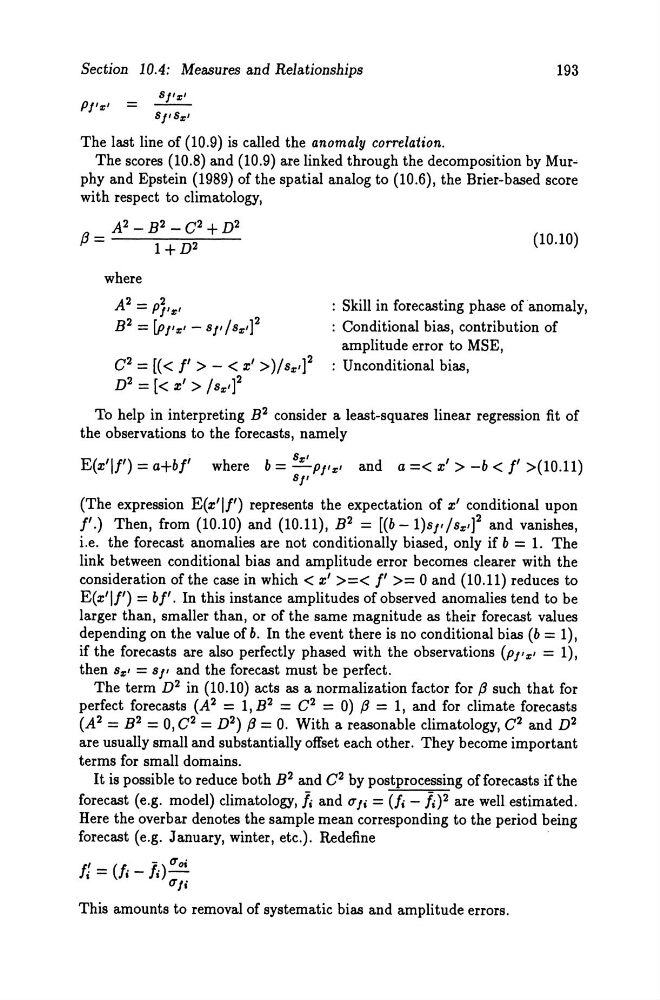
The scores (10.8) and (10.9) are linked through the decomposition by Mur~
phy and Epstein (1989) of the spatial analog to (10.6), the Brier-based score
with respect to climatology,
A2 _ B2 _ C2 + D2
ß =
1 +D2
where
c 2 = [« I' > - < x' »/8~/]2
D 2 = [< x' > /8~/]2
(10.10)
: Skill in forecasting phase of anomaly,
: Conditional bias, contribution of
amplitude error to MSE,
: Unconditional bias,
To help in interpreting B 2 consider a least-squares linear regression fit of
the observations to the forecasts, namely
E(x'll') = a+bf' where
and a =< x' > -b < f' >(10.11)
(The expression E(x'lf') represents the expectation of x' conditional upon
1'.) Then, from (10.10) and (10.11), B 2 = [(b - 1)8JI /8~/]2 and vanishes,
i.e. the forecast anomalies are not conditionally biased, only if b = 1. The
link between conditional bias and amplitude error becomes clearer with the
consideration of the case in which < x' >=< I' >= 0 and (10.11) reduces to
E(x'll') = bf'. In this instance amplitudes of observed anomalies tend to be
larger than, sm aller than, or of the same magnitude as their forecast values
depending on the value of b. In the event there is no conditional bias (b = 1),
if the forecasts are also perfectly phased with the observations (Pf'~1 = 1),
then 8:t: ' = 8JI and the forecast must be perfect.
The term D 2 in (10.10) acts as a normalization factor for ß such that for
perfect forecasts (A2 = 1, B 2 = C 2 = 0) ß = 1, and for climate forecasts
(A 2 = B2 = 0, C 2 = D2) ß = O. With a reasonable climatology, C 2 and D2
are usually small and substantially offset each other. They become important
terms for small domains.
It is possible to reduce both B2 and C 2 by postprocessing offorecasts ifthe
forecast (e.g. model) climatology, li and UJi = (fi -1i)2 are well estimated.
Here the overbar denotes the sam pie mean corresponding to the period being
forecast (e.g. January, winter, etc.). Redefine
ff = (fi -li) Uoi
UJi
This amounts to removal of systematic bias and amplitude errors.
193
The last line of (10.9) is called the anomaly correlation.
The scores (10.8) and (10.9) are linked through the decomposition by Mur~
phy and Epstein (1989) of the spatial analog to (10.6), the Brier-based score
with respect to climatology,
A2 _ B2 _ C2 + D2
ß =
1 +D2
where
c 2 = [« I' > - < x' »/8~/]2
D 2 = [< x' > /8~/]2
(10.10)
: Skill in forecasting phase of anomaly,
: Conditional bias, contribution of
amplitude error to MSE,
: Unconditional bias,
To help in interpreting B 2 consider a least-squares linear regression fit of
the observations to the forecasts, namely
E(x'll') = a+bf' where
and a =< x' > -b < f' >(10.11)
(The expression E(x'lf') represents the expectation of x' conditional upon
1'.) Then, from (10.10) and (10.11), B 2 = [(b - 1)8JI /8~/]2 and vanishes,
i.e. the forecast anomalies are not conditionally biased, only if b = 1. The
link between conditional bias and amplitude error becomes clearer with the
consideration of the case in which < x' >=< I' >= 0 and (10.11) reduces to
E(x'll') = bf'. In this instance amplitudes of observed anomalies tend to be
larger than, sm aller than, or of the same magnitude as their forecast values
depending on the value of b. In the event there is no conditional bias (b = 1),
if the forecasts are also perfectly phased with the observations (Pf'~1 = 1),
then 8:t: ' = 8JI and the forecast must be perfect.
The term D 2 in (10.10) acts as a normalization factor for ß such that for
perfect forecasts (A2 = 1, B 2 = C 2 = 0) ß = 1, and for climate forecasts
(A 2 = B2 = 0, C 2 = D2) ß = O. With a reasonable climatology, C 2 and D2
are usually small and substantially offset each other. They become important
terms for small domains.
It is possible to reduce both B2 and C 2 by postprocessing offorecasts ifthe
forecast (e.g. model) climatology, li and UJi = (fi -1i)2 are well estimated.
Here the overbar denotes the sam pie mean corresponding to the period being
forecast (e.g. January, winter, etc.). Redefine
ff = (fi -li) Uoi
UJi
This amounts to removal of systematic bias and amplitude errors.