

Section 10.3: Measures and Relationships
189
LEPSCAT rules for two, four, and five equiprobable classes) and are used
in the same way as the rules in Table 10.2 to determine a value for S in
(10.1). The differences between Table 10.3 and Table 10.2d are subtle and
include triangular symmetry in the former but not in the latter. Prom Figures 10.5e-f it is clear that the LEPSCAT scheme is slightly superior to the
refined Heidke rules in several respects. Because it is also equitable and has
a more fundamental genesis, LEPSCAT is the preferred score for categorical
forecasts in the view of the author. 1
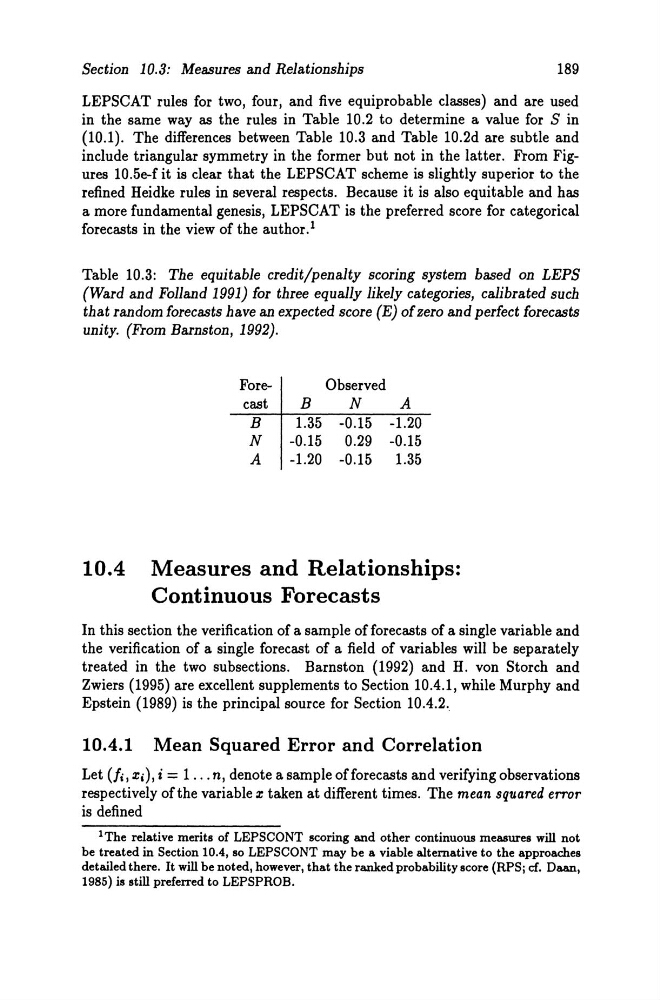
Table 10.3: The equitable credit/penalty scoring system based on LEPS
(Ward and Folland 1991) for three equally likely categories, calibrated such
that random forecasts have an expected score (E) of zero and perfect forecasts
unity. (From Barnston, 1992).
ForeObserved
cast
B
N
A
B
1.35 -0.15 -1.20
N
-0.15 0.29 -0.15
A
-1.20 -0.15 1.35
10.4 Measures and Relationships:
Continuous Forecasts
In this section the verification of a sampie of forecasts of a single variable and
the verification of a single forecast of a field of variables will be separately
treated in the two subsections. Barnston (1992) and H. von Storch and
Zwiers (1995) are excellent supplements to Section 10.4.1, while Murphy and
Epstein (1989) is the principal source for Section 10.4.2.
10.4.1 Mean Squared Error and Correlation
Let (fi, Xi), i = 1 ... n, denote a sampie offorecasts and verifying observations
respectively ofthe variable X taken at different times. The mean sq'l.lared error
is defined
IThe relative merits of LEPSCONT scoring and other continuous measures will not
be treated in Section 10.4, so LEPSCONT may be a viable alternative to the approaches
detailed there. It will be noted, however, that the ranked probability score (RPSj cf. Daan,
1985) is still preferred to LEPSPROB.
189
LEPSCAT rules for two, four, and five equiprobable classes) and are used
in the same way as the rules in Table 10.2 to determine a value for S in
(10.1). The differences between Table 10.3 and Table 10.2d are subtle and
include triangular symmetry in the former but not in the latter. Prom Figures 10.5e-f it is clear that the LEPSCAT scheme is slightly superior to the
refined Heidke rules in several respects. Because it is also equitable and has
a more fundamental genesis, LEPSCAT is the preferred score for categorical
forecasts in the view of the author. 1
Table 10.3: The equitable credit/penalty scoring system based on LEPS
(Ward and Folland 1991) for three equally likely categories, calibrated such
that random forecasts have an expected score (E) of zero and perfect forecasts
unity. (From Barnston, 1992).
ForeObserved
cast
B
N
A
B
1.35 -0.15 -1.20
N
-0.15 0.29 -0.15
A
-1.20 -0.15 1.35
10.4 Measures and Relationships:
Continuous Forecasts
In this section the verification of a sampie of forecasts of a single variable and
the verification of a single forecast of a field of variables will be separately
treated in the two subsections. Barnston (1992) and H. von Storch and
Zwiers (1995) are excellent supplements to Section 10.4.1, while Murphy and
Epstein (1989) is the principal source for Section 10.4.2.
10.4.1 Mean Squared Error and Correlation
Let (fi, Xi), i = 1 ... n, denote a sampie offorecasts and verifying observations
respectively ofthe variable X taken at different times. The mean sq'l.lared error
is defined
IThe relative merits of LEPSCONT scoring and other continuous measures will not
be treated in Section 10.4, so LEPSCONT may be a viable alternative to the approaches
detailed there. It will be noted, however, that the ranked probability score (RPSj cf. Daan,
1985) is still preferred to LEPSPROB.