

62
J.D. Albertson, G. Kiely and M.B. Parlange
is representative of the large, turbulent energy producing eddies. At the other end of the
spectrum, energy is dissipated by molecular viscosity via eddies of length scale approaching
the Kolmogorov scale 1) (typically of order ~ 1 mm). Between these two extremes lies what is
known as the inertial subrange, which marks the broad range of scales between the anisotropic
energy bearing eddies and the viscosity controlled dissipative eddies. This inertial range, for
high Reynolds number flows as found in the ASL, spreads over several orders of magnitude
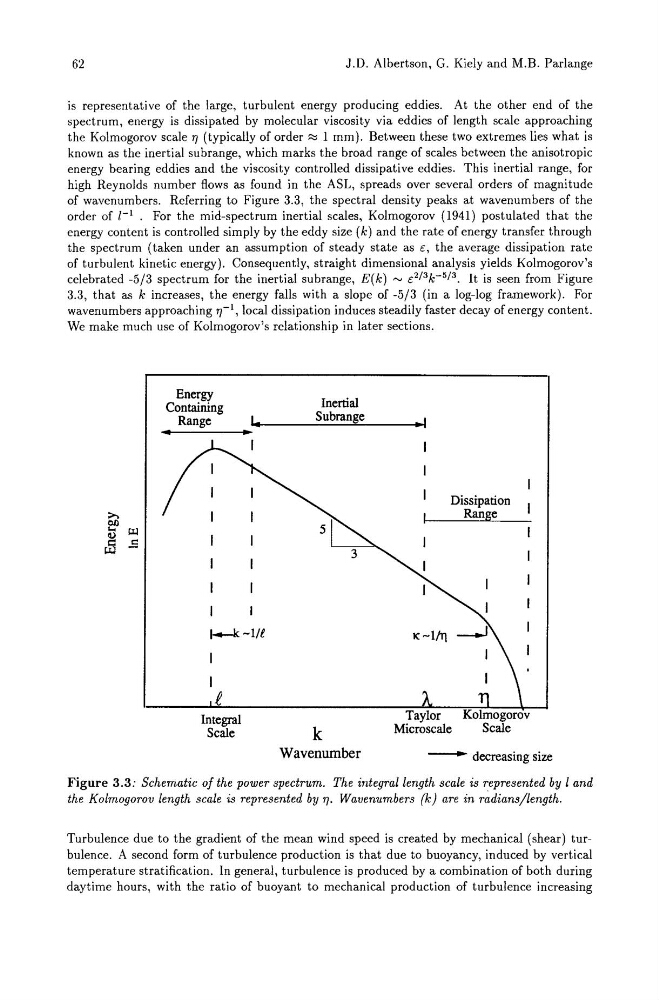
of wavenumbers. Referring to Figure 3.3, the spectral density peaks at wavenumbers of the
order of [-1 . For the mid-spectrum inertial scales, Kolmogorov (1941) postulated that the
energy content is controlled simply by the eddy size (k) and the rate of energy transfer through
the spectrum (taken under an assumption of steady state as c:, the average dissipation rate
of turbulent kinetic energy). Consequently, straight dimensional analysis yields Kolmogorov's
celebrated -5/3 spectrum for the inertial subrange, E(k) ~ c: 2 / 3 k- s / 3 • It is seen from Figure
3.3, that as k increases, the energy falls with a slope of -5/3 (in a log-log framework). For
wavenumbers approaching 1)-1, local dissipation induces steadily faster decay of energy content.
We make much use of Kolmogorov's relationship in later sections.
Energy
Containing
Range
i-k-l/l
I
I
f
Integral
Scale
Inertial
Subrange
k
Wavenumber
Dissipation
Range
-
decreasing size
Figure 3.3: Schematic of the power spectrum. The integral length scale is represented by I and
the Kolmogorov length scale is represented by 1). Wavenumbers (k) are in r~dians/length.
Turbulence due to the gradient of the mean wind speed is created by mechanical (shear) turbulence. A second form of turbulence production is that due to buoyancy, induced by vertical
temperature stratification. In general, turbulence is produced by a combination of both during
daytime hours, with the ratio of buoyant to mechanical production of turbulence increasing
J.D. Albertson, G. Kiely and M.B. Parlange
is representative of the large, turbulent energy producing eddies. At the other end of the
spectrum, energy is dissipated by molecular viscosity via eddies of length scale approaching
the Kolmogorov scale 1) (typically of order ~ 1 mm). Between these two extremes lies what is
known as the inertial subrange, which marks the broad range of scales between the anisotropic
energy bearing eddies and the viscosity controlled dissipative eddies. This inertial range, for
high Reynolds number flows as found in the ASL, spreads over several orders of magnitude
of wavenumbers. Referring to Figure 3.3, the spectral density peaks at wavenumbers of the
order of [-1 . For the mid-spectrum inertial scales, Kolmogorov (1941) postulated that the
energy content is controlled simply by the eddy size (k) and the rate of energy transfer through
the spectrum (taken under an assumption of steady state as c:, the average dissipation rate
of turbulent kinetic energy). Consequently, straight dimensional analysis yields Kolmogorov's
celebrated -5/3 spectrum for the inertial subrange, E(k) ~ c: 2 / 3 k- s / 3 • It is seen from Figure
3.3, that as k increases, the energy falls with a slope of -5/3 (in a log-log framework). For
wavenumbers approaching 1)-1, local dissipation induces steadily faster decay of energy content.
We make much use of Kolmogorov's relationship in later sections.
Energy
Containing
Range
i-k-l/l
I
I
f
Integral
Scale
Inertial
Subrange
k
Wavenumber
Dissipation
Range
-
decreasing size
Figure 3.3: Schematic of the power spectrum. The integral length scale is represented by I and
the Kolmogorov length scale is represented by 1). Wavenumbers (k) are in r~dians/length.
Turbulence due to the gradient of the mean wind speed is created by mechanical (shear) turbulence. A second form of turbulence production is that due to buoyancy, induced by vertical
temperature stratification. In general, turbulence is produced by a combination of both during
daytime hours, with the ratio of buoyant to mechanical production of turbulence increasing