

Surface Fluxes of Momentum, Heat, and Water Vapor
Atmospheric
Boundary Layer
(ABL)
Mixed layer
(Outer Region)
Surface Layer
(Inner Region)
Free Atmosphere
Free-Convective
Sublayer
FCSL
(BlUlJCIIIcyOnly)
Dynamic-Convective
Sublayer
(Mechanical &0
Buoyancy)
Dynamic Sublayer
(Mechanical ProdllClion)
DCSL
DSL
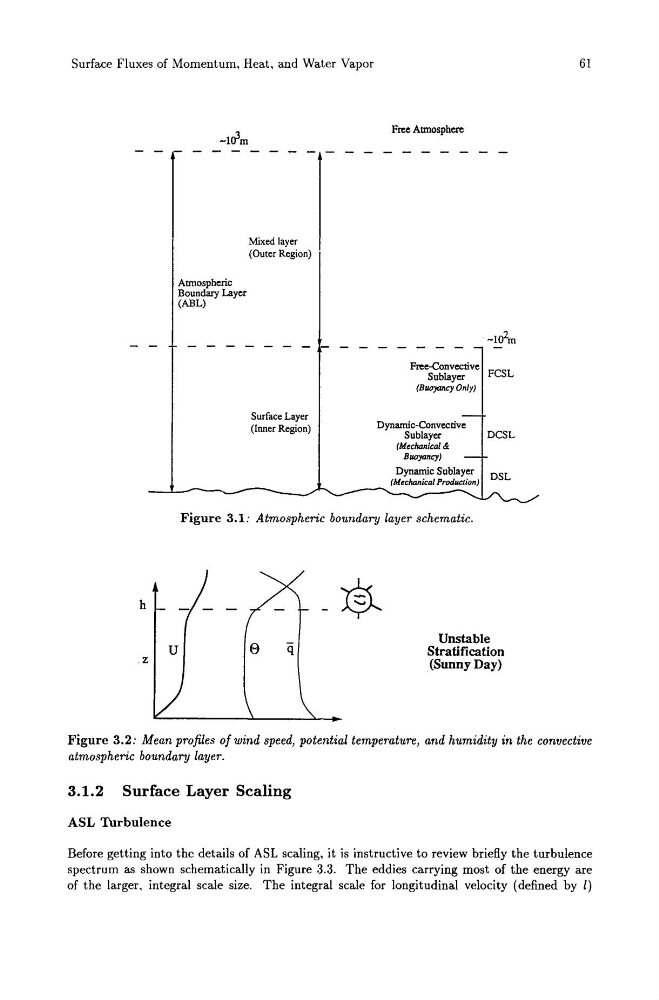
Figure 3.l: Atmospheric boundary layer schematic.
h
U
.Z
e q
Unstable
Stratification
(Sunny Day)
61
Figure 3.2: Mean profiles of wind speed, potential temperature, and humidity in the convective
atmospheric boundary layer.
3.1.2 Surface Layer Scaling
ASL 'lUrbulence
Before getting into the details of ASL scaling, it is instructive to review briefly the turbulence
spectrum as shown schematically in Figure 3.3. The eddies carrying most of the energy are
of the larger, integral scale size. The integral scale for longitudinal velocity (defined by I)
Atmospheric
Boundary Layer
(ABL)
Mixed layer
(Outer Region)
Surface Layer
(Inner Region)
Free Atmosphere
Free-Convective
Sublayer
FCSL
(BlUlJCIIIcyOnly)
Dynamic-Convective
Sublayer
(Mechanical &0
Buoyancy)
Dynamic Sublayer
(Mechanical ProdllClion)
DCSL
DSL
Figure 3.l: Atmospheric boundary layer schematic.
h
U
.Z
e q
Unstable
Stratification
(Sunny Day)
61
Figure 3.2: Mean profiles of wind speed, potential temperature, and humidity in the convective
atmospheric boundary layer.
3.1.2 Surface Layer Scaling
ASL 'lUrbulence
Before getting into the details of ASL scaling, it is instructive to review briefly the turbulence
spectrum as shown schematically in Figure 3.3. The eddies carrying most of the energy are
of the larger, integral scale size. The integral scale for longitudinal velocity (defined by I)