

Model Development for Passive Microwave Remote Sensing ...
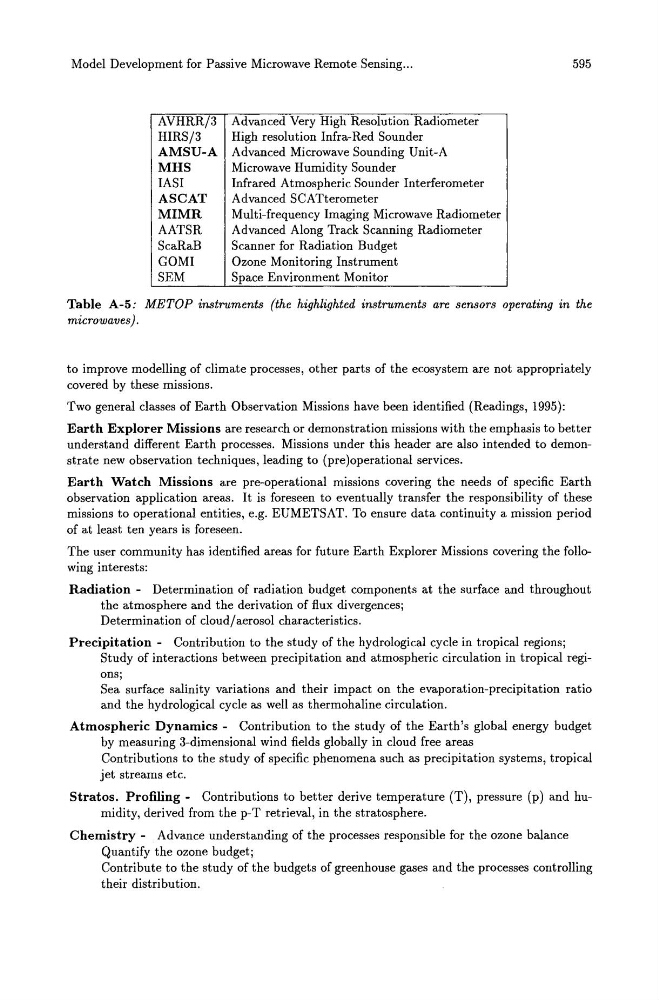
AVHRR/3
HIRS/3
AMSV-A
MHS
lAS!
ASCAT
MIMR
AATSR
ScaRaB
GOMI
SEM
Advanced Very High Resolution Radiometer
High resolution Infra-Red Sounder
Advanced Microwave Sounding Unit-A
Microwave Humidity Sounder
Infrared Atmospheric Sounder Interferometer
Advanced SCATterometer
Multi-frequency Imaging Microwave Radiometer
Advanced Along Track Scanning Radiometer
Scanner for Radiation Budget
Ozone Monitoring Instrument
Space Environment Monitor
595
Table A-5: METOP instruments (the highlighted instruments are sensors operating in the
microwaves) .
to improve modelling of climate processes, other parts of the ecosystem are not appropriately
covered by these missions.
Two general classes of Earth Observation Missions have been identified (Readings, 1995):
Earth Explorer Missions are research or demonstration missions with the emphasis to better
understand different Earth processes. Missions under this header are also intended to demonstrate new observation techniques, leading to (pre)operational services.
Earth Watch Missions are pre-operational missions covering the needs of specific Earth
observation application areas. It is foreseen to eventually transfer the responsibility of these
missions to operational entities, e.g. EUMETSAT. To ensure data continuity a mission period
of at least ten years is foreseen.
The user community has identified areas for future Earth Explorer Missions covering the following interests:
Radiation - Determination of radiation budget components at the surface and throughout
the atmosphere and the derivation of flux divergences;
Determination of cloud/aerosol characteristics.
Precipitation - Contribution to the study of the hydrological cycle in tropical regions;
Study of interactions between precipitation and atmospheric circulation in tropical regions;
Sea surface salinity variations and their impact on the evaporation-precipitation ratio
and the hydrological cycle as well as thermohaline circulation.
Atmospheric Dynamics - Contribution to the study of the Earth's global energy budget
by measuring 3-dimensional wind fields globally in cloud free areas
Contributions to the study of specific phenomena such as precipitation systems, tropical
jet streams etc.
Stratos. Profiling - Contributions to better derive temperature (T), pressure (p) and humidity, derived from the p-T retrieval, in the stratosphere.
Chemistry - Advance understanding of the processes responsible for the ozone balance
Quantify the ozone budget;
Contribute to the study of the budgets of greenhouse gases and the processes controlling
their distribution.