

50
. .
"
. .
. .
I.
DI STRIBUTION or CLOUD PR OPERTIES
txCOZ ~l XCOZ JAil Dn
( ·10 . '
OCI .. U • '0 II
~ 3.0 ' '.: ::.::::::; ~ : : ' : - : : - ~ ~ : ' c . - . . : . : . : ~ . ; - : - : - .. :.:.:.:.:-: - :-:.:.:.: - :-:.:::::/
· · · · ~:if;,.,:
.,
" c 720
... u
23 . 0
CLOUD OPTICAL THICKNESS
. .
'"
" '"
:l .. .. .. o
.. .,
" ~ u
A.D. Del Genio
DISTRIBUTION or CLO UD PROP ER TIES
I.
' .
CLOUD OPTI CAL THICKNESS
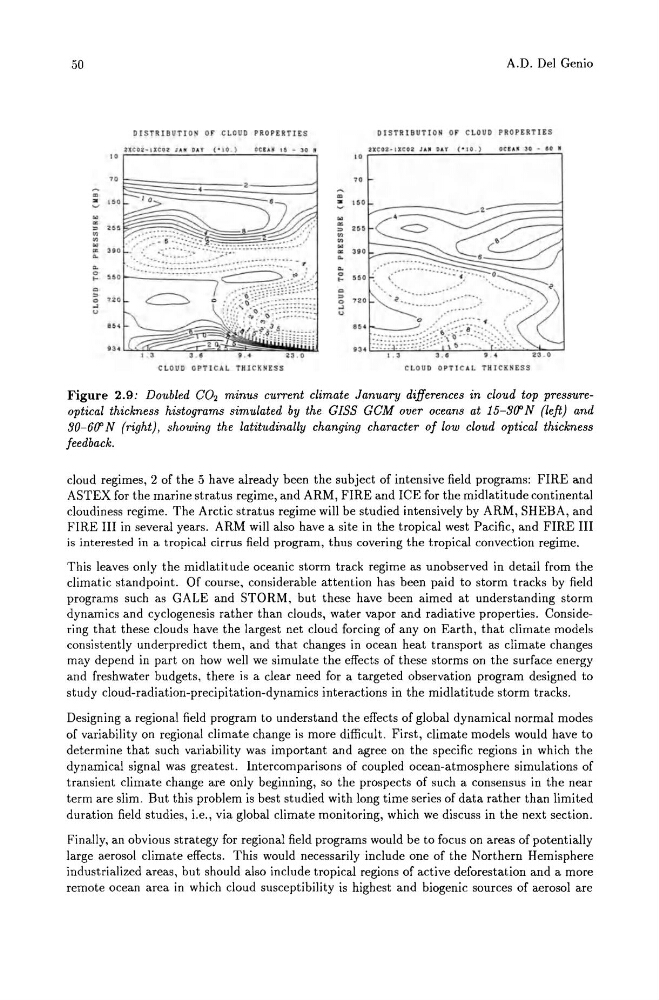
Figure 2.9: Doubled CO2 minus current climate January differences in cloud top pressureoptical thickness histograms simulated by the GISS GCM over oceans at 15-S(f' N (left) and
SO-6(f' N (right), showing the latitudinally changing character of low cloud optical thickness
feedback.
cloud regimes, 2 of the 5 have already been the subject of intensive field programs: FIRE and
ASTEX for the marine stratus regime, and ARM, FIRE and ICE for the midlatitude continental
cloudiness regime. The Arctic stratus regime will be studied intensively by ARM, SHEBA, and
FIRE III in several years. ARM will also have a site in the tropical west Pacific, and FIRE III
is interested in a tropical cirrus field program, thus covering the tropical convection regime.
This leaves only the midlatitude oceanic storm track regime as unobserved in detail from the
climatic standpoint. Of course, considerable attention has been paid to storm tracks by field
programs such as GALE and STORM, but these have been aimed at understanding storm
dynamics and cyclogenesis rather than clouds, water vapor and radiative properties. Considering that these clouds have the largest net cloud forcing of any on Earth, that climate models
consistently underpredict them, and that changes in ocean heat transport as climate changes
may depend in part on how well we simulate the effects of these storms on the surface energy
and freshwater budgets, there is a clear need for a targeted observation program designed to
study cloud-radiation-precipitation-dynamics interactions in the midlatitude storm tracks.
Designing a regional field program to understand the effects of global dynamical normal modes
of variability on regional climate change is more difficult. First, climate models would have to
determine that such variability was important and agree on the specific regions in which the
dynamical signal was greatest. Intercomparisons of coupled ocean-atmosphere simulations of
transient climate change are only beginning, so the prospects of such a consensus in the near
term are slim. But this problem is best studied with long time series of data rather than limited
duration field studies, i.e., via global climate monitoring, which we discuss in the next section.
Finally, an obvious strategy for regional field programs would be to focus on areas of potentially
large aerosol climate effects. This would necessarily include one of the Northern Hemisphere
industrialized areas, but should also include tropical regions of active deforestation and a more
remote ocean area in which cloud susceptibility is highest and biogenic sources of aerosol are
. .
"
. .
. .
I.
DI STRIBUTION or CLOUD PR OPERTIES
txCOZ ~l XCOZ JAil Dn
( ·10 . '
OCI .. U • '0 II
~ 3.0 ' '.: ::.::::::; ~ : : ' : - : : - ~ ~ : ' c . - . . : . : . : ~ . ; - : - : - .. :.:.:.:.:-: - :-:.:.:.: - :-:.:::::/
· · · · ~:if;,.,:
.,
" c 720
... u
23 . 0
CLOUD OPTICAL THICKNESS
. .
'"
" '"
:l .. .. .. o
.. .,
" ~ u
A.D. Del Genio
DISTRIBUTION or CLO UD PROP ER TIES
I.
' .
CLOUD OPTI CAL THICKNESS
Figure 2.9: Doubled CO2 minus current climate January differences in cloud top pressureoptical thickness histograms simulated by the GISS GCM over oceans at 15-S(f' N (left) and
SO-6(f' N (right), showing the latitudinally changing character of low cloud optical thickness
feedback.
cloud regimes, 2 of the 5 have already been the subject of intensive field programs: FIRE and
ASTEX for the marine stratus regime, and ARM, FIRE and ICE for the midlatitude continental
cloudiness regime. The Arctic stratus regime will be studied intensively by ARM, SHEBA, and
FIRE III in several years. ARM will also have a site in the tropical west Pacific, and FIRE III
is interested in a tropical cirrus field program, thus covering the tropical convection regime.
This leaves only the midlatitude oceanic storm track regime as unobserved in detail from the
climatic standpoint. Of course, considerable attention has been paid to storm tracks by field
programs such as GALE and STORM, but these have been aimed at understanding storm
dynamics and cyclogenesis rather than clouds, water vapor and radiative properties. Considering that these clouds have the largest net cloud forcing of any on Earth, that climate models
consistently underpredict them, and that changes in ocean heat transport as climate changes
may depend in part on how well we simulate the effects of these storms on the surface energy
and freshwater budgets, there is a clear need for a targeted observation program designed to
study cloud-radiation-precipitation-dynamics interactions in the midlatitude storm tracks.
Designing a regional field program to understand the effects of global dynamical normal modes
of variability on regional climate change is more difficult. First, climate models would have to
determine that such variability was important and agree on the specific regions in which the
dynamical signal was greatest. Intercomparisons of coupled ocean-atmosphere simulations of
transient climate change are only beginning, so the prospects of such a consensus in the near
term are slim. But this problem is best studied with long time series of data rather than limited
duration field studies, i.e., via global climate monitoring, which we discuss in the next section.
Finally, an obvious strategy for regional field programs would be to focus on areas of potentially
large aerosol climate effects. This would necessarily include one of the Northern Hemisphere
industrialized areas, but should also include tropical regions of active deforestation and a more
remote ocean area in which cloud susceptibility is highest and biogenic sources of aerosol are