

Observational Requirements for Modeling of Global...
49
But ISCCP data suggest that this behavior occurs only at cold temperatures, and more so over
land than ocean; at warm temperatures, optical thickness decreases with temperature instead
(Tselioudis et al., 1992). To understand this, consider first that optical thickness is a function
not only of liquid water content, but also cloud physical thickness and droplet effective radius.
Sensitivity tests with the GISS GCM show that cloud thickness variations alone can simulate
the ISCCP behavior at most latitudes. In the GCM. cloud physical thickness is a function of
stability (Del Genio et aI., 1996), as suggested by analyses of ISCCP and temperature profile
observations for several marine stratus regions (Klein and Hartmann, 1993). Surface-based
remote sensing data from the DOE Atmospheric Radiation Measurement (ARM) Program in
the central U.S. suggest that liquid water path is correlated both with cloud top pressure (Del
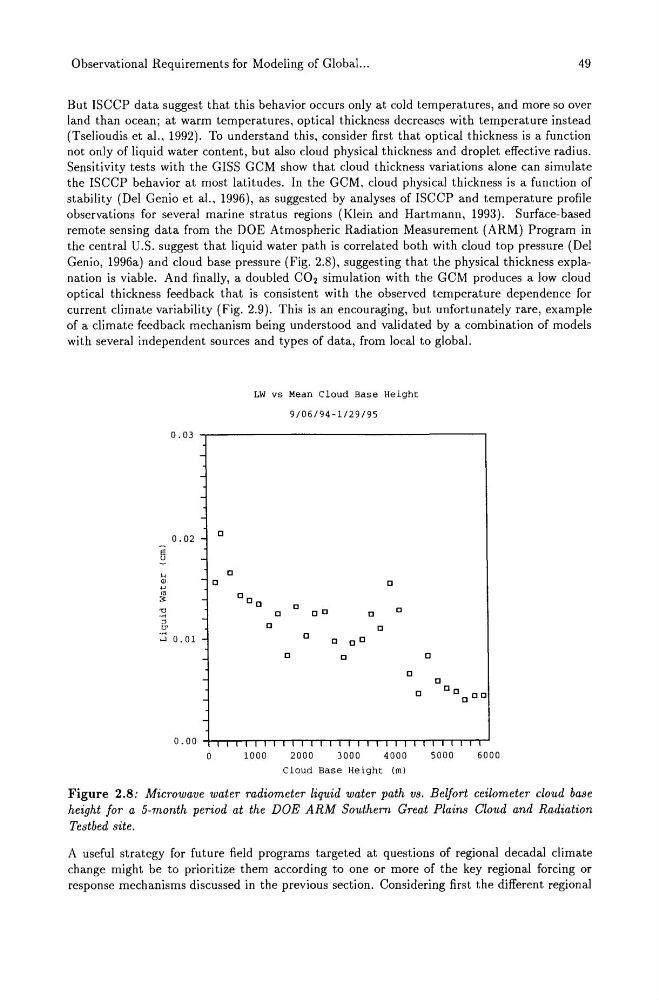
Genio, 1996a) and cloud base pressure (Fig. 2.8), suggesting that the physical thickness explanation is viable. And finally, a doubled CO2 simulation with the GCM produces a low cloud
optical thickness feedback that is consistent with the observed temperature dependence for
current climate variability (Fig. 2.9). This is an encouraging, but unfortunately rare, example
of a climate feedback mechanism being understood and validated by a combination of models
with several independent sources and types of data, from local to global.
LW vs Mean Cloud Base Height
9/06/94-1/29/95
0.03 ~---------------------------------------.
0.02
0
E
::
H
0
<1J
.,
0
0
3:
IJ
~
0
DO
0
IJ
60
0
',3 0.01
0
0
DO
0
0
0
0
0
0
DO o 0 0
0.00
1000
2000
3000
4000
5000
6000
Cloud Base Height (m)
Figure 2.8: Microwave water radiometer liquid water path vs. Belfort ceilometer cloud base
height for a 5-month period at the DOE ARM Southern Great Plains Cloud and Radiation
Testbed site.
A useful strategy for future field programs targeted at questions of regional decadal climate
change might be to prioritize them according to one or more of the key regional forcing or
response mechanisms discussed in the previous section. Considering first the different regional
49
But ISCCP data suggest that this behavior occurs only at cold temperatures, and more so over
land than ocean; at warm temperatures, optical thickness decreases with temperature instead
(Tselioudis et al., 1992). To understand this, consider first that optical thickness is a function
not only of liquid water content, but also cloud physical thickness and droplet effective radius.
Sensitivity tests with the GISS GCM show that cloud thickness variations alone can simulate
the ISCCP behavior at most latitudes. In the GCM. cloud physical thickness is a function of
stability (Del Genio et aI., 1996), as suggested by analyses of ISCCP and temperature profile
observations for several marine stratus regions (Klein and Hartmann, 1993). Surface-based
remote sensing data from the DOE Atmospheric Radiation Measurement (ARM) Program in
the central U.S. suggest that liquid water path is correlated both with cloud top pressure (Del
Genio, 1996a) and cloud base pressure (Fig. 2.8), suggesting that the physical thickness explanation is viable. And finally, a doubled CO2 simulation with the GCM produces a low cloud
optical thickness feedback that is consistent with the observed temperature dependence for
current climate variability (Fig. 2.9). This is an encouraging, but unfortunately rare, example
of a climate feedback mechanism being understood and validated by a combination of models
with several independent sources and types of data, from local to global.
LW vs Mean Cloud Base Height
9/06/94-1/29/95
0.03 ~---------------------------------------.
0.02
0
E
::
H
0
<1J
.,
0
0
3:
IJ
~
0
DO
0
IJ
60
0
',3 0.01
0
0
DO
0
0
0
0
0
0
DO o 0 0
0.00
1000
2000
3000
4000
5000
6000
Cloud Base Height (m)
Figure 2.8: Microwave water radiometer liquid water path vs. Belfort ceilometer cloud base
height for a 5-month period at the DOE ARM Southern Great Plains Cloud and Radiation
Testbed site.
A useful strategy for future field programs targeted at questions of regional decadal climate
change might be to prioritize them according to one or more of the key regional forcing or
response mechanisms discussed in the previous section. Considering first the different regional