

586
J. Noll
dient of the SD37/ 85 no general trend is noticeable. However, both negative gradients as for
the observed vertical SD37/ 85 and positive gradients for the observed horizontal SD37/ 85 are
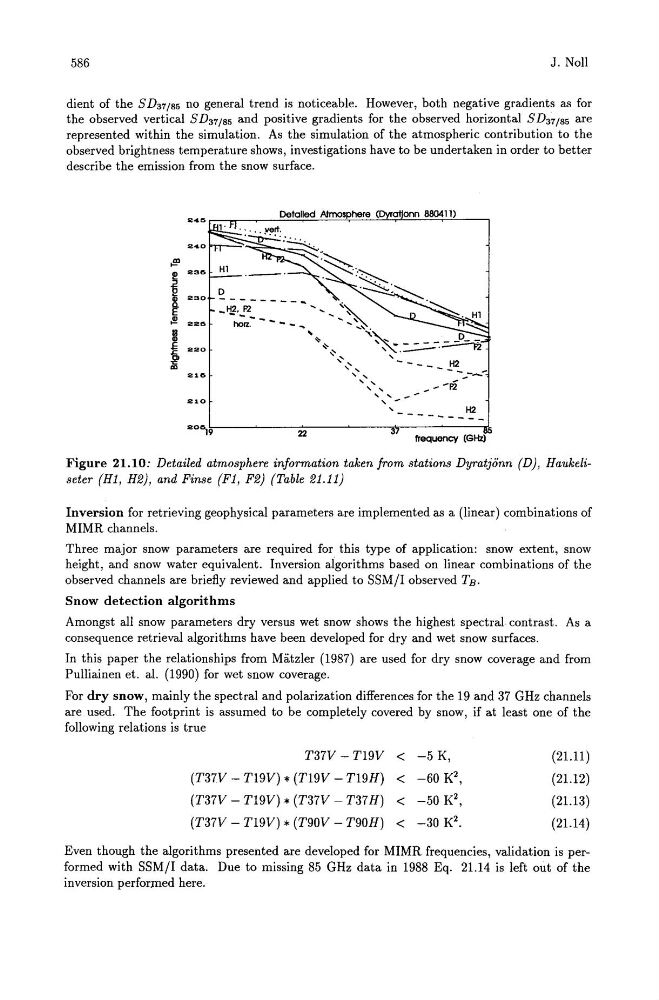
represented within the simulation. As the simulation of the atmospheric contribution to the
observed brightness temperature shows, investigations have to be undertaken in order to better
describe the emission from the snow surface.
"."
Detailed Atmosphere (Dyratjonn 880411)
".0
,!P
H1
~
"31>
~
0
~
"30
E
tJl
""I>
~
f ""0
~
"11>
H2
- - ----_--Ff
"10
H2
206 19
22
frequency (GHz)
Figure 21.10: Detailed atmosphere information taken from stations Dyratjonn (D), H aukeliseter (H1, H2), and Finse (F1, F2) (Table 21.11)
Inversion for retrieving geophysical parameters are implemented as a (linear) combinations of
MIMR channels.
Three major snow parameters are required for this type of application: snow extent, snow
height, and snow water equivalent. Inversion algorithms based on linear combinations of the
observed channels are briefly reviewed and applied to SSM/I observed TB .
Snow detection algorithms
Amongst all snow parameters dry versus wet snow shows the highest spectral contrast. As a
consequence retrieval algorithms have been developed for dry and wet snow surfaces.
In this paper the relationships from Matzler (1987) are used for dry snow coverage and from
Pulliainen et. al. (1990) for wet snow coverage.
For dry snow, mainly the spectral and polarization differences for the 19 and 37 GHz channels
are used. The footprint is assumed to be completely covered by snow, if at least one of the
following relations is true
T37V - T19V < -5 K,
(21.11)
(T37V - T19V) * (T19V - T19H) < -60 K2,
(21.12)
(T37V - T19V) * (T37V - T37 H) < -50 K2,
(21.13)
(T37V - T19V) * (T90V - T90H) < -30 K2.
(21.14)
Even though the algorithms presented are developed for MIMR frequencies, validation is performed with SSM/I data. Due to missing 85 GHz data in 1988 Eq. 21.14 is left out of the
inversion performed here.