

580
J. Noll
21.3.1.2 Inversion algorithm
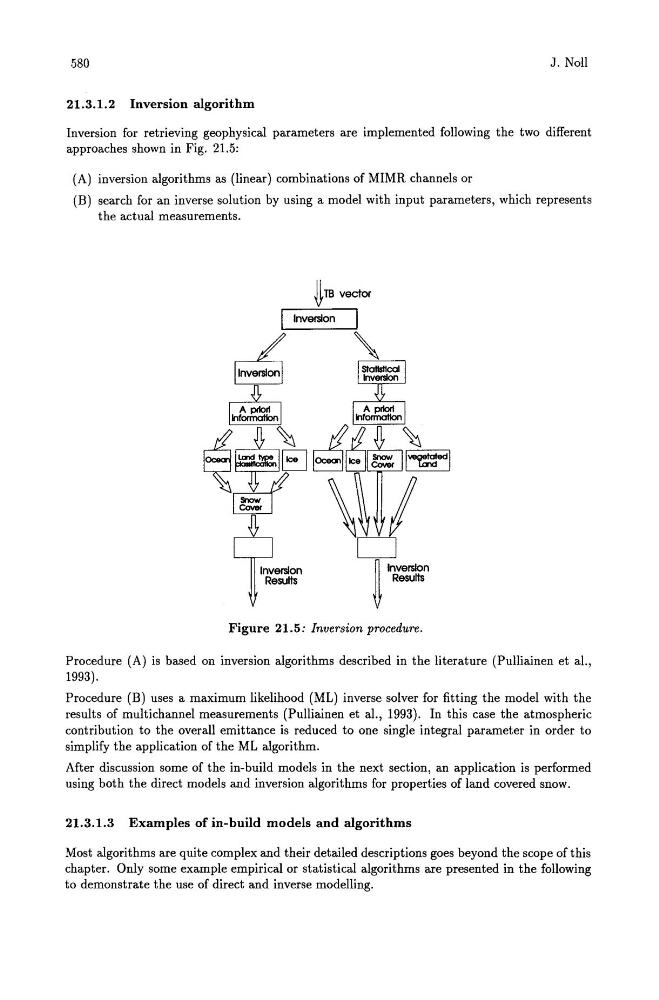
Inversion for retrieving geophysical parameters are implemented following the two different
approaches shown in Fig. 21.5:
(A) inversion algorithms as (linear) combinations of MIMR channels or
(B) search for an inverse solution by using a model with input parameters, which represents
the actual measurements.
Figure 21.5: Inversion procedure.
Procedure (A) is based on inversion algorithms described in the literature (Pulliainen et al.,
1993).
Procedure (B) uses a maximum likelihood (ML) inverse solver for fitting the model with the
results of multichannel measurements (Pulliainen et al., 1993). In this case the atmospheric
contribution to the overall emittance is reduced to one single integral parameter in order to
simplify the application of the ML algorithm.
After discussion some of the in-build models in the next section, an application is performed
using both the direct models and inversion algorithms for properties of land covered snow.
21.3.1.3 Examples of in-build models and algorithms
Most algorithms are quite complex and their detailed descriptions goes beyond the scope of this
chapter. Only some example empirical or statistical algorithms are presented in the following
to demonstrate the use of direct and inverse modelling.