

570
J. Noll
sical parameter retrieval for cryosphere, land, ocean and atmosphere communities. Geophysical
products related to the instrument parameters will be addressed.
21.2.1 Short history of microwave radiometers
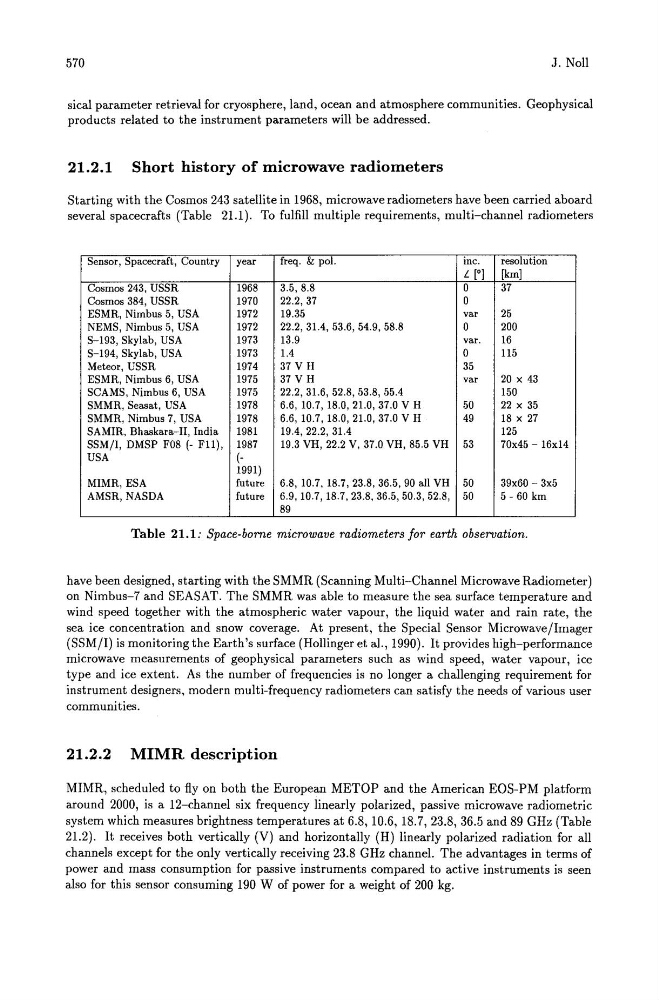
Starting with the Cosmos 243 satellite in 1968, microwave radiometers have been carried aboard
several spacecrafts (Table 21.1). To fulfill multiple requirements, multi-channel radiometers
Sensor, Spacecraft, Country year
freq. & pol.
inc.
resolution
L [0]
[km]
Cosmos 243, USSR
1968
3.5,8.8
0
37
Cosmos 384, USSR
1970
22.2,37
0
ESMR, Nimbus 5, USA
1972
19.35
var
25
NEMS, Nimbus 5, USA
1972
22.2, 31.4, 53.6, 54.9, 58.8
0
200
S-193, Skylab, USA
1973
13.9
var.
16
S-194, Skylab, USA
1973
1.4
0
115
Meteor, USSR
1974
37 V H
35
ESMR, Nimbus 6, USA
1975
37 V H
var
20 x 43
SCAMS, Nimbus 6, USA
1975
22.2, 31.6, 52.8,53.8, 55.4
150
SMMR, Seasat, USA
1978
6.6, 10.7,18.0,21.0,37.0 V H
50
22 x 35
SMMR, Nimbus 7, USA
1978
6.6, 10.7,18.0,21.0,37.0 V H
49
18 x 27
SAMIR, Bhaskara-II, India
1981
19.4,22.2, 31.4
125
SSM/I, DMSP F08 (- F11), 1987
19.3 VH, 22.2 V, 37.0 VH, 85.5 VH 53
70x45 - 16x14
USA
( -
1991)
MIMR, ESA
future 6.8, 10.7, 18.7,23.8,36.5,90 all VH 50
39x60 - 3x5
AMSR, NASDA
future 6.9,10.7,18.7,23.8,36.5,50.3,52.8, 50
5 - 60 km
89
Table 21.1: Space-borne microwave radiometers for earth observation.
have been designed, starting with the SMMR (Scanning Multi-Channel Microwave Radiometer)
on Nimbus-7 and SEASAT. The SMMR was able to measure the sea surface temperature and
wind speed together with the atmospheric water vapour, the liquid water and rain rate, the
sea ice concentration and snow coverage. At present, the Special Sensor Microwave/Imager
(SSM/I) is monitoring the Earth's surface (Hollinger et aI., 1990). It provides high-performance
microwave measurements of geophysical parameters such as wind speed, water vapour, ice
type and ice extent. As the number of frequencies is no longer a challenging requirement for
instrument designers, modern multi-frequency radiometers can satisfy the needs of various user
communities.
21.2.2 MIMR description
MIMR, scheduled to fly on both the European METOP and the American EOS-PM platform
around 2000, is a 12-channel six frequency linearly polarized, passive microwave radiometric
system which measures brightness temperatures at 6.8, 10.6, 18.7, 23.8, 36.5 and 89 GHz (Table
21.2). It receives both vertically (V) and horizontally (H) linearly polarized radiation for all
channels except for the only vertically receiving 23.8 GHz channel. The advantages in terms of
power and mass consumption for passive instruments compared to active instruments is seen
also for this sensor consuming 190 W of power for a weight of 200 kg.